


Bone mineral density, bone turnover markers and fractures in patients with systemic sclerosis: a case control study
- PMID: 23818972
- PMCID: PMC3688576
- DOI: 10.1371/journal.pone.0066991
Bone mineral density, bone turnover markers and fractures in patients with systemic sclerosis: a case control study
Abstract
Objective: The aim of our study was to elucidate the pathophysiology of systemic sclerosis-related osteoporosis and the prevalence of vertebral fragility fracture in postmenopausal women with systemic sclerosis (SSc).
Methodology: Fifty-four postmenopausal women with scleroderma and 54 postmenopausal controls matched for age, BMI, and smoking habits were studied. BMD was measured by dual energy-x-ray absorptiometry at spine and femur, and by ultrasonography at calcaneus The markers of bone turnover included serum osteocalcin and urinary deoxypyridinoline. All subjects had a spine X-ray to ascertain the presence of vertebral fractures.
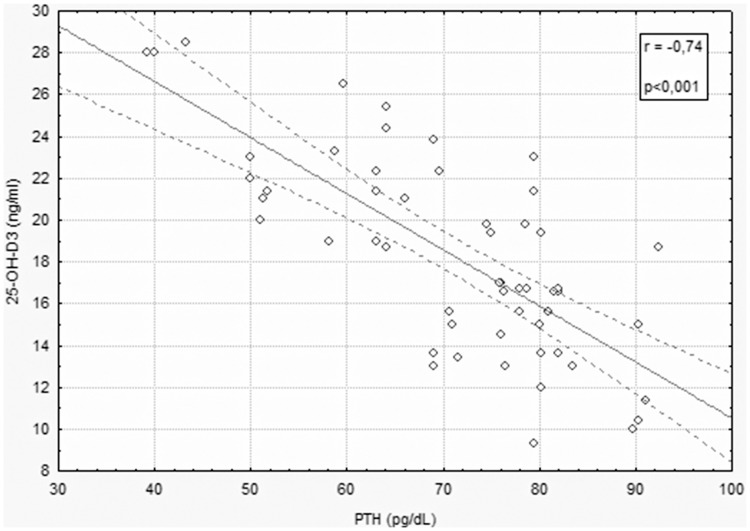
Results: bone mineral density at lumbar spine (BMD 0.78±0.08 vs 0.88±0.07; p<0,001), femoral neck (BMD: 0.56±0.04 vs 0.72±0.07; p<0,001) and total femur (BMD: 0.57±0.04 vs 0.71±0.06; p<0,001) and ultrasound parameter at calcaneus (SI: 80.10±5.10 vs 94.80±6.10 p<0,001) were significantly lower in scleroderma compared with controls; bone turnover markers and parathyroid hormone level were significantly higher in scleroderma compared with controls, while serum of 25(OH)D3 was significantly lower. In scleroderma group the serum levels of 25(OH)D3 significantly correlated with PTH levels, BMD, stiffness index and bone turnover markers. One or more moderate or severe vertebral fractures were found in 13 patients with scleroderma, wherease in control group only one patient had a mild vertebral fracture.
Conclusion: Our data shows, for the first time, that vertebral fractures are frequent in subjects with scleroderma, and suggest that lower levels of 25(OH)D3 may play a role in the risk of osteoporosis and vertebral fractures.
Conflict of interest statement
Figures
References
-
- Souza RB, Borges CT, Takayama L, Aldrighi JM, Pereira RM (2006) Systemic sclerosis and bone loss: the role of the disease and body composition. Scand J Rheumatol 35: 384–387. - PubMed
-
- Carbone L, Tylavsky F, Wan J, McKown K, Cheng S (1999) Bone mineral density in scleroderma. Rheumatology (Oxford) 37: 1–2. - PubMed
-
- Di Munno O, Mazzantini M, Massei P, Ferdeghini M, Pitaro N, et al. (1995) Reduced bone mass and normal calcium metabolism in systemic sclerosis with and without calcinosis. Clin Rheumatol 14: 407–412. - PubMed
-
- La Montagna G, Vatti M, Valentini G, Tirri G (1991) Osteopenia in systemic sclerosis evidence of a participating role of earlier menopause. Clin Rheumatol 10: 18–22. - PubMed
-
- Bischoff-Ferrari HA, Giovannucci E, Willett WC, Dietrich T, Dawson-Hughes B (2006) Estimation of optimal serum concentrations of 25-hydroxyvitamin D for multiple health outcomes. Am J Clin Nutr 84: 18–28. - PubMed
MeSH terms
Substances
LinkOut - more resources
Full Text Sources
Other Literature Sources
Medical
