


WS-SNPs&GO: a web server for predicting the deleterious effect of human protein variants using functional annotation
- PMID: 23819482
- PMCID: PMC3665478
- DOI: 10.1186/1471-2164-14-S3-S6
WS-SNPs&GO: a web server for predicting the deleterious effect of human protein variants using functional annotation
Abstract
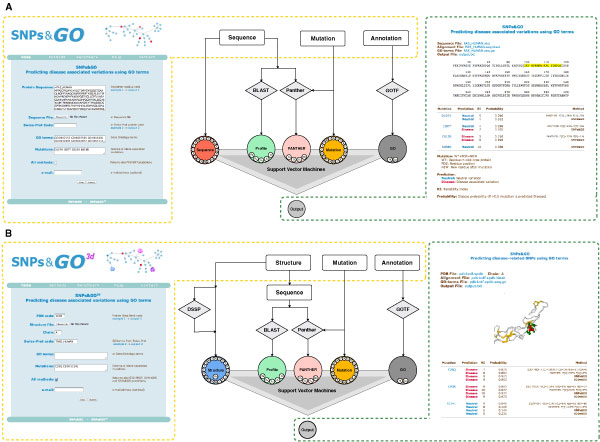
Background: SNPs&GO is a method for the prediction of deleterious Single Amino acid Polymorphisms (SAPs) using protein functional annotation. In this work, we present the web server implementation of SNPs&GO (WS-SNPs&GO). The server is based on Support Vector Machines (SVM) and for a given protein, its input comprises: the sequence and/or its three-dimensional structure (when available), a set of target variations and its functional Gene Ontology (GO) terms. The output of the server provides, for each protein variation, the probabilities to be associated to human diseases.
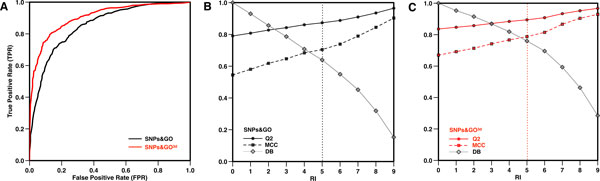
Results: The server consists of two main components, including updated versions of the sequence-based SNPs&GO (recently scored as one of the best algorithms for predicting deleterious SAPs) and of the structure-based SNPs&GO(3d) programs. Sequence and structure based algorithms are extensively tested on a large set of annotated variations extracted from the SwissVar database. Selecting a balanced dataset with more than 38,000 SAPs, the sequence-based approach achieves 81% overall accuracy, 0.61 correlation coefficient and an Area Under the Curve (AUC) of the Receiver Operating Characteristic (ROC) curve of 0.88. For the subset of ~6,600 variations mapped on protein structures available at the Protein Data Bank (PDB), the structure-based method scores with 84% overall accuracy, 0.68 correlation coefficient, and 0.91 AUC. When tested on a new blind set of variations, the results of the server are 79% and 83% overall accuracy for the sequence-based and structure-based inputs, respectively.
Conclusions: WS-SNPs&GO is a valuable tool that includes in a unique framework information derived from protein sequence, structure, evolutionary profile, and protein function. WS-SNPs&GO is freely available at http://snps.biofold.org/snps-and-go.
Figures
References
Publication types
MeSH terms
Substances
Grants and funding
LinkOut - more resources
Full Text Sources
Other Literature Sources
