


Physical strain of handcycling: an evaluation using training guidelines for a healthy lifestyle as defined by the American College of Sports Medicine
- PMID: 23820153
- PMCID: PMC3758534
- DOI: 10.1179/2045772313Y.0000000127
Physical strain of handcycling: an evaluation using training guidelines for a healthy lifestyle as defined by the American College of Sports Medicine
Abstract
Objective: Developments in assistive technology such as handcycling provide attractive possibilities to pursue a healthy lifestyle for patients with spinal cord injury. The objective of the study is to evaluate physical stress and strain of handcycling against training guidelines as defined by the American College of Sports Medicine (ACSM).
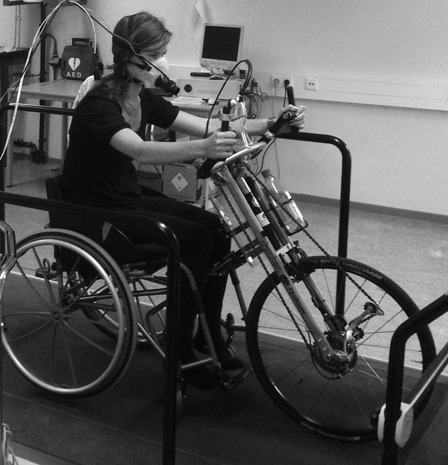
Design: Seven able-bodied males conducted an incremental peak exercise handcycling test on a treadmill. In addition, two indoor treadmill (1.3 m/second with an inclination of 0.7% and 1.0 m/second with an inclination of 4.8%) and three outdoor over ground exercise bouts were performed (1.7, 3.3, and 5.0 m/second). One individual handcycled a representative 8-km-distance outdoors.
Outcome measures: Physical stress and strain were described in terms of absolute and relative power output, oxygen uptake (VO2), gross efficiency (GE), and heart rate (HR). Also, local perceived discomfort (LPD) was determined.
Results: Relative handcycling exercise intensities varied between 23.3 ± 4.2 (below the ACSM lower limit of 46%VO2peak) and 72.5 ± 15.1%VO2peak (well above the ACSM lower limit), with GE ranging from 6.0 ± 1.5% at the lower to 13.0 ± 2.6% at the higher exercise intensities. Exercise intensities were performed at 49.8 ± 4.2 to 80.1 ± 10.5%HRpeak. LPD scores were low to moderate (<27 ± 7).
Conclusion: Handcycling is relatively efficient and exercise intensities > 46%VO2peak were elicited. However, exercise load seems to be underestimated using %HRpeak. LPD was not perceived as limiting. Physiological stress and strain in able-bodied individuals appear to be comparable to individuals with a paraplegia. To understand individualize and optimize upper-body training, different training programs must be evaluated.
Figures
References
-
- van der Woude LH, de Groot G, Hollander AP, van Ingen Schenau GJ, Rozendal RH. Wheelchair ergonomics and physiological testing of prototypes. Ergonomics 1986;29(12):1561–73 - PubMed
-
- Dallmeijer AJ, Ottjes L, de Waardt E, van der Woude LH. A physiological comparison of synchronous and asynchronous hand cycling. Int J Sports Med 2004;25(8):622–6 - PubMed
-
- Dallmeijer AJ, Zentgraaff ID, Zijp NI, van der Woude LH. Submaximal physical strain and peak performance in handcycling versus handrim wheelchair propulsion. Spinal Cord 2004;42(2):91–8 - PubMed
-
- Abel T, Rojas Vega S, Bleicher I, Platen P. Handbiking: Physiological responses to synchronous and asynchronous crank montage. Eur J Appl Physiol Occup Physiol 2003;3(4):1–9
-
- Abel T, Schneider S, Platen P, Struder HK. Performance diagnostics in handbiking during competition. Spinal Cord 2006;44(4):211–16 - PubMed
MeSH terms
LinkOut - more resources
Full Text Sources
Other Literature Sources
Medical
