. 2013 Sep;195(1):263-73.
doi: 10.1534/genetics.113.152330. Epub 2013 Jul 2.

Cloning and characterization of a critical regulator for preharvest sprouting in wheat

Affiliations

Cloning and characterization of a critical regulator for preharvest sprouting in wheat

Shubing Liu et al. Genetics. 2013 Sep.

Abstract

Sprouting of grains in mature spikes before harvest is a major problem in wheat (Triticum aestivum) production worldwide. We cloned and characterized a gene underlying a wheat quantitative trait locus (QTL) on the short arm of chromosome 3A for preharvest sprouting (PHS) resistance in white wheat using comparative mapping and map-based cloning. This gene, designated TaPHS1, is a wheat homolog of a MOTHER OF FLOWERING TIME (TaMFT)-like gene. RNA interference-mediated knockdown of the gene confirmed that TaPHS1 positively regulates PHS resistance. We discovered two causal mutations in TaPHS1 that jointly altered PHS resistance in wheat. One GT-to-AT mutation generates a mis-splicing site, and the other A-to-T mutation creates a premature stop codon that results in a truncated nonfunctional transcript. Association analysis of a set of wheat cultivars validated the role of the two mutations on PHS resistance. The molecular characterization of TaPHS1 is significant for expediting breeding for PHS resistance to protect grain yield and quality in wheat production.

Keywords: DNA marker; Preharvesting sprouting; RNA interference; gene clone; wheat abiotic stress.


Figures
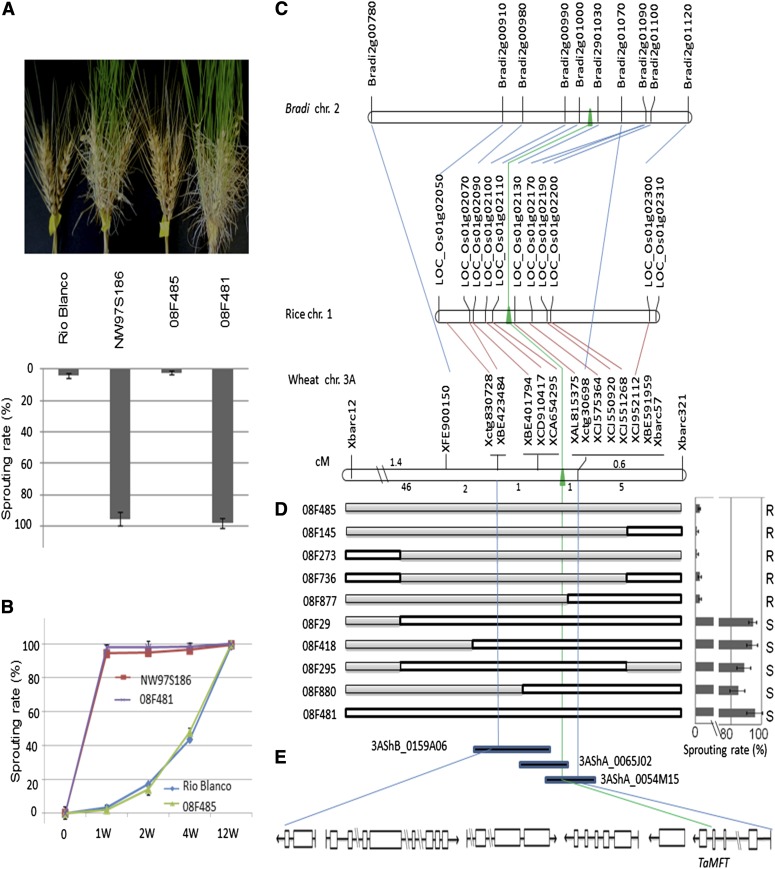
Figure 1
Figure 1
Map-based cloning of QTL (Qphs.pseru-3AS) for preharvest sprouting (PHS) resistance. (A) PHS phenotypes of different genotypes after 1 week in a moist chamber. The top picture shows wheat spikes of resistant (Rio Blanco) and susceptible parents (NW97S186), and resistant (08F485) and susceptible (08F481) near-isogenic lines (NILs). The bottom graph shows the difference in spike sprouting rates (%) with standard deviations for different genotypes. (B) Spike sprouting rates for both parents and NILs evaluated from harvesting date to 12 weeks after harvest. Wheat spikes were stored at room temperature for different weeks before moist treatment. (C) Comparative maps of the Qphs.pseru-3AS region across wheat chromosome 3A, Brachypodium chromosome 2, and rice chromosome 1. The green arrow indicates the location of TaPHS1. The blue line connects the other syntenic genes in Brachypodium, and the red line connects rice to wheat homologs in the Qphs.pseru-3AS region. The wheat chromosome 3A fine map was generated using a high-resolution mapping population from the analysis of 1874 F2 plants using three SSR markers Xbarc12, Xbarc57, and Xbarc321; the other markers are added to the map using the high-resolution mapping population. The numbers below the linkage map indicate the number of recombinants between the intervals of two markers on the two bars. (D) Graphical genotypes of the Qphs.pseru-3AS region in 10 near-isogenic recombinants with unique recombination among markers (left) and graphical phenotypes (10 plants for each line) showing their sprouting levels (right). Solid and open bars in the genotypic graph represent chromosomal segments from Rio Blanco and NW97S186. R, sprouting resistant; S, sprouting susceptible. (E) Six candidate genes, including TaMFT (first on the right), were identified after sequencing the three BACs covering the Qphs.pseru-3AS region.
Figure 2
Figure 2
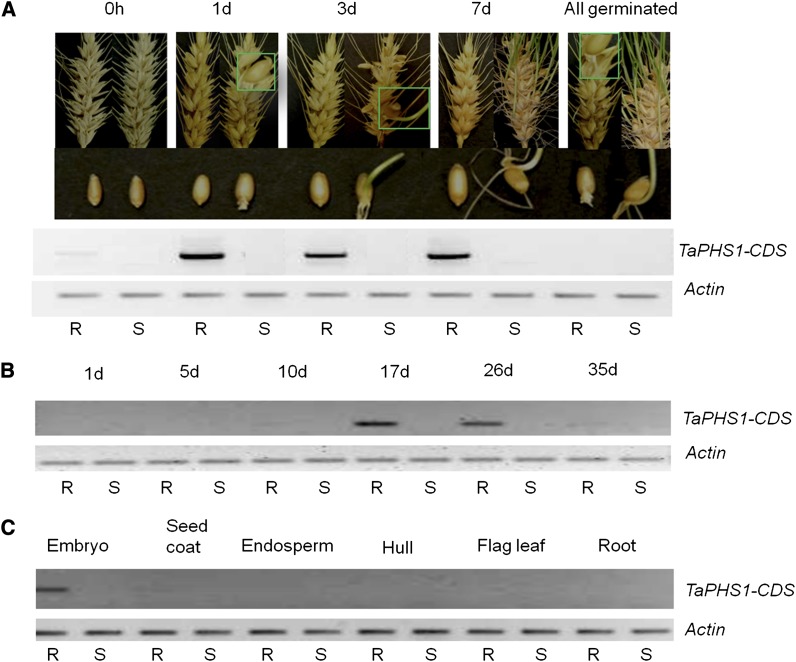
Expression of all the genes in the Qphs.pseru-3AS region during spike sprouting determined the wheat MFT homolog (TaMFT) as TaPHS1. (A) TaMFT was amplified in the PHS resistant (R) NIL, but not in the susceptible (S) NIL, during sprouting. RNA was extracted from the embryos of seeds harvested from the spikes at 0 hr, 1 day, 3 days, and 7 days after imbibing. “All germinated” embryos were obtained by incubating the spikes at 4° for 3 days after imbibing and then keeping them at room temperature for 1 day. (B) TaPHS1 is expressed only in the embryo of the resistant (R) NIL after 10 days and before physical maturity during seed development, not in the susceptible (S) NIL. (C) TaPHS1 expression occurs only in the embryo, not in other tissues at 15 days after anthesis. Actin was used as control. TaPHS1-CDS refers to the primer pair P1 + P6 that were used in RT–PCR and designed from the full-length cDNA sequence of Rio Blanco (Table S1).
Figure 3
Figure 3
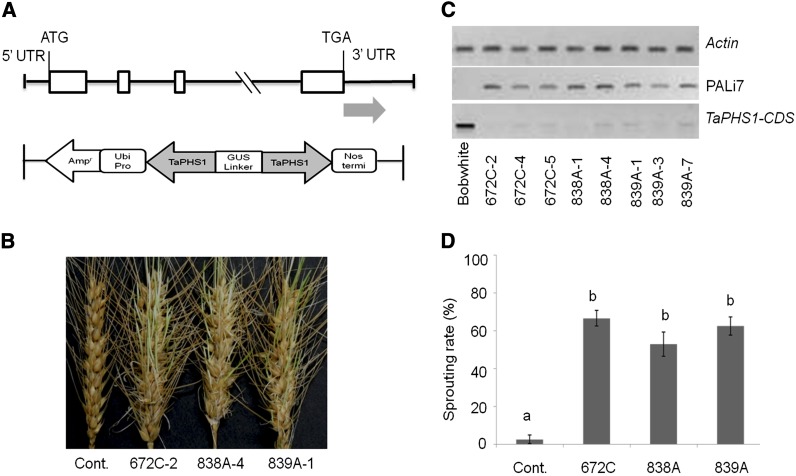
Confirmation of TaPHS1’s function on PHS resistance by RNA interference (RNAi). (A) Structure of the RNAi construct, PALi7. The gray arrow shows that the fragment in 3′-UTR of Rio Blanco TaPHS1 was introduced into the construct as inverted repeats. (B) Representative spikes from PHS-resistant cultivar Bobwhite and three Bobwhite RNAi T1 transgenic lines at 5 days in a moist chamber. (C) Reverse transcription PCR detected PALi7 only in the transgenic T1 lines, not in the nontransgenic control; in contrast, TaPHS1 strongly expressed in nontransgenic control but not in its RNAi lines. RNA was extracted from the embryo 1 day after the spikes were put into a moist chamber. (D) Spike sprouting rates of nontransgenic Bobwhite (Cont) and its T1 lines from the three transgenic events with standard deviations.
Figure 4
Figure 4
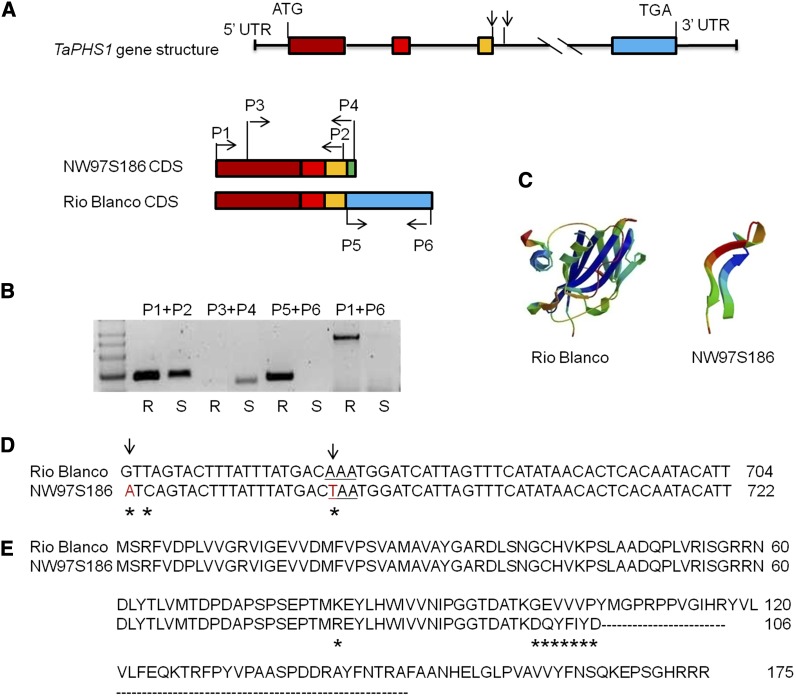
Gene and protein structures of TaPHS1 in Rio Blanco (R) and NW97S186 (S). (A) Genomic sequence and the full-length cDNA sequences of TaPHS1 from both parents. Boxes represent exons; the green box shows the extension of exon 3 caused by mis-splicing and truncation of exon 4 in NW97S186. Lines represent introns and 5′- and 3′-UTR; arrows point to two critical mutation sites (mis-splicing site and the premature stop codon) in NW97S186. P1–P6 were the primers used to confirm the truncated mRNA in NW97S186. (B) The two critical mutations in intron 3 of NW97S186 were validated by RT–PCR using four pairs of primers (see A). (C) The predicted disruption of the protein structure of the TaPHS1 in NW97S186, not in Rio Blanco. (D) Partial sequences of TaPHS1 show the two key mutations that form the mis-splicing site and a premature stop codon in intron 3 of NW97S186. Arrows point to the key mutation sites, and * indicates SNPs between two parents. (E) Deduced amino acid sequences of TaPHS1. * represents polymorphic amino acids between parents.
Figure 5
Figure 5
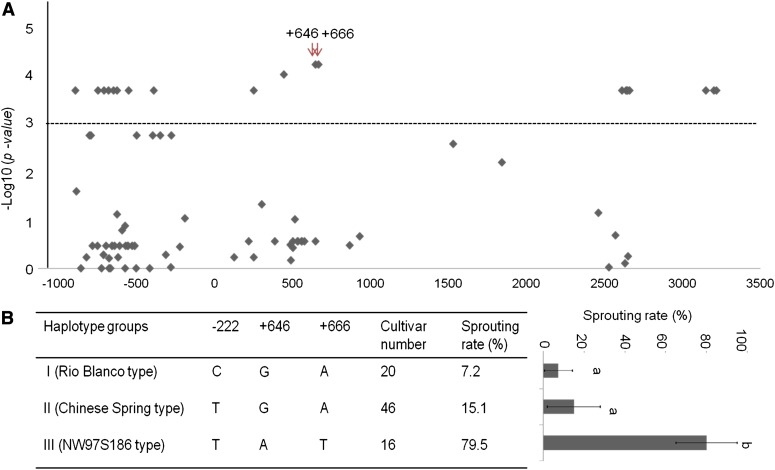
Association analysis to validate two causal SNPs in intron 3 of TaPHS1 for PHS resistance. (A) Twenty SNPs were significantly associated with PHS resistance at P < 0.001. The SNP positions are based on TaPHS1 sequence of Rio Blanco with the start codon as 0. Red arrows point to the two SNPs causing the mis-splicing and the premature stop codon in intron 3. (B) Mean sprouting rates of three contrasting haplotype groups according to the three SNPs, where haplotype I represents 20 cultivars that share the same haplotype with Rio Blanco; haplotype II represents 46 cultivars that share the same haplotype with Chinese Spring, which has one mutation at the promoter region (Nakamura et al. 2011), and haplotype III represents 16 cultivars that share the same haplotype with NW97S186, which has all mutations at three sites. Error bar denotes standard deviation. Different letters, a and b, indicate significant difference at P < 0.05.

References

    1. Altpeter F., Vasil V., Srivastava V., Stoger E., Vasil I. K., 1996. Accelerated production of transgenic wheat (Triticum aestivum L.) plants. Plant Cell Rep. 16: 12–17. - PubMed
    1. Altschul S. F., Madden T. L., Schaeffer A. A., Zhang J., Zhang Z., et al. , 1997. A new generation of protein database search programs. Nucleic Acids Res. 25: 3389–3402. - PMC - PubMed
    1. Baumlein H., Nagy I., Villarroel R., Inze D., Wobus U., 1992. Cis-analysis of a seed protein gene promoter: The conservative RY repeat CATGCATG within the legumin box is essential for tissue-specific expression of a legumin gene. Plant J. 2: 233–239. - PubMed
    1. Bentsink L., Jowett J., Hanhart C. J., Koornneef M., 2006. Cloning of DOG1, a quantitative trait locus controlling seed dormancy in Arabidopsis. Proc. Natl. Acad. Sci. USA 103: 17042–17047. - PMC - PubMed
    1. Bewley J. D., 1997. Seed germination and dormancy. Plant Cell 9: 1055–1066. - PMC - PubMed

Publication types