


Mechanisms of impaired differentiation in rhabdomyosarcoma
- PMID: 23822136
- PMCID: PMC6250433
- DOI: 10.1111/febs.12421
Mechanisms of impaired differentiation in rhabdomyosarcoma
Abstract
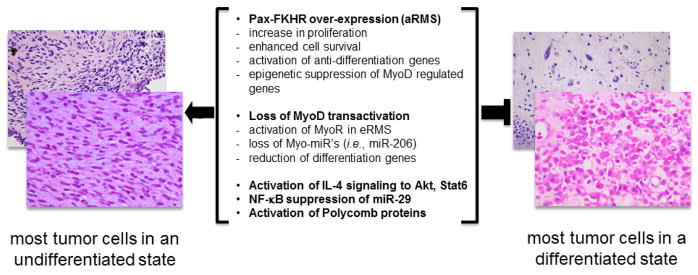
Rhabdomyosarcoma (RMS) is the most common soft tissue sarcoma of childhood, with presumed skeletal muscle origins, because of its myogenic phenotype. RMS is composed of two main subtypes, embryonal RMS (eRMS) and alveolar RMS (aRMS). Whereas eRMS histologically resembles embryonic skeletal muscle, the aRMS subtype is more aggressive and has a poorer prognosis. In addition, whereas the genetic profile of eRMS is not well established, aRMS is commonly associated with distinct chromosome translocations that fuse domains of the transcription factors Pax3 and Pax7 to the forkhead family member FOXO1A. Both eRMS and aRMS tumor cells express myogenic markers such as MyoD, but their ability to complete differentiation is impaired. How this impairment occurs is the subject of this review, which will focus on several themes, including signaling pathways that converge on Pax-forkhead gene targets, alterations in MyoD function, epigenetic modifications of myogenic promoters, and microRNAs whose expression patterns in RMS alter key regulatory circuits to help maintain tumor cells in an opportunistically less differentiated state.
Keywords: MyoD; differentiation; microRNA; myogenesis; rhabdomyosarcoma; signaling.
© 2013 FEBS.
Figures
References
-
- Ries LAG, Smith MA, Gurney JG, et al. Cancer incidence and survival among children and adolescents: United States SEER Program 1975–1995. NIH Pub. NCI SEER Program. 1999;99:4649.
-
- Perez EA, et al. Rhabdomyosarcoma in children: a SEER population based study. J Surg Res. 2011;170:e243–251. - PubMed
-
- Punyko JA, et al. Long-term survival probabilities for childhood rhabdomyosarcoma. A population-based evaluation. Cancer. 2005;103:1475–1483. - PubMed
-
- Punyko JA, et al. Long-term medical effects of childhood and adolescent rhabdomyosarcoma: a report from the childhood cancer survivor study. Pediatr Blood Cancer. 2005;44:643–653. - PubMed
-
- Xia SJ, Pressey JG, Barr FG. Molecular pathogenesis of rhabdomyosarcoma. Cancer Biol Ther. 2002;1:97–104. - PubMed
Publication types
MeSH terms
Grants and funding
LinkOut - more resources
Full Text Sources
Other Literature Sources
Molecular Biology Databases
Research Materials
Miscellaneous
