. 2013 Jul 2;105(1):231-41.
doi: 10.1016/j.bpj.2013.05.013.

Tunable signal processing through a kinase control cycle: the IKK signaling node

Affiliations

Tunable signal processing through a kinase control cycle: the IKK signaling node

Marcelo Behar et al. Biophys J. .

Abstract

The transcription factor NFκB, a key component of the immune system, shows intricate stimulus-specific temporal dynamics. Those dynamics are thought to play a role in controlling the physiological response to cytokines and pathogens. Biochemical evidence suggests that the NFκB inducing kinase, IKK, a signaling hub onto which many signaling pathways converge, is regulated via a regulatory cycle comprising a poised, an active, and an inactive state. We hypothesize that it operates as a modulator of signal dynamics, actively reshaping the signals generated at the receptor proximal level. Here we show that a regulatory cycle can function in at least three dynamical regimes, tunable by regulating a single kinetic parameter. In particular, the simplest three-state regulatory cycle can generate signals with two well-defined phases, each with distinct coding capabilities in terms of the information they can carry about the stimulus. We also demonstrate that such a kinase cycle can function as a signal categorizer classifying diverse incoming signals into outputs with a limited set of temporal activity profiles. Finally, we discuss the extension of the results to other regulatory motifs that could be understood in terms of the regimes of the three-state cycle.


Figures

Figure 1
Figure 1
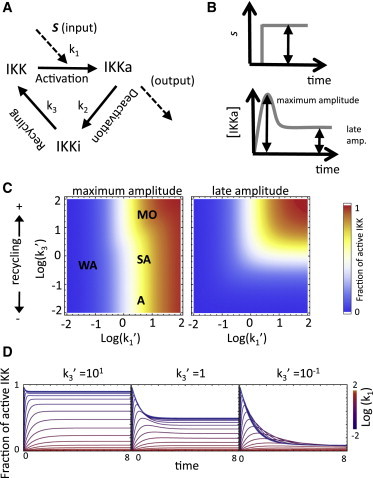
Operational regimes of the three-state cycle. (A) The input signal causes the kinase IKK to transition from a poised (IKK) to an active state (IKKa). Active IKK is then transformed into an inactive form (IKKi) from which the poised state is regenerated. (B) When stimulated with square steps of varying amplitude, the cycle can generate biphasic signals with well-defined early and late phases. (C) Maximum amplitude (fraction of IKK active) during the early and late phases (left and right, respectively) as a function of the normalized stimulus strength (k1′) and recycling rate (k3′) parameters. Regions corresponding to the weak activation (WA) limit, and the monotonic (M), semiadaptive (SA), and adaptive (A) regimes are indicated. (D) Typical time courses of IKK activation.
Figure 2
Figure 2
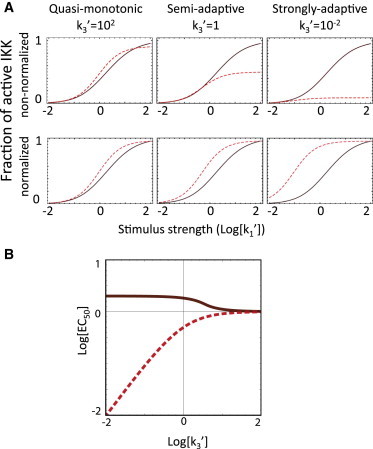
Amplitude dose response. (A) Dose response for the early (solid) and late (dashed) phases of IKK response for the monotonic, semiadaptive, and strongly adaptive cases (k3′ = 102, 1, 10−2, left to right). (Lower panels) Dose responses normalized to their maximum attained value to emphasize the shift of the EC50 toward lower stimulus concentrations. (B) EC50PEAK and EC50SS (solid and dashed, respectively) as a function of k3′.
Figure 3
Figure 3
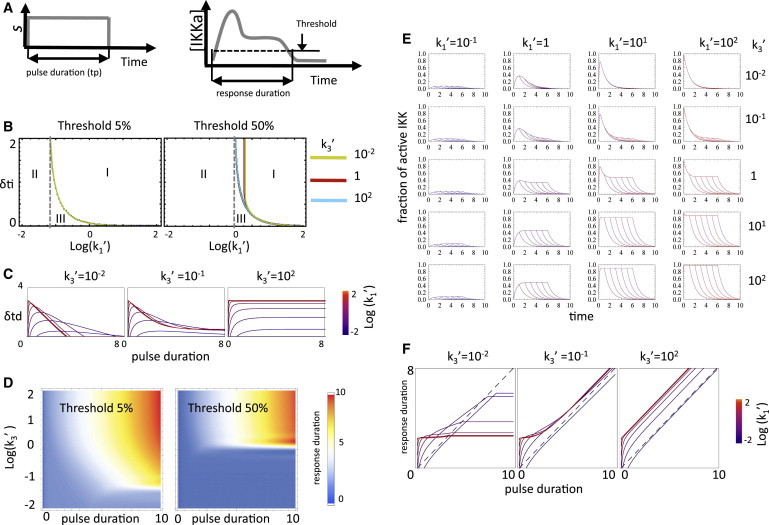
Duration dose response. (A) The three-state cycle was stimulated with square pulses of various durations. The period of time for which the IKKa fraction remained over an arbitrary threshold was defined as response duration. (B) Initial lag (δti) as a function of k1′ for monotonic (cyan), semiadaptive (red), and strongly adaptive (yellow) regimes (k3′ = 102, 10−1, 10−2, respectively), and 5 and 50% thresholds. Regions with nonzero duration (I), amplitude-limited (II), and duration-limited (III) are indicated. (C) Termination delay (δtd) for the three regimes and various values of k1′ as a function of pulse duration. (D) Duration dose-response for 5 and 50% thresholds. (E) Typical time courses of IKKa in response to square pulses. (F) Cross-sections of the duration dose-response surfaces along the pulse duration axis. All times in transformed units.
Figure 4
Figure 4
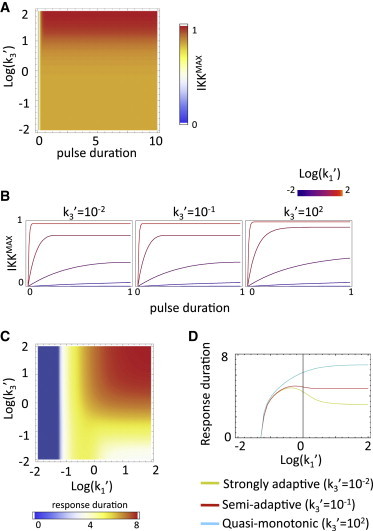
Amplitude-duration transformation. (A) Maximum output amplitude versus input duration for a pulse of saturating amplitude. (B) Maximum output amplitude versus input pulse duration for monotonic, semiadaptive, and adaptive regimes (k3′ = 102, 10−1, 10−2) and various input amplitudes. (C) Duration of the response (5% threshold) as a function of the normalized stimulus strength (k1′) and recycling rate (k3′) parameters for a pulse of duration 0.7 (in transformed time units). (D) Response duration versus normalized input amplitude for the three regimes in panel B. All times in transformed units.
Figure 5
Figure 5
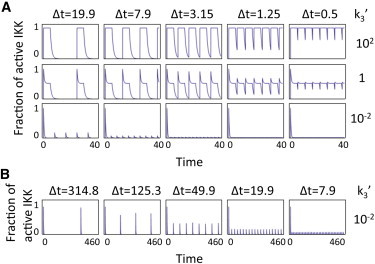
Response to repeated stimulation. (A) Cycle response to a train of square pulses of duration 5, separated by Δt = 19.9, 7.9, 3.15,1.25, and 0.5 (left to right). Responses shown for monotonic, semiadaptive, and strongly adaptive regimes (k3′ = 102, 10−0, 10−2, respectively). Values for 95% IKK recovery times are 2.3, 2.3, and 299, respectively. (B) Response of the strongly adaptive case in panel A over an extended period of time showing full recovery for low-frequency pulses. All times in transformed units.
Figure 6
Figure 6
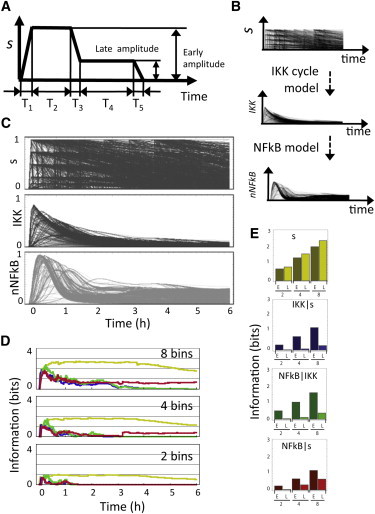
Information transfer in IKK-IkB-NFκB module. (A) A library of input functions defined by variations of five temporal and two amplitude parameters was used to stimulate the cycle. (B) The resulting time profiles of IKK activity were used as inputs to a model of NFκB regulation. (C) Input functions and the corresponding time courses of IKK and NFκB activity. (D) The information content metric for the input library (yellow) and the mutual information for IKK-Input, NFκB-IKK, and NFκB-Input (blue, green, and red, respectively), as a function of time at different levels of discretization (2, 4, and 8 bins corresponding to 1, 2, and 3 bits). (E) Average information content for the input (yellow) and mutual information for the early (t < 30′) and late (30′ < t < 360′) phases of the response at different discretization levels.

References

    1. Hayden M.S., Ghosh S. Shared principles in NF-κB signaling. Cell. 2008;132:344–362. - PubMed
    1. Delhase M., Hayakawa M., Karin M. Positive and negative regulation of IκB kinase activity through IKKβ subunit phosphorylation. Science. 1999;284:309–313. - PubMed
    1. Palkowitsch L., Leidner J., Marienfeld R.B. Phosphorylation of serine 68 in the IκB kinase (IKK)-binding domain of NEMO interferes with the structure of the IKK complex and Tumor Necrosis Factor-α -induced NFκB activity. J. Biol. Chem. 2008;283:76–86. - PubMed
    1. Kray A.E., Carter R.S., Wadzinski B.E. Positive regulation of IκB kinase signaling by protein serine/threonine phosphatase 2A. J. Biol. Chem. 2005;280:35974–35982. - PubMed
    1. Broemer M., Krappmann D., Scheidereit C. Requirement of Hsp90 activity for IκB kinase (IKK) biosynthesis and for constitutive and inducible IKK and NF-κB activation. Oncogene. 2004;23:5378–5386. - PubMed

Publication types

Substances

LinkOut - more resources