


Impact of geocoding methods on associations between long-term exposure to urban air pollution and lung function
- PMID: 23823697
- PMCID: PMC3764075
- DOI: 10.1289/ehp.1206016
Impact of geocoding methods on associations between long-term exposure to urban air pollution and lung function
Abstract
Background: Errors in address geocodes may affect estimates of the effects of air pollution on health.
Objective: We investigated the impact of four geocoding techniques on the association between urban air pollution estimated with a fine-scale (10 m × 10 m) dispersion model and lung function in adults.
Methods: We measured forced expiratory volume in 1 sec (FEV1) and forced vital capacity (FVC) in 354 adult residents of Grenoble, France, who were participants in two well-characterized studies, the Epidemiological Study on the Genetics and Environment on Asthma (EGEA) and the European Community Respiratory Health Survey (ECRHS). Home addresses were geocoded using individual building matching as the reference approach and three spatial interpolation approaches. We used a dispersion model to estimate mean PM10 and nitrogen dioxide concentrations at each participant's address during the 12 months preceding their lung function measurements. Associations between exposures and lung function parameters were adjusted for individual confounders and same-day exposure to air pollutants. The geocoding techniques were compared with regard to geographical distances between coordinates, exposure estimates, and associations between the estimated exposures and health effects.
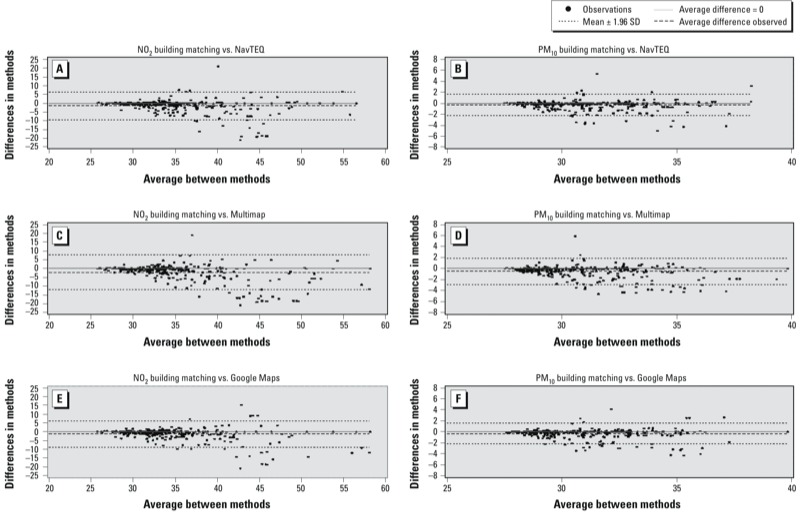
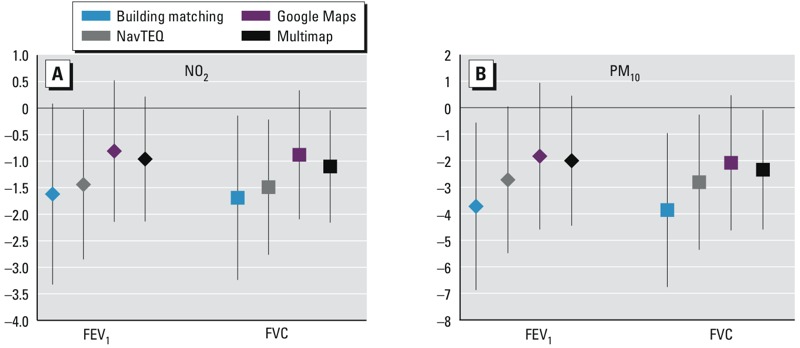
Results: Median distances between coordinates estimated using the building matching and the three interpolation techniques were 26.4, 27.9, and 35.6 m. Compared with exposure estimates based on building matching, PM10 concentrations based on the three interpolation techniques tended to be overestimated. When building matching was used to estimate exposures, a one-interquartile range increase in PM10 (3.0 μg/m3) was associated with a 3.72-point decrease in FVC% predicted (95% CI: -0.56, -6.88) and a 3.86-point decrease in FEV1% predicted (95% CI: -0.14, -3.24). The magnitude of associations decreased when other geocoding approaches were used [e.g., for FVC% predicted -2.81 (95% CI: -0.26, -5.35) using NavTEQ, or 2.08 (95% CI -4.63, 0.47, p = 0.11) using Google Maps].
Conclusions: Our findings suggest that the choice of geocoding technique may influence estimated health effects when air pollution exposures are estimated using a fine-scale exposure model.
Conflict of interest statement
The authors declare they have no actual or potential competing financial interests.
Figures
References
-
- Ackermann-Liebrich U, Leuenberger P, Schwartz J, Schindler C, Monn C, Bolognini G, et al. Lung function and long term exposure to air pollutants in Switzerland. Study on Air Pollution and Lung Diseases in Adults (SAPALDIA) team. Am J Respir Crit Care Med. 1997;155:122–129. - PubMed
-
- Bonner MR, Han D, Nie J, Rogerson P, Vena JE, Freudenheim JL. Positional accuracy of geocoded addresses in epidemiologic research. Epidemiology. 2003;14:408–412. - PubMed
-
- Burney PG, Luczynska C, Chinn S, Jarvis D. The European Community Respiratory Health Survey. Eur Respir J. 1994;7:954–960. - PubMed
Publication types
MeSH terms
LinkOut - more resources
Full Text Sources
Other Literature Sources
Medical