


Antibiotic prophylaxis for short-term catheter bladder drainage in adults
- PMID: 23824735
- PMCID: PMC7388872
- DOI: 10.1002/14651858.CD005428.pub2
Antibiotic prophylaxis for short-term catheter bladder drainage in adults
Abstract
Background: Urinary tract infections account for about 40% of hospital-acquired (nosocomial) infections, and about 80% of urinary tract infections acquired in hospital are associated with urinary catheters.
Objectives: To determine if certain antibiotic prophylaxes are better than others in terms of prevention of urinary tract infections, complications, quality of life and cost-effectiveness in short-term catheterisation in adults.
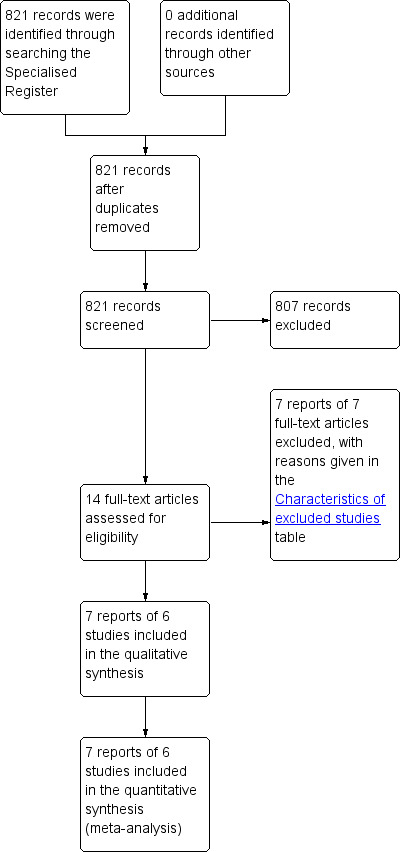
Search methods: We searched the Cochrane Incontinence Group Specialised Register, which contains trials identified from the Cochrane Central Register of Controlled Trials (CENTRAL), MEDLINE and MEDLINE in Process, and handsearching of journals and conference proceedings (searched 31st October 2012). Additionally, we examined all reference lists of identified trials.
Selection criteria: All randomised and quasi-randomised trials comparing antibiotic prophylaxis for short-term (up to and including 14 days) catheterisation in adults.
Data collection and analysis: Data were independently extracted by all review authors and compared. Disagreements were resolved by discussion. Data were processed as described in the Cochrane Handbook for Systemtic Reviews of Interventions. Where data had not been fully reported, clarification was sought directly from the authors of the trial.
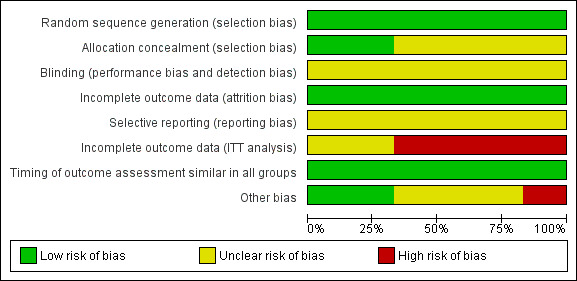
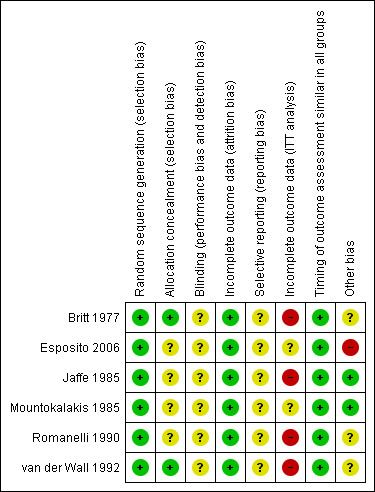
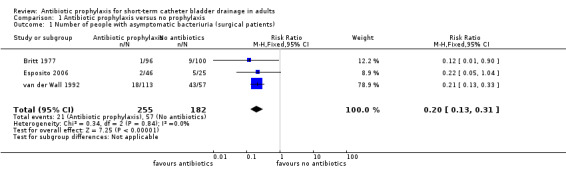
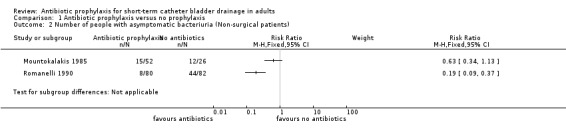
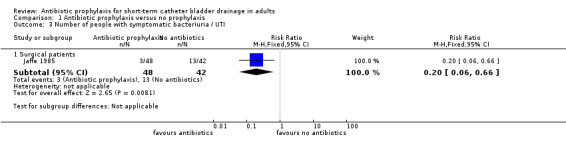
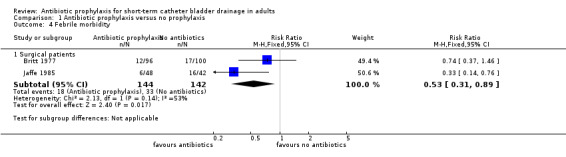
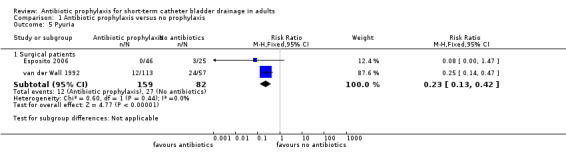
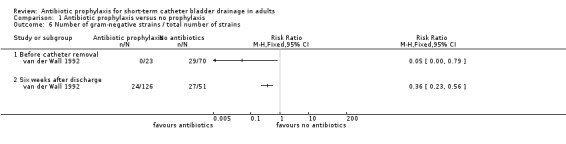
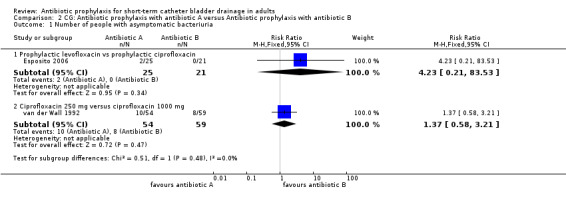
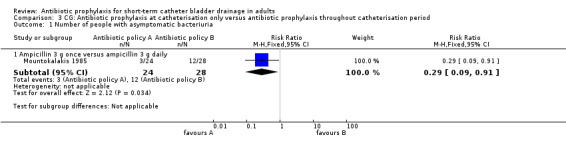
Main results: Six parallel-group randomised controlled trials with 789 participants met the inclusion criteria. All six trials compared antibiotic prophylaxis versus no prophylaxis. Studies presented a low to unclear risk of bias with similar interventions and measured outcomes.The primary outcome of bacteriuria was less common in the prophylaxis group amongst surgical patients with asymptomatic bacteriuria (I(2) = 0; risk ratio (RR) 0.20; 95% confidence interval (CI) 0.13 to 0.31) . Two non-surgical studies could not be combined in a meta-analysis due to heterogeneity and only one showed significantly fewer cases of bacteriuria (RR 0.19; 95% CI 0.09 to 0.37).Two trials of surgical patients with asymptomatic bacteriuria only (255 participants) compared one type of antibiotic prophylaxis with another and neither study showed a significant difference in cases of bacteriuria.One study (78 participants) compared antibiotic prophylaxis in patients at catheterisation only versus antibiotic prophylaxis throughout catheterisation period with asymptomatic bacteriuria. Antibiotics at catheterisation only, resulted in significantly fewer cases of bacteriuria than giving prophylaxis throughout the catheterisation period (RR 0.29 95% CI 0.09 to 0.91).Secondary data of pyuria were provided by two surgical studies (255 participants). When studies were pooled, pyuria occurred in significantly fewer cases in the prophylactic antibiotic group (RR 0.23, 95% CI 0.13 to 0.42). The number of gram-negative isolates in patients' urine just before catheter removal in one study (RR 0.05, 95% CI 0.00 to 0.79) and six weeks after hospital discharge (RR 0.36, 95% CI 0.23 to 0.56) were significantly lower. There were no events in the treatment group before catheter removal. When pooled data from two studies showed significantly reduced febrile morbidity in those receiving antibiotic prophylaxis (RR 0.53 95% CI 0.31 to 0.89).Although all studies assessed micro-organisms isolated from the urine specimens the data were too heterogenous to pool in a meta-analysis and have been provided in a narrative form. Further secondary data such as economic analysis, length of stay and quality of life were not covered in detail.
Authors' conclusions: The limited evidence indicated that receiving prophylactic antibiotics reduced the rate of bacteriuria and other signs of infection, such as pyuria, febrile morbidity and gram-negative isolates in patients' urine, in surgical patients who undergo bladder drainage for at least 24 hours postoperatively. There was also limited evidence that prophylactic antibiotics reduced bacteriuria in non-surgical patients.
Conflict of interest statement
None known.
Figures
Update of
-
Antibiotic policies for short-term catheter bladder drainage in adults.Cochrane Database Syst Rev. 2005 Jul 20;(3):CD005428. doi: 10.1002/14651858.CD005428. Cochrane Database Syst Rev. 2005. Update in: Cochrane Database Syst Rev. 2013 Jul 03;(7):CD005428. doi: 10.1002/14651858.CD005428.pub2. PMID: 16034973 Updated.
References
References to studies included in this review
Britt 1977 {published data only}
Esposito 2006 {published data only}
-
- Esposito S, Noviello S, Leone S, Marvaso A, Drago L, Marchetti F, for the LEVT06 Study Group. A pilot study on prevention of catheter‐related urinary tract infections with fluoroquinolones. Journal of Chemotherapy 2006;18(5):494‐501. - PubMed
-
- Petronella P, Scorzeli M, Fiore A, Corbisiero MC, Agresti E, Esposito S, et al. Antibiotic prophylaxis in catheter‐associated urinary infections. New Microbiologica 2012;35(2):191‐8. - PubMed
Jaffe 1985 {published data only}
-
- Jaffe R, Altaras M, Fejgin M, Ben‐Aderet N. Prophylactic single‐dose co‐trimoxazole for prevention of urinary tract infection after abdominal hysterectomy. Chemotherapy 1985;31(6):476‐9. - PubMed
Mountokalakis 1985 {published data only}
-
- Mountokalakis T, Skounakis M, Tselentis J. Short‐term versus prolonged systemic antibiotic prophylaxis in patients treated with indwelling catheters. Journal of Urology 1985;134(3):506‐8. - PubMed
Romanelli 1990 {published data only}
-
- Romanelli G, Giustina A, Cravarezza P, Bossoni S, Bodini C, Girelli A, et al. A single dose of aztreonam in the prevention of urinary tract infections in elderly catheterized patients. Journal of Chemotherapy 1990;2(3):178‐81. - PubMed
van der Wall 1992 {published data only}
-
- Wall E, Verkooyen RP, Mintjes‐de Groot J, Oostinga J, Dijk A, Hustinx WN, et al. Prophylactic ciprofloxacin for catheter‐associated urinary‐tract infection [see comments]. Lancet 1992;339(8799):946‐51. - PubMed
References to studies excluded from this review
Gasser 1996 {published data only}
-
- Gasser TC, Wisard M, Frei R. Oral fleroxacin prophylaxis in transurethral surgery. Journal of Urology 1996;156:146‐8. - PubMed
Little 1974 {published data only}
-
- Little PJ, Pearson S, Peddie BA, Greenslade NF, Utley WL. Amoxicillin in the prevention of catheter‐induced urinary infection. Journal of Infectious Diseases 1974;129(Suppl 2):S241‐2. - PubMed
Meyer 1975 {published data only}
-
- Meyer FP, Walther H, Matzke G. The need for early therapy in gynecologic patients with postoperative indwelling catheters [German]. Zentralblatt fur Gynakologie 1975;97(6):333‐42. - PubMed
Ragnaud 1983 {published data only}
-
- Ragnaud JM, Gin H, Tauzin‐Fin P, Ballanger P, Ballanger R, Aubertin J. Prevention of post‐operative infections in urologic surgery. Comparative study of cotrimoxazole and cefazolin. [French]. Pathologie Biologie 1983;31:434‐7. - PubMed
Shohet 1983 {published data only}
-
- Shohet I, Alagam M, Shafir R, Tsur H, Cohen B. Postoperative catheterization and prophylactic antimicrobials in children with hypospadias. Urology 1983;22(4):391‐3. - PubMed
Stricker 1988 {published data only}
-
- Stricker PD, Grant AB. Relative value of antibiotics and catheter care in the prevention of urinary tract infection after transurethral prostatic resection. British Journal of Urology 1988;61(6):494‐7. - PubMed
Verbrugh 1988 {published data only}
-
- Verbrugh HA, Mintjes‐de Groot AJ, Andriesse R, Hamersma K. Postoperative prophylaxis with norfloxacin in patients requiring bladder catheters. European Journal of Clinical Microbiology of Infectious Diseases 1988;7(4):490‐4. - PubMed
Additional references
Alsaywid 2012
-
- Alsaywid BS, Deshpande AV, Smith GH, Farnsworth RH, Webb NR. Antibiotic prophylaxis for transurethral urological procedures. Cochrane Database of Systematic Reviews 2012, Issue 9. [DOI: 10.1002/14651858.CD010074] - DOI
Bernard 2012
-
- Bernard MS, Hunter KF, Moore KN. A review of strategies to decrease the duration of indwelling urethral catheters and potentially reduce the incidence of catheter‐associated urinary tract infections. Urological Nursing 2012;32(1):29‐37. - PubMed
CDC 2008
-
- Horan TC, Andrus M, Dudeck M. CDC/NHSN surveillance definition of health care–associated infection and criteria for specific types of infections in the acute care setting. American Journal of Infection Control 2008;36(5):309‐32. - PubMed
Foon 2012
Higgins 2003
Higgins 2011
-
- Higgins JPT, Green S (editors). Cochrane Handbook for Systemtic Reviews of Interventions Version 5.1.0 [updated March 2011]. The Cochrane Collaboration, 2011. Available from www.cochrane‐handbook.org. Chichester: John Wiley & Sons, 2011.
Huth 1992
-
- Huth TS, Burke JP, Larsen RA, Classen DC, Stevens LE. Randomized trial of meatal care with silver sulfadiazine cream for the prevention of catheter‐associated bacteriuria. Journal of Infectious Diseases 1992;165(1):14‐8. [MEDLINE: ; 15405] - PubMed
Klevens 2007
National Audit Office 2009
-
- National Auidt Office. Reducing Healthcare Associated Infections in Hospitals in England. London Stationery Office. London: NAO, 2009.
Niël‐Weise 2005a
Petronella 2012
-
- Petronella P, Scorzeli M, Fiore A, Corbisiero MC, Agresti E, Esposito S, et al. Antibiotic prophylaxis in catheter‐associated urinary infections. New Microbiologica 2012;35(2):191‐8. - PubMed
Pfefferkorn 2009
-
- Pfefferkorn U, Lea S, Moldenhauer J, Peterli R, Flue M, Ackerman C. Antibiotic prophylaxis at urinary catheter removal prevents urinary tract infections: a prospective randomized trial. Annals of Surgery 2009;249(4):573‐5. - PubMed
Plowman 1997
-
- Plowman RP, Graves N, Roberts JA. Hospital Acquired Infection. Office of Health Economics, London. 1997.
Pratt 2007
Schumm 2008
Scott 2009
-
- Scott RD. The direct medical costs of healthcare‐associated infections in U.S. hospitals and the benefits of prevention. Altanta, GA: Division of Healthcare Quality Promotion, National Center for Preparedness, Detection, and Control of Infectious Diseases, Coordinating Center for Infectious Diseases, Centers for Disease Control and Prevention, 2009. Available from: http://www.cdc.gov/HAI/pdfs/hai/Scott_CostPaper.pdf.
Stickler 2008
-
- Stickler DJ, Morgan SD. Observations on the development of the crystalline bacterial biofilms that encrust and block Foley catheters. Journal of Hospital Infection 2008;69(4):350‐60. - PubMed
Tambyah 2002
-
- Tambyah PA, Knasinski V, Maki DG. The direct costs of nosocomial catheter‐associated urinary tract infection in the era of managed care. Infection Control and Hospital Epidemiology 2002;23(1):27‐31. - PubMed
Ware 1992
-
- Ware JE Jr, Sherbourne CD. The MOS 36‐item short‐form health survey (SF‐36). I. Conceptual framework and item selection. Medical Care 1992;30(6):473‐83. [MEDLINE: ] - PubMed
Warren 2001
-
- Warren JW. Catheter‐associated urinary tract infections. International Journal of Antimicrobial Agents 2001;17:299‐303. [MEDLINE: ; 15414] - PubMed
Zigmond 1983
-
- Zigmond AS, Snaith RP. The hospital anxiety and depression scale. Acta Psychiatrica Scandinavica 1983;67(6):361‐70. [MEDLINE: ] - PubMed
Publication types
MeSH terms
LinkOut - more resources
Full Text Sources
Other Literature Sources
Medical
Miscellaneous
