


Hawkmoths produce anti-bat ultrasound
- PMID: 23825084
- PMCID: PMC3730625
- DOI: 10.1098/rsbl.2013.0161
Hawkmoths produce anti-bat ultrasound
Abstract
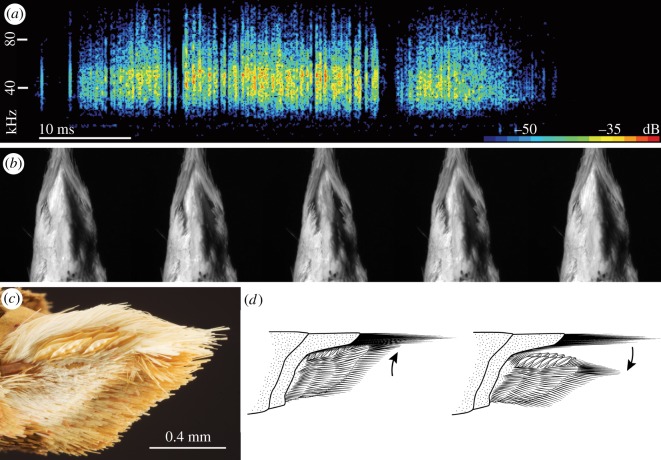
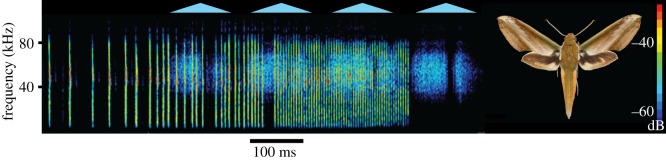
Bats and moths have been engaged in aerial warfare for nearly 65 Myr. This arms race has produced a suite of counter-adaptations in moths, including bat-detecting ears. One set of defensive strategies involves the active production of sound; tiger moths' ultrasonic replies to bat attack have been shown to startle bats, warn the predators of bad taste and jam their biosonar. Here, we report that hawkmoths in the Choerocampina produce entirely ultrasonic sounds in response to tactile stimulation and the playback of biosonar attack sequences. Males do so by grating modified scraper scales on the outer surface of the genital valves against the inner margin of the last abdominal tergum. Preliminary data indicate that females also produce ultrasound to touch and playback of echolocation attack, but they do so with an entirely different mechanism. The anti-bat function of these sounds is unknown but might include startling, cross-family acoustic mimicry, warning of unprofitability or physical defence and/or jamming of echolocation. Hawkmoths present a novel and tractable system to study both the function and evolution of anti-bat defences.
Keywords: Sphingidae; arms race; bat; echolocation; sphinx moth.
Figures
References
-
- Yager DD. 1999. Structure, development, and evolution of insect auditory systems. Microsc. Res. Tech. 47, 380–400 (doi:10.1002/(SICI)1097-0029(19991215)47:6<380::AID-JEMT3>3.0.CO;2-P) - DOI - PubMed
-
- Miller LA, Surlykke A. 2001. How some insects detect and avoid being eaten by bats: tactics and countertactics of prey and predator. Bioscience 51, 570–581 (doi:10.1641/0006-3568(2001)051[0570:HSIDAA]2.0.CO;2) - DOI
-
- Bates DL, Fenton MB. 1990. Aposematism or startle? Predators learn their responses to the defenses of prey. Can. J. Zool. 68, 49–52 (doi:10.1139/z90-009) - DOI
-
- Hristov IH, Conner WE. 2005. Sound strategy: acoustic aposematism in the bat–tiger moth arms race. Naturwissenschaften 92, 164–169 (doi:10.1007/s00114-005-0611-7) - DOI - PubMed
-
- Barber JR, Conner WE. 2007. Acoustic mimicry in a predator–prey interaction. Proc. Natl Acad. Sci. USA 104, 9331–9334 (doi:10.1073/pnas.0703627104) - DOI - PMC - PubMed
Publication types
MeSH terms
LinkOut - more resources
Full Text Sources
Other Literature Sources
Research Materials
