


Chronobiology by moonlight
- PMID: 23825199
- PMCID: PMC3712431
- DOI: 10.1098/rspb.2012.3088
Chronobiology by moonlight
Abstract
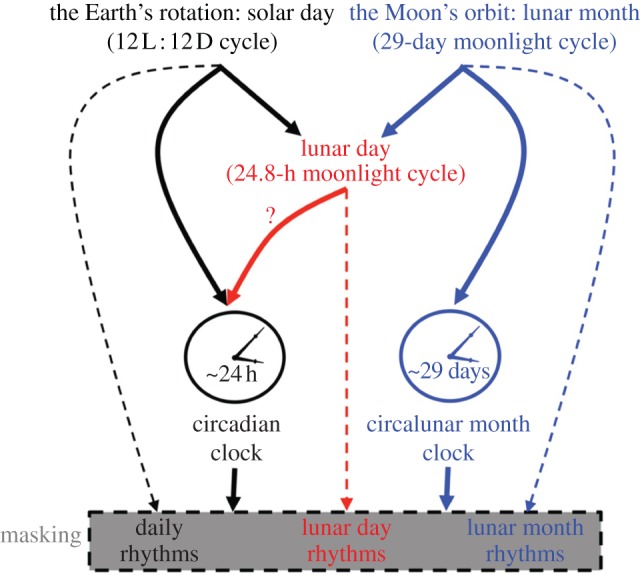
Most studies in chronobiology focus on solar cycles (daily and annual). Moonlight and the lunar cycle received considerably less attention by chronobiologists. An exception are rhythms in intertidal species. Terrestrial ecologists long ago acknowledged the effects of moonlight on predation success, and consequently on predation risk, foraging behaviour and habitat use, while marine biologists have focused more on the behaviour and mainly on reproduction synchronization with relation to the Moon phase. Lately, several studies in different animal taxa addressed the role of moonlight in determining activity and studied the underlying mechanisms. In this paper, we review the ecological and behavioural evidence showing the effect of moonlight on activity, discuss the adaptive value of these changes, and describe possible mechanisms underlying this effect. We will also refer to other sources of night-time light ('light pollution') and highlight open questions that demand further studies.
Keywords: communication; foraging; light pollution; lunar cycle; predation; reproduction.
Figures
References
-
- Tessmar-Raible K, Raible F, Arboleda E. 2011. Another place, another timer: marine species and the rhythms of life. Bioessays 33, 165–172 (doi:10.1002/bies.201000096) - DOI - PMC - PubMed
-
- De la Iglesia H, Hsu YW. 2010. Biological clocks and rhythms in intertidal crustaceans. Front. Biosci. (Elite Ed) 2, 1394–1404 (doi:10.2741/E200) - DOI - PubMed
-
- Brown JS. 1999. Vigilance, patch use and habitat selection: foraging under predation risk. Evol. Ecol. Res. 1, 49–71
-
- Daly M, Behrends PR, Wilson MI, Jacobs LF. 1992. Behavioral modulation of predation risk—moonlight avoidance and crepuscular compensation in a nocturnal desert rodent, Dipodomys-Merriami. Anim. Behav. 44, 1–9 (doi:10.1016/S0003-3472(05)80748-1) - DOI
-
- Stolov HL. 1965. Further investigations of a variation of geomagnetic activity with lunar phase. J. Geophys. Res. 70, 4921–4926 (doi:10.1029/JZ070i019p04921) - DOI
Publication types
MeSH terms
LinkOut - more resources
Full Text Sources
Other Literature Sources
