


First outbreak with MRSA in a Danish neonatal intensive care unit: risk factors and control procedures
- PMID: 23825581
- PMCID: PMC3692537
- DOI: 10.1371/journal.pone.0066904
First outbreak with MRSA in a Danish neonatal intensive care unit: risk factors and control procedures
Abstract
Introduction: The purpose of the study was to describe demographic and clinical characteristics and outbreak handling of a large methicillin-resistant Staphylococcus aureus (MRSA) outbreak in a neonatal intensive care unit (NICU) in Denmark June 25(th)-August 8(th) 2008, and to identify risk factors for MRSA transmission.
Methods: Data were collected retrospectively from medical records and the Danish Neobase database. All MRSA isolates obtained from neonates, relatives and NICU health care workers (HCW) as well as environmental cultures were typed.
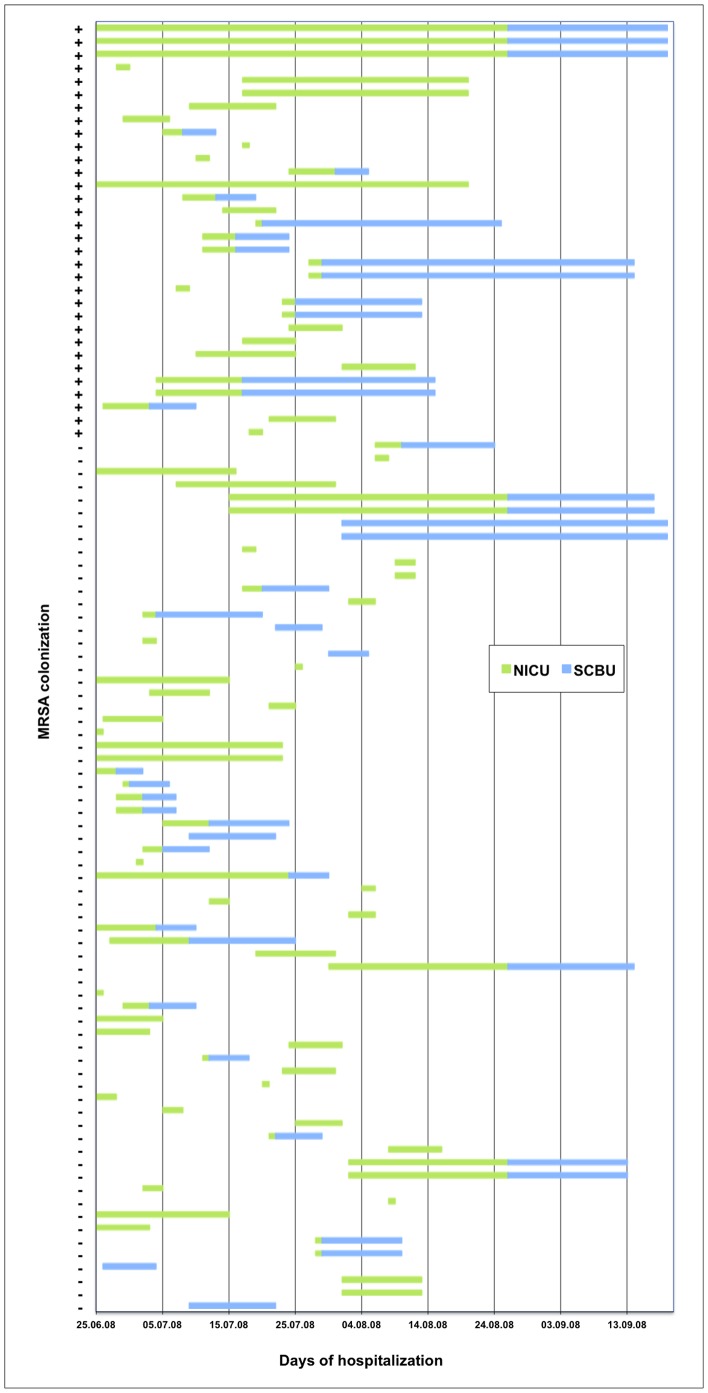
Results: During the 46 day outbreak period, 102 neonates were admitted to the two neonatal wards. Ninety-nine neonates were subsequently sampled, and 32 neonates (32%) from 25 families were colonized with MRSA (spa-type t127, SCCmec V, PVL negative). Thirteen family members from 11 of those families (44%) and two of 161 HCWs (1%) were colonized with the same MRSA. No one was infected. Five environmental cultures were MRSA positive. In a multiple logistic regression analysis, nasal Continuous Positive Airway Pressure (nCPAP) treatment (p = 0.006) and Caesarean section (p = 0.016) were independent risk factors for MRSA acquisition, whereas days of exposure to MRSA was a risk factors in the unadjusted analysis (p = 0.04).
Conclusions: MRSA transmission occurs with high frequency in the NICU during hospitalization with unidentified MRSA neonates. Caesarean section and nCPAP treatment were identified as risk factors for MRSA colonization. The MRSA outbreak was controlled through infection control procedures.
Conflict of interest statement
Figures
References
-
- EPI-NEWS No 47–2012 - Statens Serum Institut. Available: http://www.ssi.dk/English/News/EPI-NEWS/2012/No%2047%20-%202012.aspx. Accessed 13 December 2012.
-
- Hetem DJ, Westh H, Boye K, Jarløv JO, Bonten MJ, et al. (2012) Nosocomial transmission of community-associated methicillin-resistant Staphylococcus aureus in Danish Hospitals. J Antimicrob Chemother 2012 Jul 67(7): 1775–80. - PubMed
MeSH terms
LinkOut - more resources
Full Text Sources
Other Literature Sources
Medical
