


A longitudinal study simultaneously exploring the carriage of APEC virulence associated genes and the molecular epidemiology of faecal and systemic E. coli in commercial broiler chickens
- PMID: 23825682
- PMCID: PMC3692481
- DOI: 10.1371/journal.pone.0067749
A longitudinal study simultaneously exploring the carriage of APEC virulence associated genes and the molecular epidemiology of faecal and systemic E. coli in commercial broiler chickens
Abstract
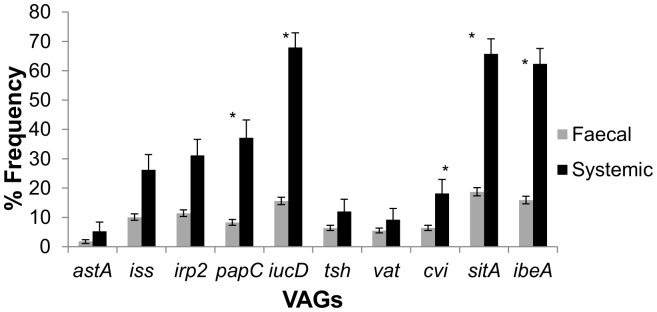
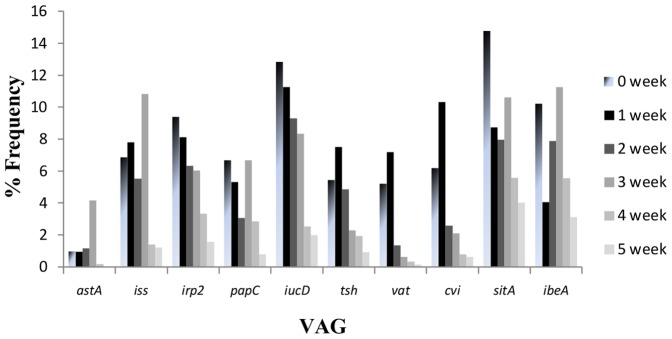
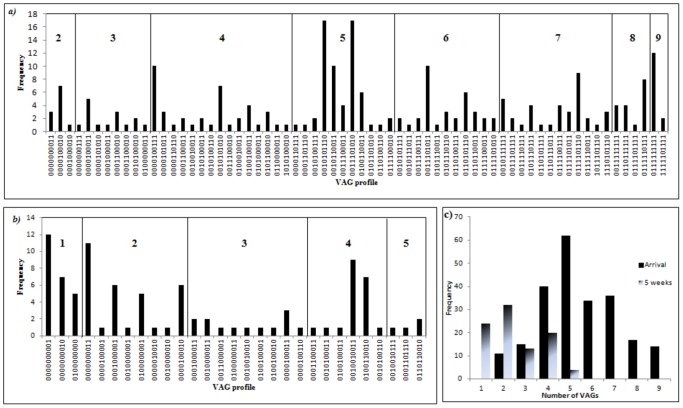
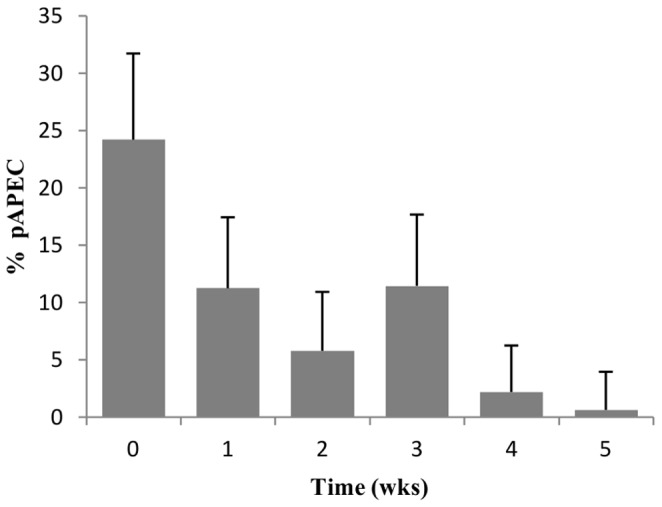
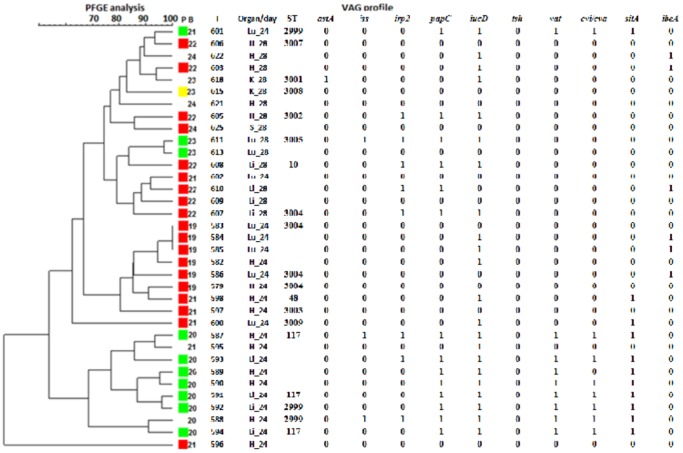
Colibacillosis is an economically important syndromic disease of poultry caused by extra-intestinal avian pathogenic Escherichia coli (APEC) but the pathotype remains poorly defined. Combinations of virulence-associated genes (VAGs) have aided APEC identification. The intestinal microbiota is a potential APEC reservoir. Broiler chickens are selectively bred for fast, uniform growth. Here we simultaneously investigate intestinal E. coli VAG carriage in apparently healthy birds and characterise systemic E. coli from diseased broiler chickens from the same flocks. Four flocks were sampled longitudinally from chick placement until slaughter. Phylogrouping, macro-restriction pulsed-field gel electrophoresis (PFGE) and multi-locus sequence typing (MLST) were performed on an isolate subset from one flock to investigate the population structure of faecal and systemic E. coli. Early in production, VAG carriage among chick intestinal E. coli populations was diverse (average Simpson's D value = 0.73); 24.05% of intestinal E. coli (n = 160) from 1 day old chicks were carrying ≥5 VAGs. Generalised Linear models demonstrated VAG prevalence in potential APEC populations declined with age; 1% of E. coli carrying ≥5 VAGs at slaughter and demonstrated high strain diversity. A variety of VAG profiles and high strain diversity were observed among systemic E. coli. Thirty three new MLST sequence types were identified among 50 isolates and a new sequence type representing 22.2% (ST-2999) of the systemic population was found, differing from the pre-defined pathogenic ST-117 at a single locus. For the first time, this study takes a longitudinal approach to unravelling the APEC paradigm. Our findings, supported by other studies, highlight the difficulty in defining the APEC pathotype. Here we report a high genetic diversity among systemic E. coli between and within diseased broilers, harbouring diverse VAG profiles rather than single and/or highly related pathogenic clones suggesting host susceptibility in broilers plays an important role in APEC pathogenesis.
Conflict of interest statement
Figures
References
-
- Barnes HJ, Gross WB (1999) Colibacillosis. In: W.B.Gross, editor. Diseases of Poultry. 10th ed: Iowa state university press, Ames.pp. 131–141.
-
- Skyberg JA, Horne SM, Giddings CW, Wooley RE, Gibbs PS, et al. (2003) Characterizing avian Escherichia coli isolates with multiplex polymerase chain reaction. Avian Diseases 47: 1441–1447. - PubMed
-
- Ewers C, Janssen T, Kiessling S, Philipp HC, Wieler LH (2005) Rapid detection of virulence-associated genes in avian pathogenic Escherichia coli by multiplex polymerase chain reaction. Avian Diseases 49: 269–273. - PubMed
-
- Germon P, Chen YH, He L, Blanco JE, Bree A, et al. (2005) ibeA, a virulence factor of avian pathogenic Escherichia coli. Microbiology-Sgm 151: 1179–1186. - PubMed
-
- McPeake SJM, Smyth JA, Ball HJ (2005) Characterisation of avian pathogenic Escherichia coli (APEC) associated with colisepticaemia compared to faecal isolates from healthy birds. Veterinary Microbiology 110: 245–253. - PubMed
Publication types
MeSH terms
Grants and funding
LinkOut - more resources
Full Text Sources
Other Literature Sources
Medical
