


Dressings combined with injection of meglumine antimoniate in the treatment of cutaneous leishmaniasis: a randomized controlled clinical trial
- PMID: 23826087
- PMCID: PMC3691234
- DOI: 10.1371/journal.pone.0066123
Dressings combined with injection of meglumine antimoniate in the treatment of cutaneous leishmaniasis: a randomized controlled clinical trial
Abstract
Background: Cutaneous leishmaniasis (CL) is a neglected infectious disease and a major health problem in several developing countries. Despite some reasonable explanation for their potential benefits, there is only trace evidence regarding the role of dressings in the treatment of CL.
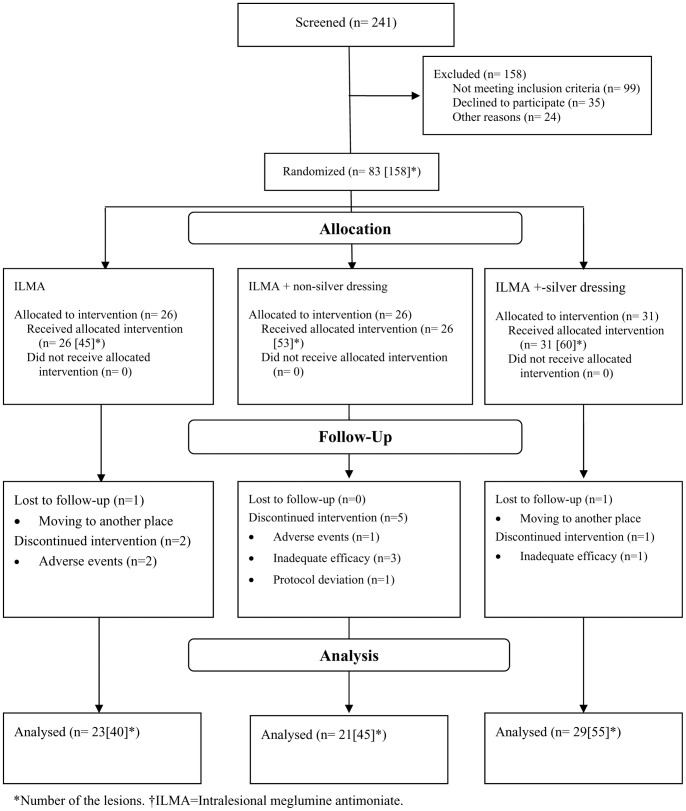
Methods: This randomized, assessor-blind, controlled, clinical trial was conducted in an endemic area for CL caused by Leishmania major in Iran to assess the efficacy of administration of weekly intralesional meglumine antimoniate (i.l.MA) either alone or combined with application of a silver or a non-silver polyester dressing on their lesions for 6 weeks. After screening of 241 patients with CL lesions, 83 eligible patients with 158 lesions were randomly allocated in three arms of the study. Eligibility criteria included parasitologically confirmed CL, age of 12 to 60 years; willingness to participate, duration of lesion<3 months, number of lesions<5, largest ulcer diameter<5 cm. Pregnant or lactating women were excluded. The primary outcome was absolute risk reduction (ARR) based on the proportion of complete healing, which was defined as more than 75% reduction in the size of the lesion compared with baseline in each group at the termination of treatment and 1 month later.
Findings: ARR (95% Confidence Interval [CI]) in i.l.MA versus i.l.MA+non-silver dressing groups was 5.98% (-7.07% to 20.25%), between i.l.MA versus i.l.MA+silver dressing groups was -0.23% (-13.53% to 14.82%), and between i.l.MA+non-silver dressing versus i.l.MA+silver dressing groups was -6.21%(-18.28% to 6.52%) after 6 weeks of treatment. ARR (95% CI) in i.l.MA versus i.l.MA+non-silver dressing groups was -2.22% (-22.12% to 18.10%), between i.l.MA versus i.l.MA+silver dressing groups was 3.64% (-15.36% to 22.82%), and between i.l.MA+non-silver dressing versus i.l.MA+silver dressing groups was 5.86% (-12.86% to 24.31%) 1 month later.
Conclusion: It could not be demonstrated that the efficacy of i.l.MA was improved by either dressing.
Trial registration: Iranian Registry of Clinical Trials (IRCT.ir) IRCT138707201166N2.
Conflict of interest statement
Figures
References
-
- World Health Organization (2010) Control of the Leishmaniases: Report of a meeting of the WHO expert committee on the control of Leishmaniases, Geneva, 22–26 March 2010. Geneva: World Health Organization.
-
- Desjeux P (2004) Leishmaniasis: current situation and new perspectives. Comp Immunol Microbiol Infect Dis 27: 305–318. - PubMed
-
- Dowlati Y (1996) Cutaneous leishmaniasis: clinical aspect. Clin Dermatol 14: 425–431. - PubMed
-
- Nilforoushzadeh M, Sadeghian G (2001) Cutaneous leishmaniasis (In Persian). Isfahan; Orouj Publications and Isfahan University of Medical Sciences Publications.
-
- Bailey MS, Lockwood DN (2007) Cutaneous leishmaniasis. Clin Dermatol 25: 203–211. - PubMed
Publication types
MeSH terms
Substances
LinkOut - more resources
Full Text Sources
Other Literature Sources
