. 2013 Jun 24;8(6):e67527.
doi: 10.1371/journal.pone.0067527. Print 2013.

An integrated diagnosis strategy for congenital myopathies

Affiliations

An integrated diagnosis strategy for congenital myopathies

Johann Böhm et al. PLoS One. .

Abstract

Congenital myopathies are severe muscle disorders affecting adults as well as children in all populations. The diagnosis of congenital myopathies is constrained by strong clinical and genetic heterogeneity. Moreover, the majority of patients present with unspecific histological features, precluding purposive molecular diagnosis and demonstrating the need for an alternative and more efficient diagnostic approach. We used exome sequencing complemented by histological and ultrastructural analysis of muscle biopsies to identify the causative mutations in eight patients with clinically different skeletal muscle pathologies, ranging from a fatal neonatal myopathy to a mild and slowly progressive myopathy with adult onset. We identified RYR1 (ryanodine receptor) mutations in six patients and NEB (nebulin) mutations in two patients. We found novel missense and nonsense mutations, unraveled small insertions/deletions and confirmed their impact on splicing and mRNA/protein stability. Histological and ultrastructural findings of the muscle biopsies of the patients validated the exome sequencing results. We provide the evidence that an integrated strategy combining exome sequencing with clinical and histopathological investigations overcomes the limitations of the individual approaches to allow a fast and efficient diagnosis, accelerating the patient's access to a better healthcare and disease management. This is of particular interest for the diagnosis of congenital myopathies, which involve very large genes like RYR1 and NEB as well as genetic and phenotypic heterogeneity.


Conflict of interest statement

Competing Interests: The authors have declared that no competing interests exist.

Figures

Figure 1
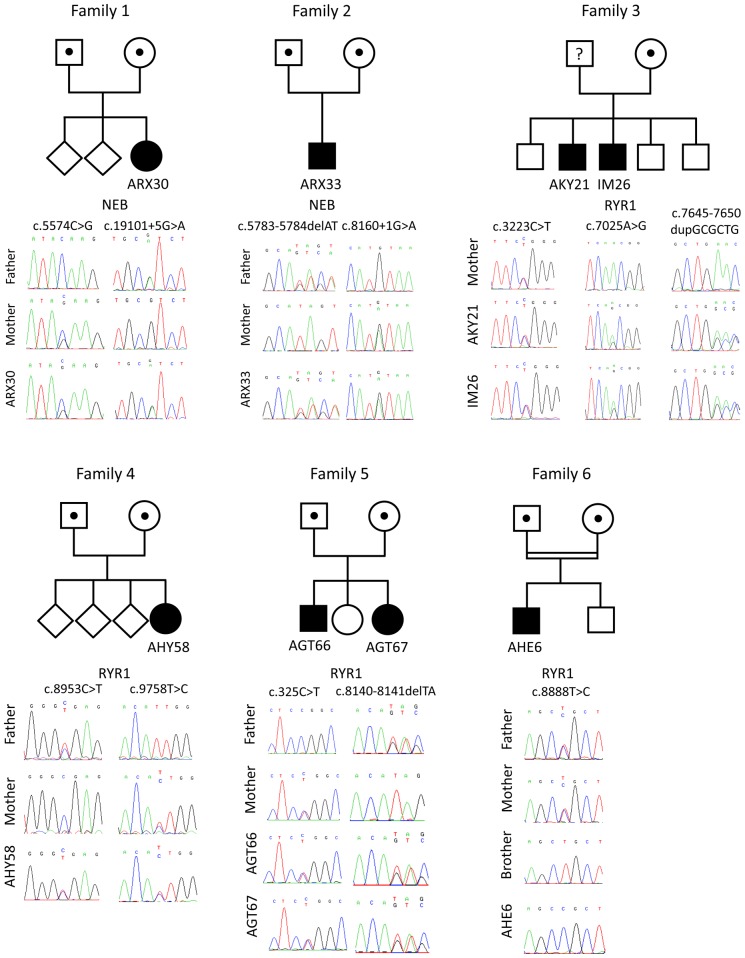
Figure 1. Pedigrees andRYR1/NEB mutations in six families with different muscle disorders.
Patient ARX30 harbors the NEB c.5574C>G mutation on the maternal and the NEB c.19101+5G>A mutation on the paternal allele. Patient ARX33 harbors the NEB c.8160+1G>A mutation on the maternal and the NEB c.5783_5784delAT mutation on the paternal allele. Patients AKY21 and IM26 carry the heterozygous c.3223C>T, c.7025A>G and c.7645-7650dupGCGCTG mutations in RYR1. The c.3223C>T mutation was found on the maternal allele, the father’s DNA was not available. AHY58 harbors two heterozygous RYR1 mutations: c.8953C>T on the paternal allele and c.9758T>C on the maternal allele. In patients AGT66 and AGT67 we identified the heterozygous RYR1 mutations c.325C>T on the maternal and c.8140_8141delTA on the paternal allele. Patient AHE6 from a consanguineous family was found to harbor the homozygous RYR1 c.8888T>C mutation, both parents were heterozygous.
Figure 2
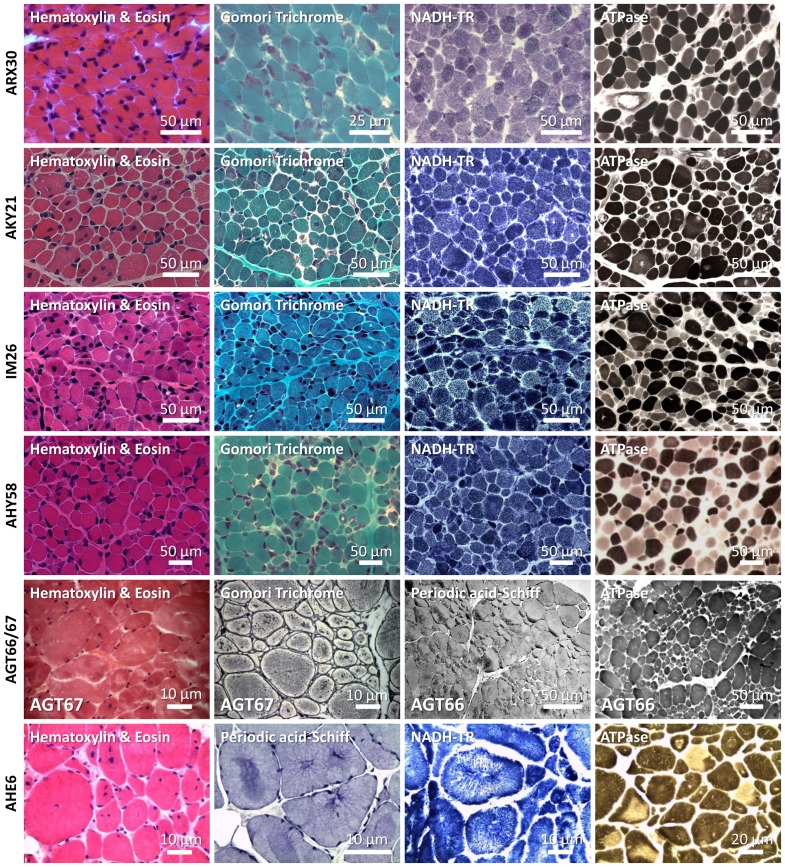
Figure 2. Histological analysis of muscle biopsies from patients ARX30, AKY21, IM26, AHY58, AGT66/AGT67, and AHE6.
The deltoid muscle biopsy of patient ARX30 was performed 2 days after birth and revealed nemaline bodies, fiber size variability and type I fiber predominance. On the deltoid muscle biopsies from AKY21 and IM26 (shortly after birth), nuclear internalization, atrophy, fiber size variability, and areas devoid of oxidative enzyme activity became apparent. Analysis of the deltoid muscle biopsy of patient AHY58 (20 days) demonstrated fiber size variability, atrophy, internal nuclei, and discrete areas of reduced oxidative enzyme activity. Biceps brachii biopsy from AGT66 (8 years) and AGT67 (shortly after birth) revealed nuclear internalization, fiber size variability, multiple minicores devoid of oxidative enzyme activity and type I fiber predominance. Left deltoid muscle biopsy from patient AHE6 (performed at 30 years) revealed internalized nuclei, fiber size variation, radial arrangements of sarcoplasmic strands, necklace fibers, type I fiber predominance, core-like structures, fibrosis and fatty infiltrations.
Figure 3
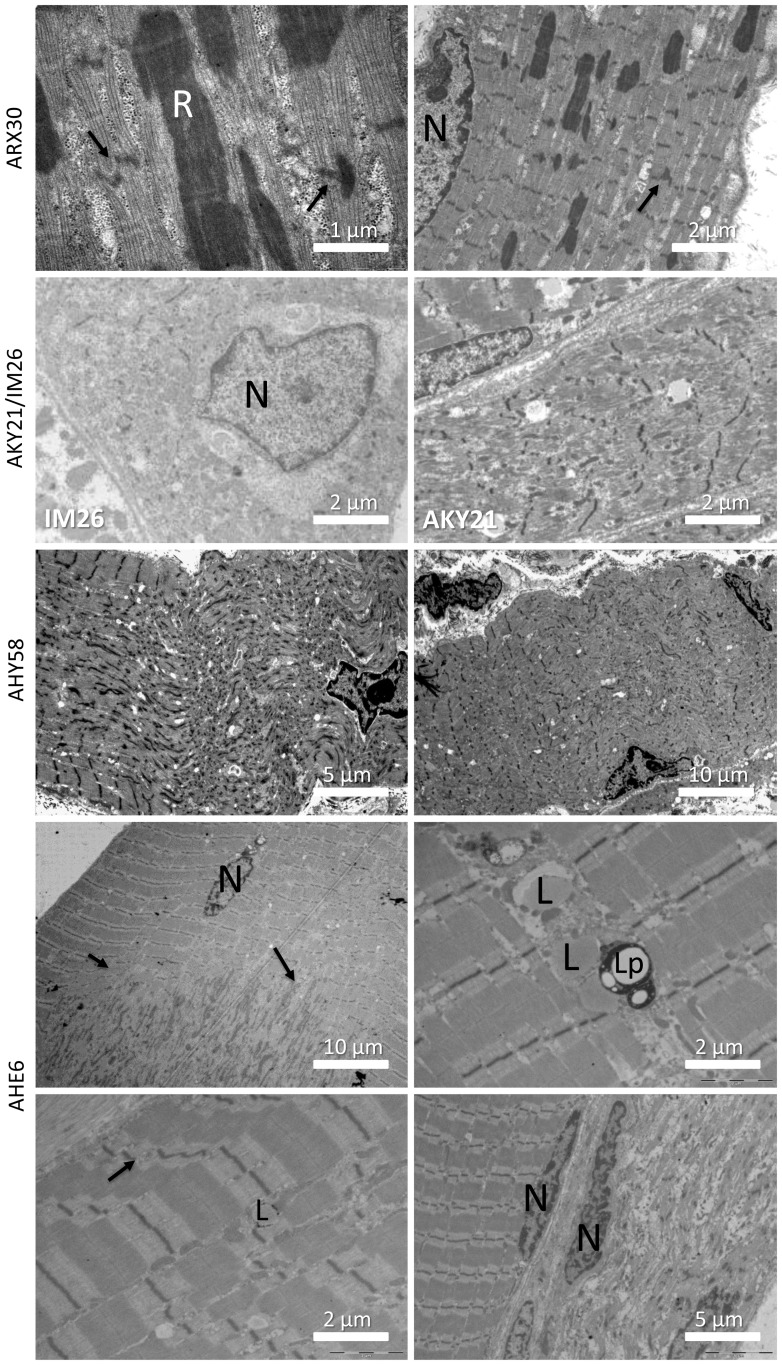
Figure 3. Ultrastructural analysis of muscle biopsies.
Ultrastructural analysis of the biopsy from patient ARX30 revealed myofibrillar disorganization, Z-line streaming of adjacent sarcomeres (arrows), and prominent nemaline rods. The biopsy of patient IM26 showed large disorganized areas around internalized nuclei, the longitudinal muscle section of AKY21 revealed prominent Z-band streaming. Analysis of the biopsy of AHY58 demonstrated marked myofibrillar disorganization, fragmented Z-bands and internalized nuclei. The biopsy of patient AHE6 displayed nuclear centralization, myofibrillar disorganization, fibrosis, lipofuscin granules and myofiber degeneration. R  =  nemaline rods, N  =  nuclei, L  =  lipids, Lp  =  lipofuscin
Figure 4
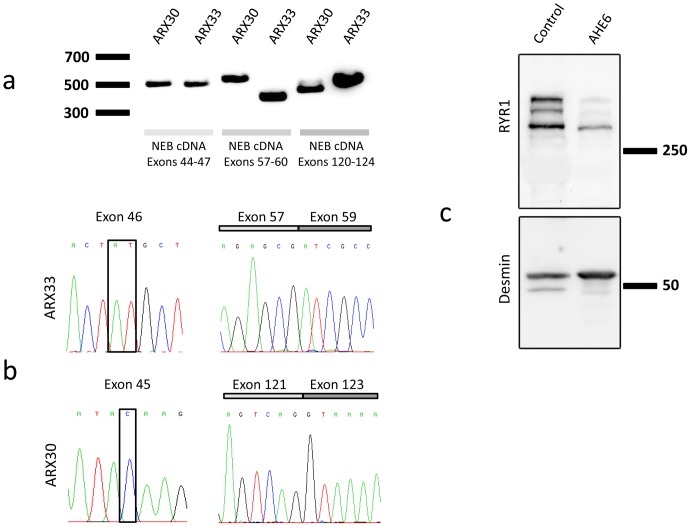
Figure 4. Impact of theNEB/RYR1 mutations.
(A) Normal sized cDNA amplicons for exons 44 to 47 from patient ARX30 with the heterozygous c.5574C>G nonsense mutation (exon 45) and from patient ARX33 with the heterozygous c.5783_5784delAT deletion (exon 46). The splice mutation c.8160+1G>A (intron 58, ARX33) resulted in a shorter NEB cDNA amplicon (exons 57–60) compared to the control. The splice mutation c.19101+5G>A (intron 122, ARX30) involved a weak cDNA amplicon (exons 120–124) of normal size and a strong amplicon of smaller size. (B) The NEB c.8160+1G>A splice mutation (ARX33) causes a complete skipping of the in-frame exon 58. The c.5783_5784delAT mutation was not seen in the cDNA, indicating mRNA degradation by nonsense-mediated mRNA decay (NMD) of the allele containing this deletion. The NEB cDNA amplicon of patient ARX30 (exons 122–126) did not contain the in-frame exon 122. The c.5574C>G mutation in exon 46 was not seen by cDNA sequencing, suggesting NMD of the allele harboring this nonsense mutation. (C) Western blot of a deltoid muscle extract revealed a strong reduction of the RYR1 protein level in patient AHE6 compared to a healthy age-matched control. Desmin was used for normalization.

References

    1. North K (2008) What's new in congenital myopathies? Neuromuscul Disord 18: 433–442. - PubMed
    1. Wang CH, Dowling JJ, North K, Schroth MK, Sejersen T, et al. (2012) Consensus statement on standard of care for congenital myopathies. J Child Neurol 27: 363–382. - PMC - PubMed
    1. Nance JR, Dowling JJ, Gibbs EM, Bonnemann CG (2012) Congenital myopathies: an update. Curr Neurol Neurosci Rep 12: 165–174. - PMC - PubMed
    1. Sewry CA (2008) Pathological defects in congenital myopathies. J Muscle Res Cell Motil 29: 231–238. - PubMed
    1. Amburgey K, McNamara N, Bennett LR, McCormick ME, Acsadi G, et al. (2011) Prevalence of congenital myopathies in a representative pediatric united states population. Ann Neurol 70: 662–665. - PubMed

Publication types