Review
. 2013 Oct:109:1-27.
doi: 10.1016/j.pneurobio.2013.06.003. Epub 2013 Jul 1.

Pain and suicidality: insights from reward and addiction neuroscience

Affiliations
Review

Pain and suicidality: insights from reward and addiction neuroscience

Igor Elman et al. Prog Neurobiol. 2013 Oct.

Abstract

Suicidality is exceedingly prevalent in pain patients. Although the pathophysiology of this link remains unclear, it may be potentially related to the partial congruence of physical and emotional pain systems. The latter system's role in suicide is also conspicuous during setbacks and losses sustained in the context of social attachments. Here we propose a model based on the neural pathways mediating reward and anti-reward (i.e., allostatic adjustment to recurrent activation of the reward circuitry); both are relevant etiologic factors in pain, suicide and social attachments. A comprehensive literature search on neurobiology of pain and suicidality was performed. The collected articles were critically reviewed and relevant data were extracted and summarized within four key areas: (1) physical and emotional pain, (2) emotional pain and social attachments, (3) pain- and suicide-related alterations of the reward and anti-reward circuits as compared to addiction, which is the premier probe for dysfunction of these circuits and (4) mechanistically informed treatments of co-occurring pain and suicidality. Pain-, stress- and analgesic drugs-induced opponent and proponent states of the mesolimbic dopaminergic pathways may render reward and anti-reward systems vulnerable to sensitization, cross-sensitization and aberrant learning of contents and contexts associated with suicidal acts and behaviors. These findings suggest that pain patients exhibit alterations in the brain circuits mediating reward (depressed function) and anti-reward (sensitized function) that may affect their proclivity for suicide and support pain and suicidality classification among other "reward deficiency syndromes" and a new proposal for "enhanced anti-reward syndromes". We suggest that interventions aimed at restoring the balance between the reward and anti-reward networks in patients with chronic pain may help decreasing their suicide risk.

Keywords: ACC; AMY; Aberrant learning; Allostasis; Anti-reward; BLA; BNST; CEA; CRF; Cross-sensitization; DA; DBS; DMN; DRG; DSM-IV TR; Diagnostic and Statistical Manual of Mental Disorders, 4th edition, Text Revision; GABA; HB; HT; Habenula; Homeostasis; INS; LC; NAc; NE; NR; PAG; PFC; PTSD; RF; S(1); S(2); Stress; VT; amygdala; anterior cingulate gyrus; basolateral complex of the amygdala; bed nucleus the striaterminalis; central nucleus of the amygdala; corticotropin-releasing factor; deep brain stimulation; default-mode network; dopamine; dorsal root ganglion; gamma-aminobutyricacid; habenula; hypothalamus; insula; locus coeruleus; norepinephrine; nucleus accumbens; periaqueductal gray matter; posttraumatic stress disorder; prefrontal cortex; primary somatosensory cortex; raphe nuclei; reticular formation nuclei; secondary somatosensory cortex; ventral tegmentum.


Figures

Fig. 1
Fig. 1
Schematic overview of the interface among sensory, reward, anti-reward, motivation, emotions, cognition and arousal neural systems that govern pain-related mood and behavior. Peripheral noxious stimuli are detected by nociceptors and propagated along primary afferent neurons to converge at the level of the dorsal root ganglion (DRG), which is the origin of the spinothalamic tract. The lateral portions of the spinothalamic tract relay sensory-discriminatory dimensions of nociception to the primary (S1) and secondary (S2) somatosensory cortices via the ventral postero-lateral and medial thalamic nuclei. The flow of painful stimuli is amplified or diminished at the DRG level by the Pain Modulatory System regulating pain signals flow prior to their interpretation by the cortical and subcortical areas. Specifically, the periaqueductal gray matter (PAG) integrates nociceptive data arriving from the ascending pain pathways with an extensive contribution from the superior cortical and subcortical structures including anterior cingulate gyrus (ACC), amygdala (AMY), nucleus accumbens (NAc), hypothalamus (HT) and Habenula (HB) to regulate the descending pain modulation system by the inferior brainstem nuclei including nucleus tractus solitarius, parabrachial nucleus, locus coeruleus (LC) and raphe nuclei (NR). Habenula modulates pain intensity, aversion and motor responses and is part of an anti-reward system that gets activated with exposure to a negative reinforcers (i.e., aversive stimuli) in contrast to the NAc which is part of the reward system that gets activated by positive reinforcers (i.e., reward). It receives projections from the spinothalamic tract, limbic system and the basal ganglia while its efferents are projected to the brainstem pain modulatory regions. Emotional–motivational aspects of pain are carried to the limbic structures (e.g., AMY, HT, striatum, INS and ACC) by the medial spinothalamic tract after synapsing at the medial thalamic and/or brainstem nuclei (e.g., PAG, LC and the NR). In addition to targeting sensory and limbic regions, ascending spinothalamic tract neurons also project to the reticular formation (RF) nuclei (arousal), superior colliculus (motoric orientation), parabrachial nucleus and HT (autonomic processes and neuroendocrine stress-like output). For the clarity of presentation, the scheme was rendered out-of-scale and simplified to reduce the numbers of the displayed links and structures to those of direct relevance to the main themes of this review.
Fig. 2
Fig. 2
Interface between biopsychological factors governing pain-related affect. Primary pain affect is derived from interrelated factors involved in the homeostatic monitoring of physical integrity as part of the system determining emotions and conscious self. Thus, in addition to carrying the pain sensation in isolation to the primary and secondary somatosensory cortex (S1 and S2), ascending spinal tracts also terminate in the habenula (HB), amygdala (AMY), anterior cingulate cortex (ACC), insula (INS), reticular formation nuclei (RF), parabrachial nucleus and hypothalamus (HT) to produce primary composite sensory/affective output. This output incorporates contextual data in the form of environmental influences, memories, pain-unrelated emotions, cognitive constructs, personality characteristics and neuropsychopathology to generate the secondary pain affect that resets the primary affect via feedback mechanisms.
Fig. 3
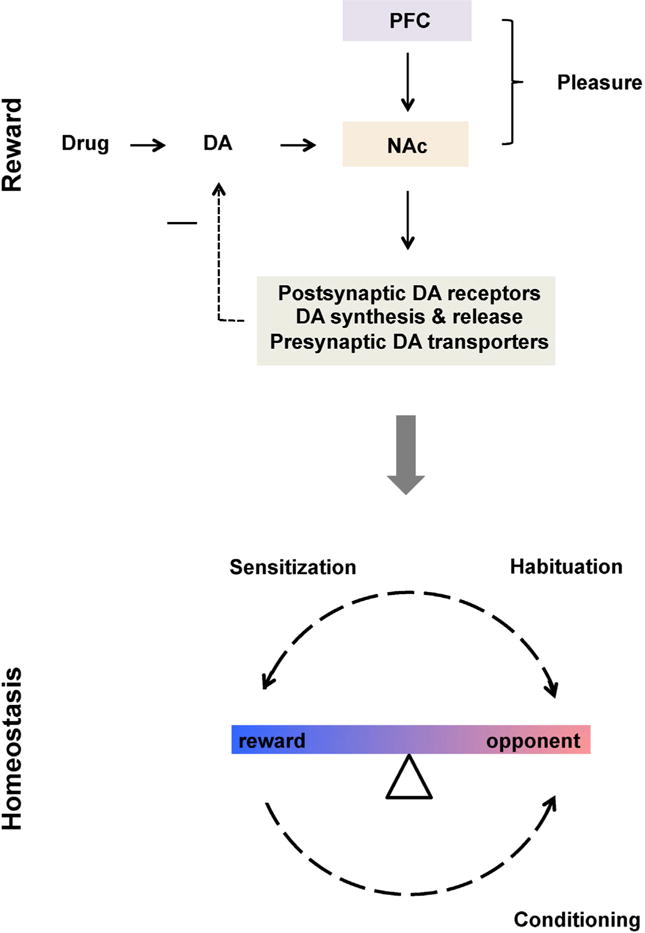
Fig. 3
Homeostatic function of reward circuitry. Prefrontal cortex exerts top down control for bottom up dopamine (DA) signals coming from the nucleus accumbens (NAc) in response to natural and pharmacological rewards. The integrated information is compared to the regulated set point and in case of discrepancy is opposed via negative feedback loop by regulating postsynaptic DA receptors, DA synthesis and release as well as presynaptic DA transporters (among other mechanisms). Opponent processes clinically evident in depressive symptomatology may enhance drug use or natural reward via amplification of their rewarding and reinforcing properties i.e., sensitization. Backward conditioning further enhances opponent processes by evoking withdrawal symptomatology. “−” sign represent inhibition.
Fig. 4
Fig. 4
Allostatic dysregulation of anti-reward. Interference with homeostatic functioning triggers between system adaptation recruiting central and basolateral amygdala (BLA) nuclei, the bed nucleus of the stria terminalis (BNST), the lateral tegmental noradrenergic nuclei of the brain stem, the hippocampus and the habenula that in concert contribute to massive outpouring of stressogenic CRF, norepinephrine and dynorphin manifested in negative affective states, anhedonia and profound craving. This results in an unstable positive feedback loop wherein anti-reward systems activation drives further drug consumption that provides momentary relief but eventually increases aversiveness and craving and thus contributes to progressive worsening of the clinical condition. “+” sign represent stimulation and “−” inhibition.
Fig. 5
Fig. 5
Schematic overview of the neurobiological processes underlying manifestation of suicidal behavior and of the potential sites where pain and treatment with opioid analgesics predispose for suicidality. Hypodopaminergic state in the striatum and prefrontal cortex (PFC) is an illustration of the opponent/anti-reward process consequential to excessive stress and drug exposure and it is linked to suicidality. Clinical correlates of the dopaminergic striatal deficits in suicidal patients could be evident in diminished hedonic capacity, low motivation for social interactions and decrease in self-harm averseness, while the hypofunctional PFC involved in the inhibitory control over suicidal behavior corresponds to impulsive and reckless behavior combined with faulty decision making. At the same time, between systems opponent/anti-reward sensitization e.g., enhanced CRF, norepinephrine, dynorphin and glutamate activities further worsens anhedonia and other negative affective states. Another manifestation of sensitization is related to death as a motivational target and so the capability for suicide is acquired via the irresistible drive to die combined with the tolerance for the emotional and physical pain. The increase in the frequency and lethality of suicidal attempts as the condition advances is yet another expression of sensitization. Suicide-stress cross-sensitization is evident in the strong link between life adversities, physical abuse and a variety of stressful experiences with the acquired suicidal capability. Aberrant salience in suicidality limits the behavioral repertoire and creates habit-based rigid motivational states fixated on suicide-related content, in contravention to its devastating outcome and with diminution of mesolimbic neurons’ ability to detect signals for normal salience (social rewards) and loss of normal modulation of reinforcers’ values by non-suicidal contexts. Suicidal urges may be further enhanced owing to a hypofunctional PFC involved in the inhibitory control. Propensity for suicide could be worsened by pain and by excessive opioid use as both are associated with reward/motivation deficits. Pain- or opioid drug-induced effects in the mesolimbic dopaminergic circuitry are salient and motivate behavior, so persistent exposure to this type of stimuli dysregulates the system, increasing the incentive salience assigned to pain- or to drug-related cues along with habit-based learning and cross-sensitization.
Fig. 6
Fig. 6
Blockade of adrenergic neurotransmission as a potential treatment option for patients with pain and suicidality. Blockade of adrenergic neurotransmission via α2 adrenoceptors’ agonists or α1 adrenoceptors’ antagonists (e.g., clonidine, guanfacine or prazosin) could be a well-tolerated therapeutic option for patients with pain and suicidality as they improve negative affective states and stabilize the sensitized motivational system.

References

    1. Ago Y, Tanaka T, Kita Y, Tokumoto H, Takuma K, Matsuda T. Lithium attenuates methamphetamine-induced hyperlocomotion and behavioral sensitization via modulation of prefrontal monoamine release. Neuropharmacology. 2012;62:1634–1639. - PubMed
    1. Ahearn EP, Chen P, Hertzberg M, Cornette M, Suvalsky L, Cooley-Olson D, Swanlund J, Eickhoff J, Becker T, Krahn D. Suicide attempts in veterans with bipolar disorder during treatment with lithium, divalproex, and atypical antipsychotics. J Affect Disord. 2012;145:77–82. - PMC - PubMed
    1. Alba-Delgado C, Llorca-Torralba M, Horrillo I, Ortega JE, Mico JA, Sanchez-Blazquez P, Meana JJ, Berrocoso E. Chronic pain leads to concomitant noradrenergic impairment and mood disorders. Biol Psychiatry. 2012;73:54–62. - PubMed
    1. Amat J, Sparks PD, Matus-Amat P, Griggs J, Watkins LR, Maier SF. The role of the habenular complex in the elevation of dorsal raphe nucleus serotonin and the changes in the behavioral responses produced by uncontrollable stress. Brain Res. 2001;917:118–126. - PubMed
    1. Amen DG, Prunella JR, Fallon JH, Amen B, Hanks C. A comparative analysis of completed suicide using high resolution brain SPECT imaging. J Neuropsychiatry Clin Neurosci. 2009;21:430–439. - PubMed

Publication types