


Whole-exome sequencing identifies tetratricopeptide repeat domain 7A (TTC7A) mutations for combined immunodeficiency with intestinal atresias
- PMID: 23830146
- PMCID: PMC3759618
- DOI: 10.1016/j.jaci.2013.06.013
Whole-exome sequencing identifies tetratricopeptide repeat domain 7A (TTC7A) mutations for combined immunodeficiency with intestinal atresias
Abstract
Background: Combined immunodeficiency with multiple intestinal atresias (CID-MIA) is a rare hereditary disease characterized by intestinal obstructions and profound immune defects.
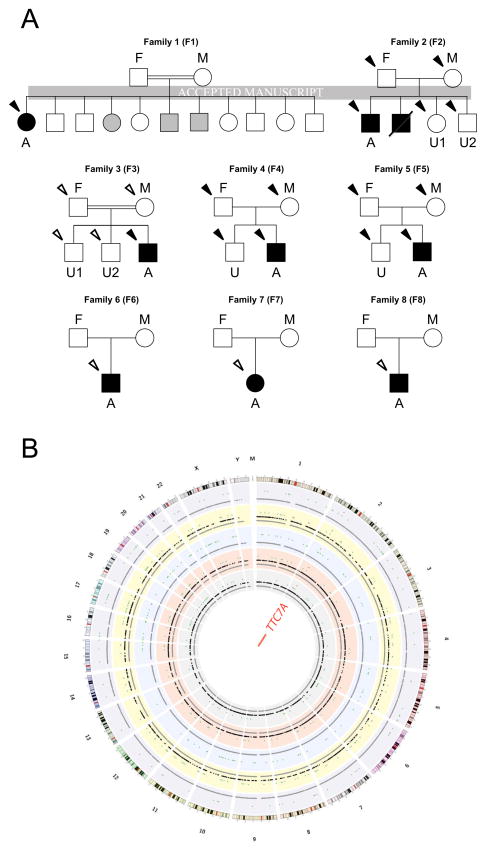
Objective: We sought to determine the underlying genetic causes of CID-MIA by analyzing the exomic sequences of 5 patients and their healthy direct relatives from 5 unrelated families.
Methods: We performed whole-exome sequencing on 5 patients with CID-MIA and 10 healthy direct family members belonging to 5 unrelated families with CID-MIA. We also performed targeted Sanger sequencing for the candidate gene tetratricopeptide repeat domain 7A (TTC7A) on 3 additional patients with CID-MIA.
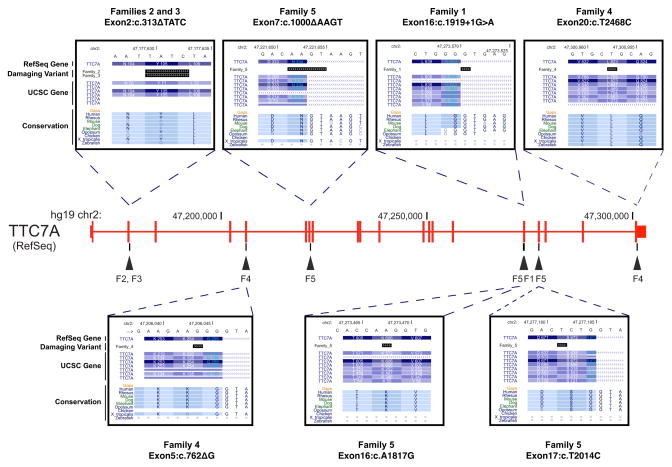
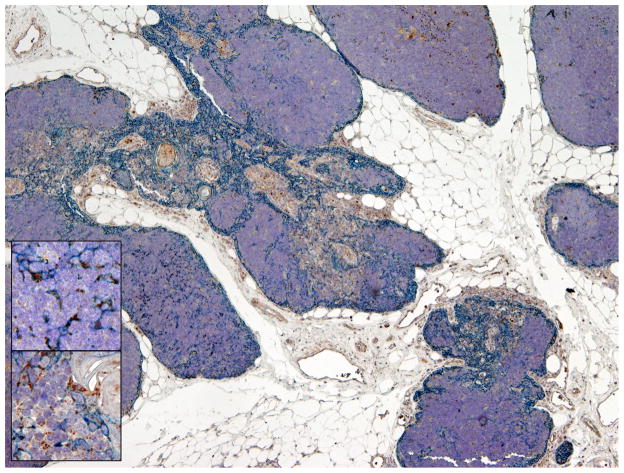
Results: Through analysis and comparison of the exomic sequence of the subjects from these 5 families, we identified biallelic damaging mutations in the TTC7A gene, for a total of 7 distinct mutations. Targeted TTC7A gene sequencing in 3 additional unrelated patients with CID-MIA revealed biallelic deleterious mutations in 2 of them, as well as an aberrant splice product in the third patient. Staining of normal thymus showed that the TTC7A protein is expressed in thymic epithelial cells, as well as in thymocytes. Moreover, severe lymphoid depletion was observed in the thymus and peripheral lymphoid tissues from 2 patients with CID-MIA.
Conclusions: We identified deleterious mutations of the TTC7A gene in 8 unrelated patients with CID-MIA and demonstrated that the TTC7A protein is expressed in the thymus. Our results strongly suggest that TTC7A gene defects cause CID-MIA.
Keywords: CID-MIA; Combined immunodeficiency with multiple intestinal atresias; GATK; Genome Analysis Toolkit; Graft-versus-host disease; GvHD; HCT; Hematopoietic cell transplantation; Indels; Insertions and/or deletions; NMD; Nonsense-mediated decay; SCID; SNV; Severe combined immunodeficiency; Single nucleotide variant; T-cell receptor excision circle; TREC; TTC7A; Tetratricopeptide repeat domain 7A; WES; Whole-exome sequencing; tetratricopeptide repeat domain 7A; thymus; whole-exome sequencing.
Copyright © 2013 American Academy of Allergy, Asthma & Immunology. Published by Mosby, Inc. All rights reserved.
Figures
References
-
- Guttman FM, Braun P, Garance PH, Blanchard H, Collin PP, Dallaire L, et al. Multiple atresias and a new syndrome of hereditary multiple atresias involving the gastrointestinal tract from stomach to rectum. Journal of pediatric surgery. 1973;8:633–40. - PubMed
-
- Mishalany HG, Der Kaloustian VM. Familial multiple-level intestinal atresias: report of two siblings. The Journal of pediatrics. 1971;79:124–5. - PubMed
-
- Moreno LA, Gottrand F, Turck D, Manouvrier-Hanu S, Mazingue F, Morisot C, et al. Severe combined immunodeficiency syndrome associated with autosomal recessive familial multiple gastrointestinal atresias: study of a family. American journal of medical genetics. 1990;37:143–6. - PubMed
-
- Rothenberg ME, White FV, Chilmonczyk B, Chatila T. A syndrome involving immunodeficiency and multiple intestinal atresias. Immunodeficiency. 1995;5:171–8. - PubMed
-
- Ali YA, Rahman S, Bhat V, Al Thani S, Ismail A, Bassiouny I. Hereditary multiple intestinal atresia (HMIA) with severe combined immunodeficiency (SCID): a case report of two siblings and review of the literature on MIA, HMIA and HMIA with immunodeficiency over the last 50 years. BMJ case reports. 2011;2011 - PMC - PubMed
Publication types
MeSH terms
Substances
Grants and funding
- 4U54AI082973-04/AI/NIAID NIH HHS/United States
- U54 AI082973/AI/NIAID NIH HHS/United States
- K99 HG007065/HG/NHGRI NIH HHS/United States
- 5P01AI076210-04/AI/NIAID NIH HHS/United States
- R00 HG007065/HG/NHGRI NIH HHS/United States
- K99HG007065/HG/NHGRI NIH HHS/United States
- T32 HG000044/HG/NHGRI NIH HHS/United States
- Z01 AI000887/ImNIH/Intramural NIH HHS/United States
- P01 AI076210/AI/NIAID NIH HHS/United States
- U01 HG007919/HG/NHGRI NIH HHS/United States
- 1R01AI00887-01/AI/NIAID NIH HHS/United States
- R01 AI100887/AI/NIAID NIH HHS/United States
LinkOut - more resources
Full Text Sources
Other Literature Sources
Molecular Biology Databases
