Comparative Study
. 2013 Aug;16(8):1101-10.
doi: 10.1038/nn.3457. Epub 2013 Jul 7.

GluN2B in corticostriatal circuits governs choice learning and choice shifting

Affiliations
Comparative Study

GluN2B in corticostriatal circuits governs choice learning and choice shifting

Jonathan L Brigman et al. Nat Neurosci. 2013 Aug.

Abstract

A choice that reliably produces a preferred outcome can be automated to liberate cognitive resources for other tasks. Should an outcome become less desirable, behavior must adapt in parallel or it becomes perseverative. Corticostriatal systems are known to mediate choice learning and flexibility, but the molecular mechanisms of these processes are not well understood. We integrated mouse behavioral, immunocytochemical, in vivo electrophysiological, genetic and pharmacological approaches to study choice. We found that the dorsal striatum (DS) was increasingly activated with choice learning, whereas reversal of learned choice engaged prefrontal regions. In vivo, DS neurons showed activity associated with reward anticipation and receipt that emerged with learning and relearning. Corticostriatal or striatal deletion of Grin2b (encoding the NMDA-type glutamate receptor subunit GluN2B) or DS-restricted GluN2B antagonism impaired choice learning, whereas cortical Grin2b deletion or OFC GluN2B antagonism impaired shifting. Our convergent data demonstrate how corticostriatal GluN2B circuits govern the ability to learn and shift choice behavior.


Figures
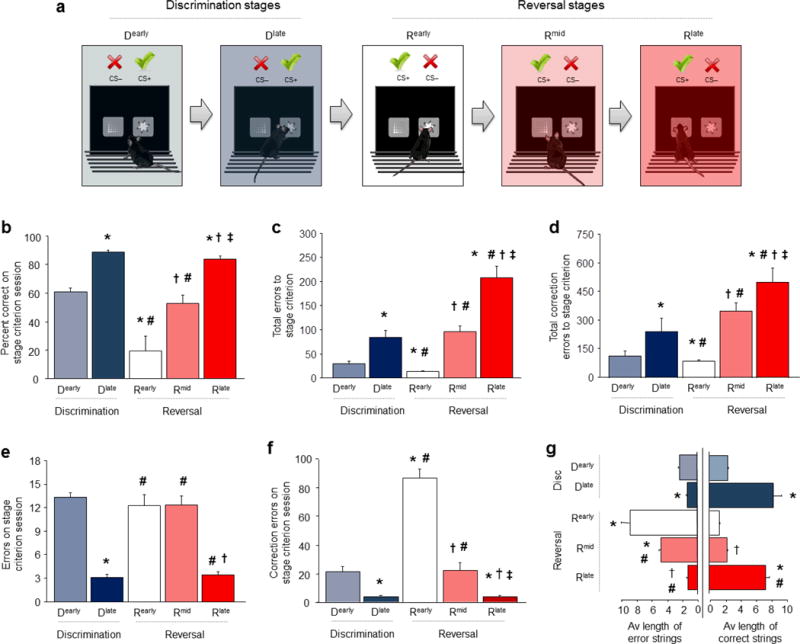
Figure 1
Figure 1. Choice learning, shifting and relearning in a choice task
(a) Five stages of choice performance as mice learn a pairwise visual discrimination, then shift and relearn after reversal. Dearly=first discrimination session, Dlate=final discrimination session, Rearly=first reversal session, Rmid=session midway through reversal, Rlate=final reversal session. (b) Percent choice accuracy increased from Dearly to Dlate, decreased during Rearly and subsequently increased on Rmid and again Rlate. (c) Total errors to reach Dlate was higher than Dearly, and higher to reach Rmid and Rlate than Rearly. (d) Similarly, total correction errors to reach Dlate was higher than Dearly, and higher to reach Rmid and Rlate than Rearly. (e) More errors were committed on Dearly than Dlate stage, and the Rearly than Rmid and Rlate stage. (f) More correction errors were committed on Dearly than Dlate stage, and were markedly elevated on Rearly, as compared to the Rmid and Rlate stage. (g) The average length of consecutive strings of correct choices increased from Dearly to Dlate, decreased during Rearly and increased on Rmid and again Rlate. The average length of consecutive strings of error (including perseverative) choices decreased from Dearly to Dlate, fell during Rearly and remained relatively elevated by Rmid and then decreased by Rlate. Data are Means±SEM. n per stage for b-f: Dearly=10, Dlate=9, Rearly=8, Rmid=8, Rlate=7. *P<.05 vs. Dearly, #P<.05 vs. Dlate, †P<.05 vs. Rearly, ‡P<.05 vs. Rmid, **P<.01 vs. Base.
Figure 2
Figure 2. Dynamic corticostriatal activation with choice learning and relearning
(a,b) The number of c-Fos-positive cells in OFC was elevated during Rearly and Rmid, relative to Dearly and Dlate. (c,d) The number of c-Fos-positive cells in PL was increased during Rearly and Rmid, relative to Dearly and Dlate. (e,f) c-Fos-positive cells in DS increased from Dearly to Dlate, decreased (<Dearly levels) during Rearly and increased in a step-wise manner on Rmid and then Rlate. C57BL/6J mice with bilateral excitotoxic lesions of DS (g), made more errors (h) and correction errors (i) to get attain discrimination criterion, as compared to sham controls. n per stage for c-Fos: Dearly=10, Dlate=9, Rearly=8, Rmid=8, Rlate=7. n per treatment for lesions: Lesion=14, Sham=15. Data are Means±SEM. Example images show the whole 360 × 460 μm region sampled. *P<.05 vs. Dearly, #P<.05 vs. Dlate, †P<.05 vs. Rearly, ‡P<.05 vs. Rlate, **P<.05 vs. sham.
Figure 3
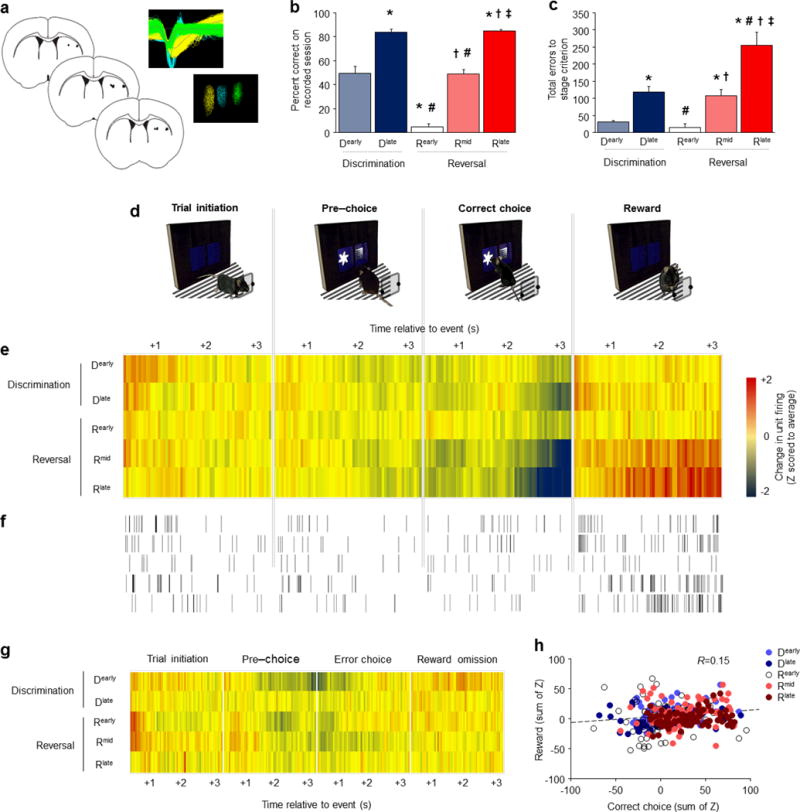
Figure 3. In vivo striatal single-unit activity shifts with choice learning
(a) Position of electrode placements and example waveforms recorded from 3 separate units. Percent correct responding (b) and total cumulative errors from the start of learning and relearning (c) on the session on which ex vivo recordings were made. (d) Single-unit activity on correct-choice trials was recorded during 3-second epoch aligned to trial-initiation, pre-choice, choice, and reward receipt. (e) Divergence from average neuronal activity per 50 msec timebin was strongest during the correct choice and reward epochs. An inhibition of activity after a correct choice and immediately prior to reward collection developed with learning and relearning, while population-level excitation after reward emerged most strongly during relearning. (f) Example of firing in an individual neuron reflecting population-level dynamics across learning/relearning. (g) Stage-wise shifts in activity around choice and reward found for correct choices were not found for error choices. (h) Reward-related activity of individual units was weakly correlated with their activity after correct choices. n=8 mice, 403 units (n=84±3/stage). Data are Means±SEM. *P<.05 vs. D early, #P<.05 vs. D late, †P<.05 vs. R early, ‡P<.05 vs. R mid.
Figure 4
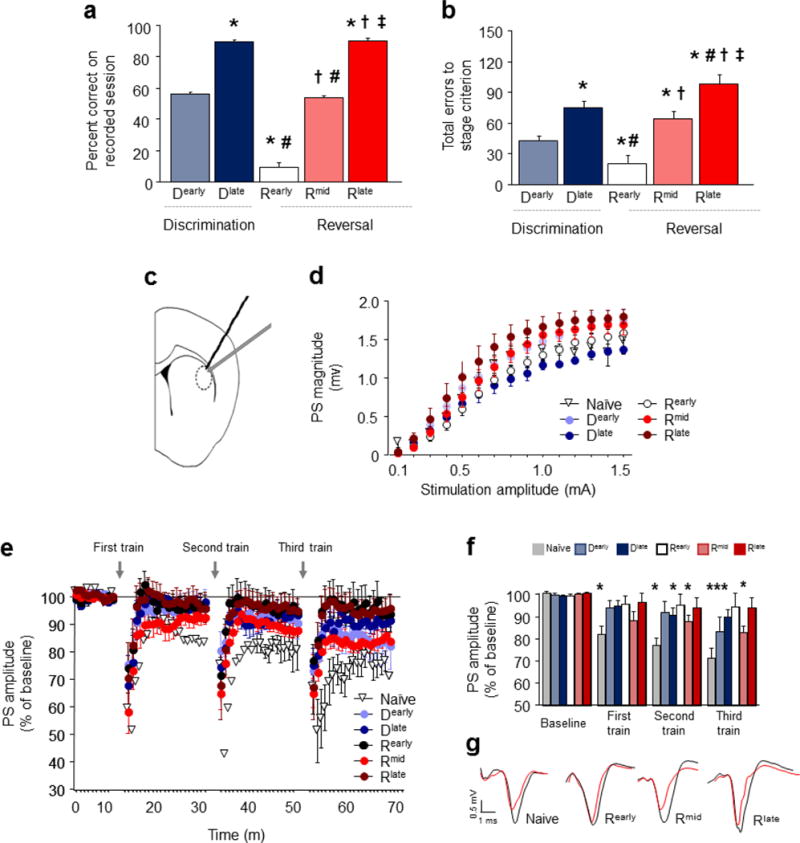
Figure 4. Striatal synaptic plasticity changes with choice learning
Ex vivo recordings were conducted after attaining the 5 choice performance stages. Percent correct responding (a) and total cumulative errors from the start of learning and relearning (b) on the session immediately prior to ex vivo recordings. (c) Position of field potential recordings in coronal slices containing DS evoked by local afferent stimulation. (d) Population spike (PS) amplitude did not vary with stage, but was relatively left-shifted in mice trained to Rlate. (e) Time course of PS amplitude at baseline and following 3 trains of high-frequency stimulation (HFS). (f) Average baseline and post-HFS values. All 3 HFS trains evoked LTD in test-naïve mice, as compared to baseline. Mice trained to Dlate or Rearly showed LTD after the 2nd or 3rd, but not 1st, HFS trains, and mice trained to Dearly showed LTD after the 3rd train only. LTD was occluded in mice trained to Rearly or Rlate. (g) Representative traces after the third stimulation train. n per stage: naïve=5, Dearly=9, Dlate=9, Rearly=9, Rmid=9, Rlate=7. For a-b: *P<.05 vs. D early, #P<.05 vs. D late, †P<.05 vs. R early, ‡P<.05 vs. Rmid. For f: *P<.05 vs. baseline.
Figure 5
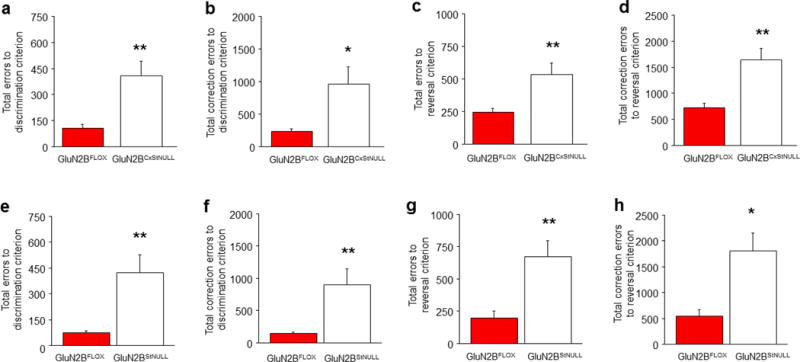
Figure 5. Corticostriatal or striatal GluN2B deletion impairs choice learning
GluN2BCxStNULL mice made more errors (a) and correction errors (b) to attain discrimination criterion, as compared to GluN2BFLOX controls (n per genotype: GluN2BFLOX=8, GluN2BCxStNULL=7). GluN2BCxStNULL mice made more errors (c) and correction errors (d) than GluN2BFLOX controls to attain reversal criterion. GluN2BStNULL mice made more errors (e) and correction errors (f) than GluN2BFLOX controls to attain discrimination criterion (n per genotype: GluN2BFLOX=10, GluN2BStNUL=9). GluN2BStNULL mice made more errors (g) and correction errors (h) to attain reversal criterion than GluN2BFLOX controls. Data are Means±SEM. *P<.05, **P<.01 vs. GluN2BFLOX controls.
Figure 6
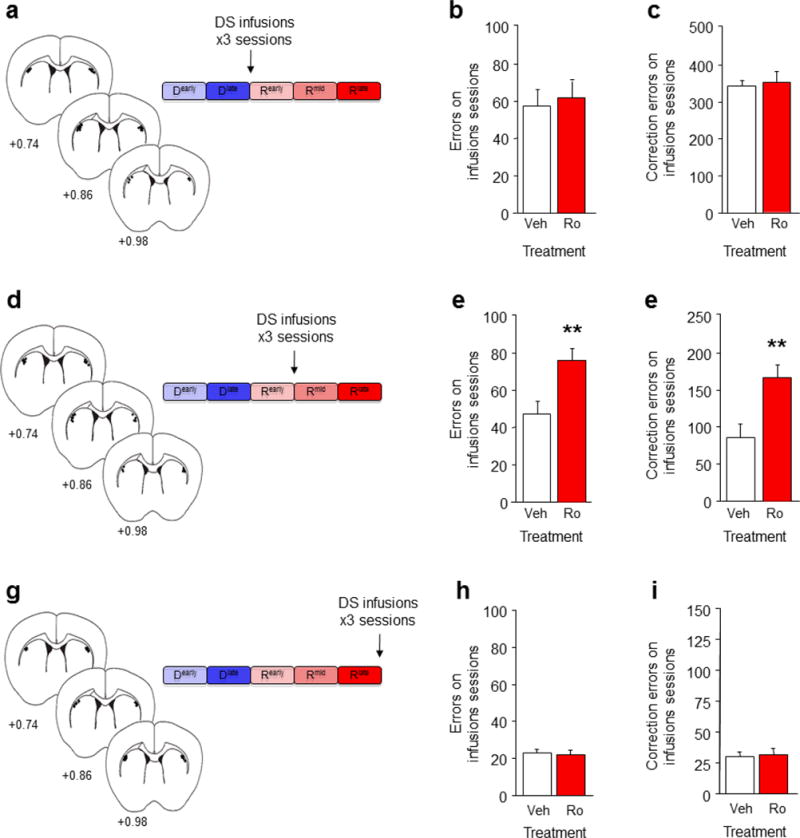
Figure 6. Striatal GluN2B blockade impairs choice learning
(a) Mice were trained to Rearly and given bilateral DS infusions of the GluN2B antagonist Ro 25-6981 on the next 3 sessions. Relative to vehicle infusion, DS GluN2B blockade at the Rearly stage did not affect the number of errors (b) or correction errors (c) made on the 3 infusion sessions. (d) Mice trained to Rmid and given bilateral DS infusions of Ro 25-6981 on the next 3 sessions. DS GluN2B blockade at the Rmid stage increased errors (e) and correction errors (f) on the 3 infusion sessions, relative to vehicle infusion. (g) Mice were trained to Rlate and given bilateral DS infusions of Ro 25-6981 on the next 3 sessions. DS GluN2B blockade at the Rlate stage did not affect the number of errors (h) or correction errors (i) made on the 3 infusion sessions, relative to vehicle infusion. n per treatment: Ro=7, Sal=11. Data are Means±SEM. **P<.01 vs. vehicle.
Figure 7
Figure 7. Cortical GluN2B deletion impairs choice shifting
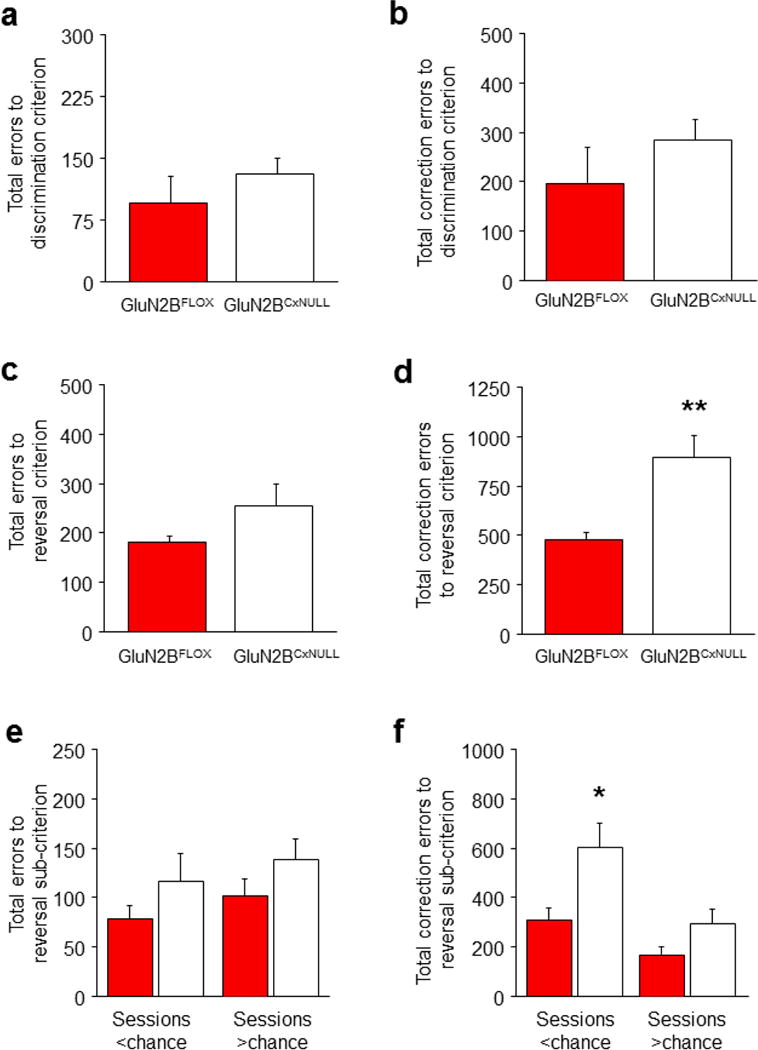
(a) GluN2BCxNULL mice made a similar number of errors (b) and correction errors (c) as GluN2BFLOX controls to attain discrimination criterion. GluN2BCxNULL mice made more errors (d) and correction errors (e) to attain reversal criterion, in comparison to GluN2BFLOX controls. As compared to GluN2BFLOX controls, GluN2BCxNULL mice made a similar number of errors (f) but made more correction errors (g) on reversal sessions on which performance was below chance, but not above chance. n per genotype: GluN2BCxNULL=7, GluN2BFLOX=8. Data are Means±SEM. *P<.05, **P<.01 vs. GluN2BFLOX controls.
Figure 8
Figure 8. Orbitofrontal GluN2B blockade impairs choice shifting
(a) Mice trained to Rearly and given bilateral OFC infusions of the GluN2B antagonist Ro 25-6981 on the next 3 sessions. Relative to vehicle infusion, OFC GluN2B blockade at the Rearly stage did not affect the number of errors (b) but increased correction errors (c) made on the 3 infusion sessions. (d) Mice were trained to Rmid and given bilateral OFC infusions of the GluN2B antagonist Ro 25-6981 on the next 3 sessions. OFC GluN2B blockade at the Rmid stage did not affect errors (e) or correction errors (f) on the 3 infusion sessions, relative to vehicle infusion. n=7-9/treatment. Data are Means±SEM. **P<.01 vs. vehicle.

References

    1. Middleton FA, Strick PL. Basal-ganglia ‘projections’ to the prefrontal cortex of the primate. Cereb Cortex. 2002;12:926–935. - PubMed
    1. Mainen ZF, Kepecs A. Neural representation of behavioral outcomes in the orbitofrontal cortex. Curr Opin Neurobiol. 2009;19:84–91. - PubMed
    1. Schoenbaum G, Roesch MR, Stalnaker TA, Takahashi YK. A new perspective on the role of the orbitofrontal cortex in adaptive behaviour. Nat Rev Neurosci. 2009;10:885–892. - PMC - PubMed
    1. Balleine BW, O’Doherty JP. Human and rodent homologies in action control: corticostriatal determinants of goal-directed and habitual action. Neuropsychopharmacology. 2010;35:48–69. - PMC - PubMed
    1. Montague PR, King-Casas B, Cohen JD. Imaging valuation models in human choice. Annu Rev Neurosci. 2006;29:417–448. - PubMed

Publication types

MeSH terms