


Rhodium-catalyzed boron arylation of 1,2-azaborines
- PMID: 23832871
- PMCID: PMC3809141
- DOI: 10.1002/anie.201304443
Rhodium-catalyzed boron arylation of 1,2-azaborines
Abstract
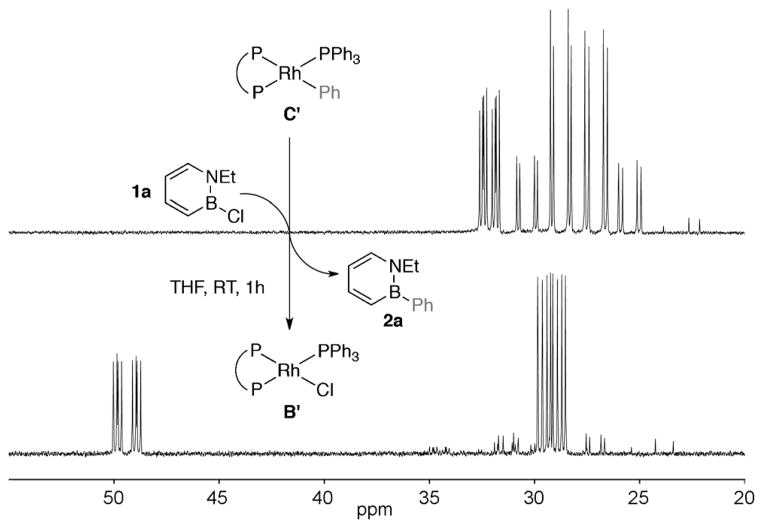
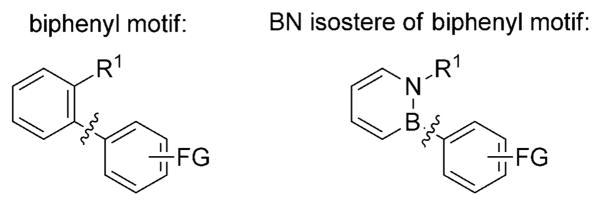
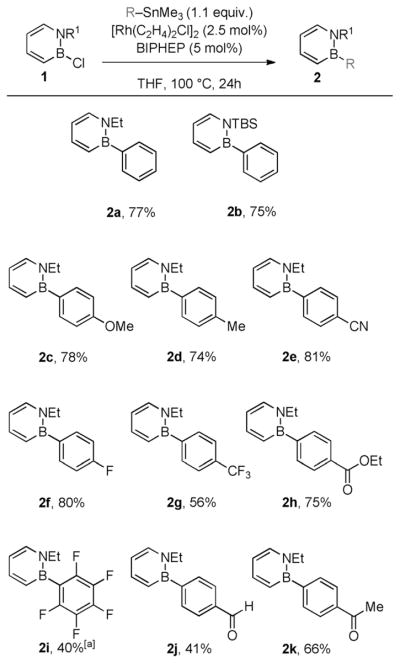
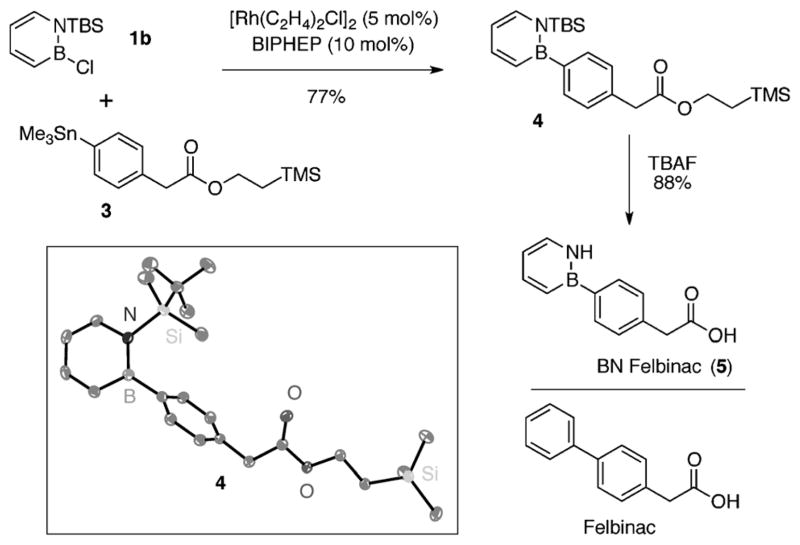
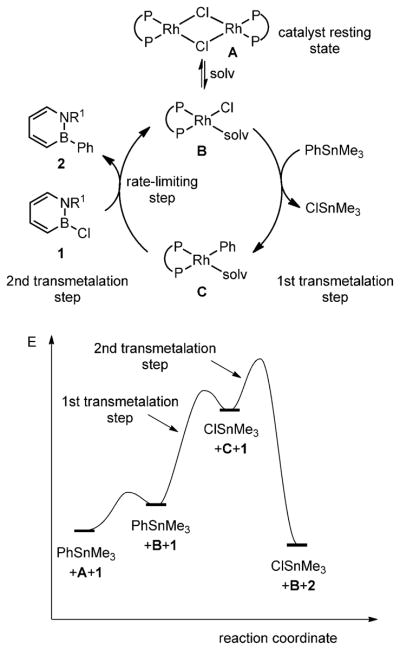
A Sn-phony in B!: BN isosteres of biphenyl compounds are prepared through Rh-catalyzed cross-coupling between 2-chloro-1,2-azaborines and arylstannanes (see scheme). The synthetic method should enable investigations of structure–activity relationships (SARs) by expanding the chemical space of the pharmaceutically relevant biphenyl structure through BN/CC isosterism.
Keywords: azaborines; biphenyl; boron; heterocycles; isosterism.
Figures
References
-
- Horton DA, Bourne GT, Smythe ML. Chem Rev. 2003;103:893–930. - PubMed
-
- Hajduk PJ, Bures M, Praestgaard J, Fesik SW. J Med Chem. 2000;43:3443–3447. - PubMed
-
-
For an overview, see: Campbell PG, Marwitz AJV, Liu SY. Angew Chem. 2012;124:6178–6197.Angew Chem Int Ed. 2012;51:6074–6092.Bosdet MJD, Piers WE. Can J Chem. 2009;87:8–29.Liu Z, Marder TB. Angew Chem. 2008;120:248–250.Angew Chem Int Ed. 2008;47:242–244.
-
-
-
For leading references, see: Hatakeyama T, Hashimoto S, Oba T, Nakamura M. J Am Chem Soc. 2012;134:19600–19603.Hatakeyama T, Hashimoto S, Seki S, Nakamura M. J Am Chem Soc. 2011;133:18614–18617.Wang X-Y, Lin H-R, Lei T, Yang D-C, Zhuang F-D, Wang J-Y, Yuan S-C. J Pei, Angew Chem. 2013;125:3199–3202.Angew Chem Int Ed. 2013;52:3117–3120.Taniguchi T, Yamaguchi S. Organometallics. 2010;29:5732–5735.Brough SA, Lamm AN, Liu SY, Bettinger HF. Angew Chem. 2012;124:11038–11041.Angew Chem Int Ed. 2012;51:10880–10883.Marwitz AJV, Lamm AN, Zakharov LN, Vasiliu M, Dixon DA, Liu SY. Chem Sci. 2012;3:825–829.Chrostowska A, Xu S, Lamm AN, Mazière A, Weber CD, Dargelos A, Baylère P, Graciaa A, Liu SY. J Am Chem Soc. 2012;134:10279–10285.Marwitz AJV, McClintock SP, Zakharov LN, Liu SY. Chem Commun. 2010;46:779–781.Campbell PG, Abbey ER, Neiner D, Grant DJ, Dixon DA, Liu SY. J Am Chem Soc. 2010;132:18048–18050.Lamm AN, Liu SY. Mol BioSyst. 2009;5:1303–1305.
-
-
-
The arene motif is commonly found in biologically active compounds, see: Roughley SD, Jordan AM. J Med Chem. 2011;54:3451–3479.
-
Publication types
MeSH terms
Substances
Grants and funding
LinkOut - more resources
Full Text Sources
Other Literature Sources
Miscellaneous
