Tumor genetic analyses of patients with metastatic melanoma treated with the BRAF inhibitor dabrafenib (GSK2118436)
- PMID: 23833299
- PMCID: PMC3924894
- DOI: 10.1158/1078-0432.CCR-13-0827
Tumor genetic analyses of patients with metastatic melanoma treated with the BRAF inhibitor dabrafenib (GSK2118436)
Abstract
Purpose: Dabrafenib is a selective inhibitor of V600-mutant BRAF kinase, which recently showed improved progression-free survival (PFS) as compared with dacarbazine, in metastatic melanoma patients. This study examined potential genetic markers associated with response and PFS in the phase I study of dabrafenib.
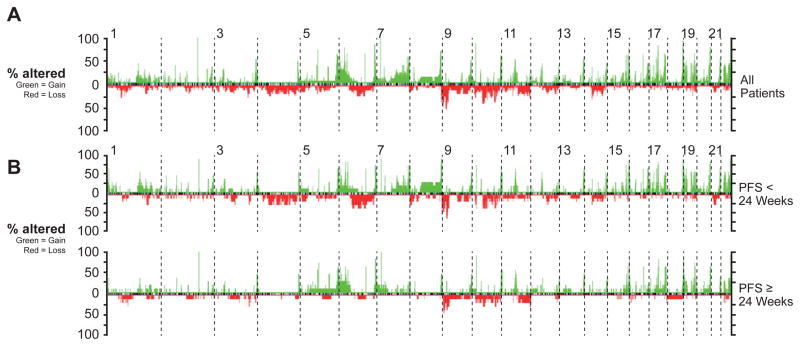
Experimental design: Baseline (pretreatment or archival) melanoma samples were evaluated in 41 patients using a custom genotyping melanoma-specific assay, sequencing of PTEN, and copy number analysis using multiplex ligation amplification and array-based comparative genomic hybridization. Nine patients had on-treatment and/or progression samples available.
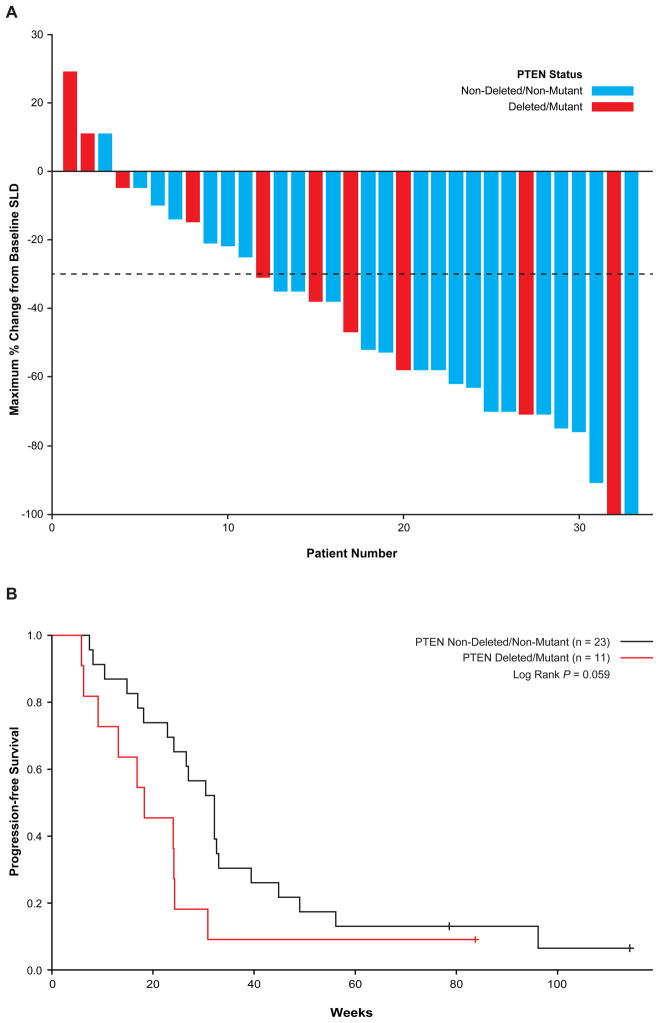
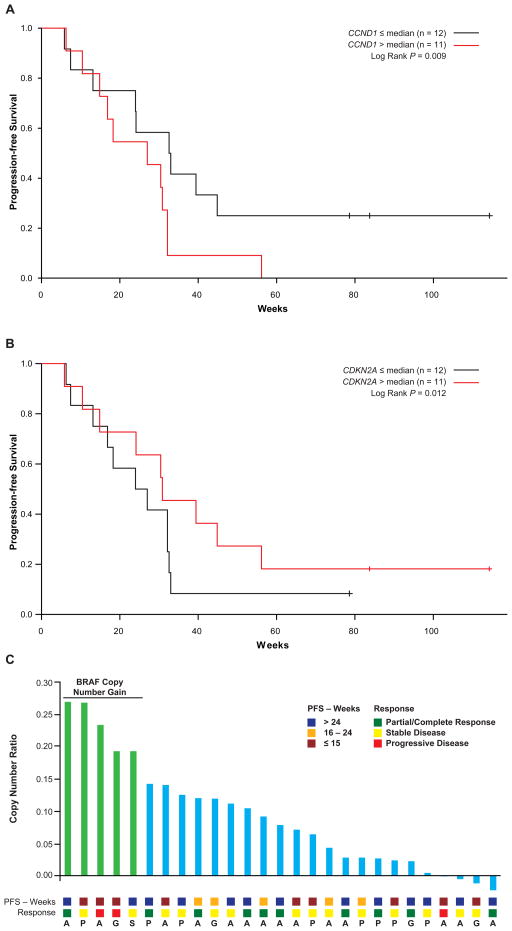
Results: All baseline patient samples had BRAF(V600E/K) confirmed. Baseline PTEN loss/mutation was not associated with best overall response to dabrafenib, but it showed a trend for shorter median PFS [18.3 (95% confidence interval, CI, 9.1-24.3) vs. 32.1 weeks (95% CI, 24.1-33), P=0.059]. Higher copy number of CCND1 (P=0.009) and lower copy number of CDKN2A (P=0.012) at baseline were significantly associated with decreased PFS. Although no melanomas had high-level amplification of BRAF, the two patients with progressive disease as their best response had BRAF copy gain in their tumors.
Conclusions: Copy number changes in CDKN2A, CCND1, and mutation/copy number changes in PTEN correlated with the duration of PFS in patients treated with dabrafenib. The results suggest that these markers should be considered in the design and interpretation of future trials with selective BRAF inhibitors in advanced melanoma patients.
©2013 AACR.
Conflict of interest statement
Conflicts of interest: KLN, SO’D and H-TA have received research funding from GlaxoSmithKline; A-MM, JG, RG, BM and MC are employees of, and have stock ownership of, GlaxoSmithKline; BW, RL, KD’A and AP have no conflicts of interest to declare; JRI has acted as an uncompensated consultant or advisor for GlaxoSmithKline; GSF has received research funding and other remuneration from GlaxoSmithKline; MM has acted as a compensated consultant or advisor for GlaxoSmithKline; MPB has acted as a compensated consultant or advisor for, and has received research funding from, GlaxoSmithKline; MAD has served on advisory boards for GlaxoSmithKline, Genentech and Novartis, and has received research funding from GlaxoSmithKline, Genentech, AstraZeneca, Merck, Myriad and Oncothyreon; PFL was an employee of GlaxoSmithKline; RK has acted as a compensated consultant or advisor for GlaxoSmithKline; GVL has acted as a compensated consultant or advisor for GlaxoSmithKline, Roche, Novartis, Amgen and Bristol-Myers Squibb, and has received honoraria from Roche.
Figures
References
-
- Howlader N, Noone AM, Krapcho M, Neyman N, Aminou R, Altekruse SF, et al. SEER Cancer Statistics Review, 1975–2009 (Vintage 2009 Populations) 2012. Bethesda, MD: National Cancer Institute; 2012. based on November 2011 SEER data submission, posted to the SEER web site.
-
- Long GV, Menzies AM, Nagrial AM, Haydu LE, Hamilton AL, Mann GJ, et al. Prognostic and clinicopathologic associations of oncogenic BRAF in metastatic melanoma. J Clin Oncol. 2011;29:1239–46. - PubMed
Publication types
MeSH terms
Substances
Grants and funding
LinkOut - more resources
Full Text Sources
Other Literature Sources
Medical
Research Materials
Miscellaneous