


Identifying patients' beliefs about treatments for chronic low back pain in primary care: a focus group study
- PMID: 23834886
- PMCID: PMC3693806
- DOI: 10.3399/bjgp13X669211
Identifying patients' beliefs about treatments for chronic low back pain in primary care: a focus group study
Abstract
Background: Current evidence-based guidelines for low back pain (LBP) recommend multiple diverse approaches to treatment and suggest considering patient preferences when formulating a treatment plan.
Aim: To explore patient preferences and to identify patients' beliefs about LBP treatments.
Design and setting: Qualitative study using focus groups in primary care in South-West England.
Method: Thirteen focus groups were organised with a purposive sample of 75 adults with LBP. Group discussions of LBP treatments were facilitated, audiorecorded, and the verbatim transcripts thematically analysed.
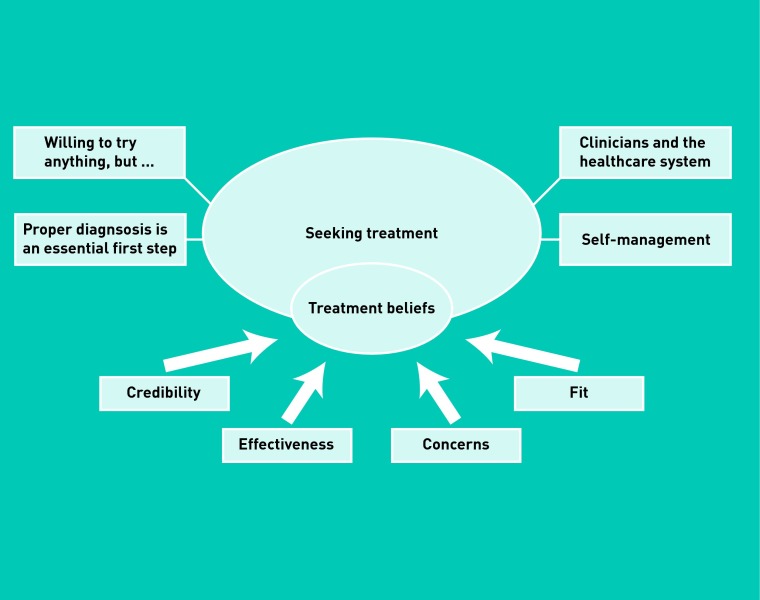
Results: Eight themes were identified, four related to treatment beliefs and four to seeking treatment. Treatment beliefs comprised participants' expectations and appraisals of specific treatments, which were underpinned by four distinct dimensions: credibility, effectiveness, concerns and individual fit. Treatment beliefs were expressed in the broader context of treatment seeking: participants' primary concern was to obtain a clear explanation of their LBP which went beyond a diagnostic label and provided an understanding of the cause(s) of their LBP. They described engaging in self-management activities and claimed they were willing to try anything if it might help them. Participants wanted an empathic and expert practitioner who could deliver a suitable treatment (or refer them on to someone else) and help them to negotiate the challenges of the healthcare system.
Conclusion: These findings highlight the importance of helping patients develop coherent illness representations about their LBP before trying to engage them in treatment-decisions, uptake, or adherence. Addressing patients' illness and treatment perceptions in clinical practice could improve shared decision making and patient outcomes.
Figures
References
-
- Balagué F, Mannion AF, Pellisé F, Cedraschi C. Non-specific low back pain. Lancet. 2012;379(9814):482–491. - PubMed
-
- Breivik H, Collett B, Ventafridda V, et al. Survey of chronic pain in Europe: Prevalence, impact on daily life, and treatment. Eur J Pain. 2006;10(4):287–333. - PubMed
-
- Maniadakis N, Gray A. The economic burden of back pain in the UK. Pain. 2000;84(1):95–103. - PubMed
-
- Savigny P, Kuntze S, Watson P, et al. Low back pain Early management of persistent non-specific low back pain. London: NICE; 2009. NICE clinical guideline 88. http://www.nice.org.uk/nicemedia/live/11887/44343/44343.pdf (accessed 23 May 2013). - PubMed
-
- Chou R, Qaseem A, Snow V, et al. Diagnosis and treatment of low back pain: a joint clinical practice guideline from the American College of Physicians and the American Pain Society. Ann Intern Med. 2007;147(7):478–491. - PubMed
Publication types
MeSH terms
Grants and funding
LinkOut - more resources
Full Text Sources
Other Literature Sources
Medical
Miscellaneous
