


Platform engineering of Corynebacterium glutamicum with reduced pyruvate dehydrogenase complex activity for improved production of L-lysine, L-valine, and 2-ketoisovalerate
- PMID: 23835179
- PMCID: PMC3754147
- DOI: 10.1128/AEM.01741-13
Platform engineering of Corynebacterium glutamicum with reduced pyruvate dehydrogenase complex activity for improved production of L-lysine, L-valine, and 2-ketoisovalerate
Abstract
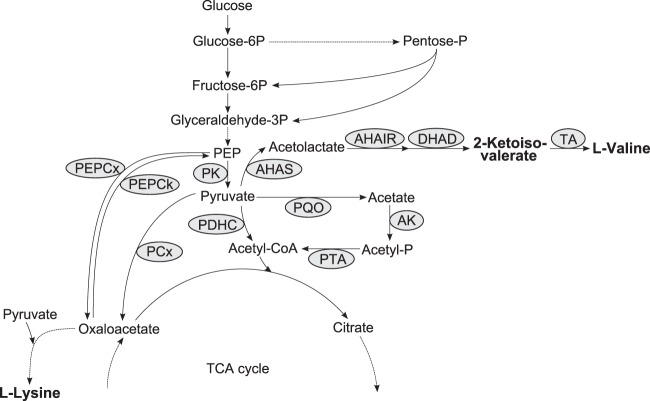
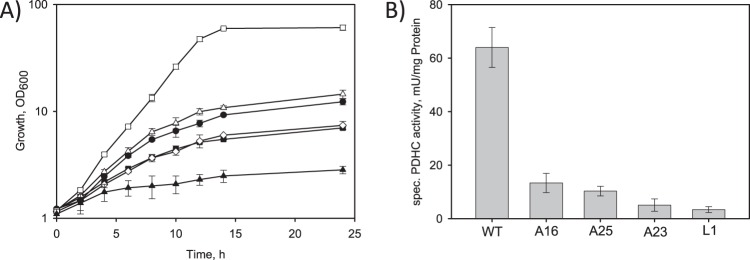
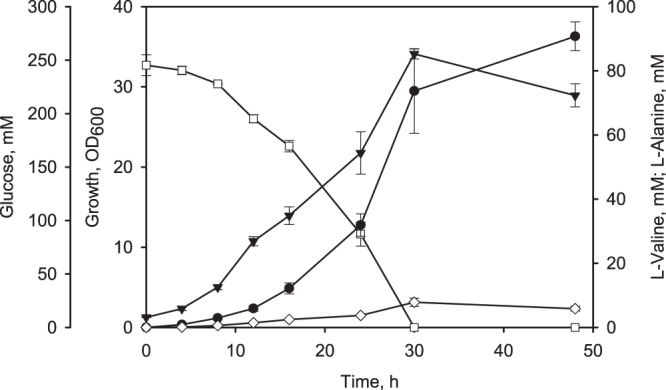
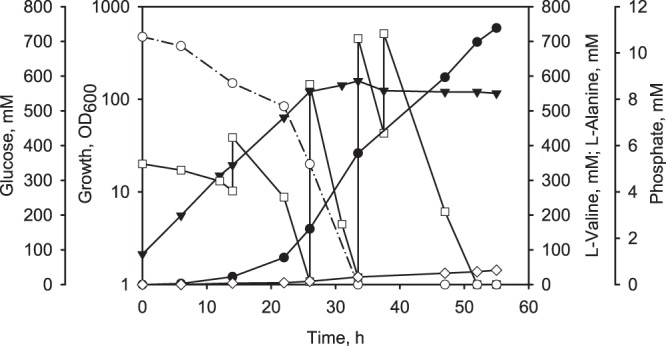
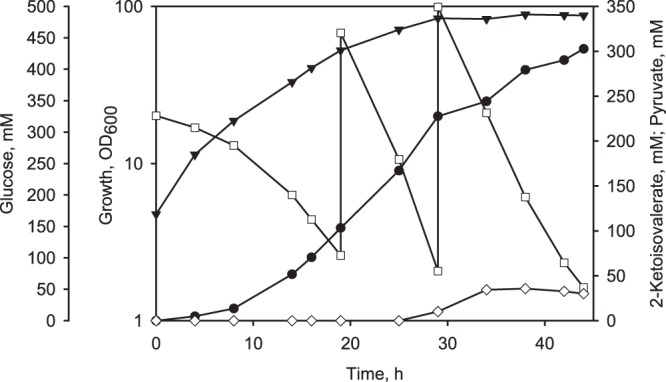
Exchange of the native Corynebacterium glutamicum promoter of the aceE gene, encoding the E1p subunit of the pyruvate dehydrogenase complex (PDHC), with mutated dapA promoter variants led to a series of C. glutamicum strains with gradually reduced growth rates and PDHC activities. Upon overexpression of the l-valine biosynthetic genes ilvBNCE, all strains produced l-valine. Among these strains, C. glutamicum aceE A16 (pJC4 ilvBNCE) showed the highest biomass and product yields, and thus it was further improved by additional deletion of the pqo and ppc genes, encoding pyruvate:quinone oxidoreductase and phosphoenolpyruvate carboxylase, respectively. In fed-batch fermentations at high cell densities, C. glutamicum aceE A16 Δpqo Δppc (pJC4 ilvBNCE) produced up to 738 mM (i.e., 86.5 g/liter) l-valine with an overall yield (YP/S) of 0.36 mol per mol of glucose and a volumetric productivity (QP) of 13.6 mM per h [1.6 g/(liter × h)]. Additional inactivation of the transaminase B gene (ilvE) and overexpression of ilvBNCD instead of ilvBNCE transformed the l-valine-producing strain into a 2-ketoisovalerate producer, excreting up to 303 mM (35 g/liter) 2-ketoisovalerate with a YP/S of 0.24 mol per mol of glucose and a QP of 6.9 mM per h [0.8 g/(liter × h)]. The replacement of the aceE promoter by the dapA-A16 promoter in the two C. glutamicum l-lysine producers DM1800 and DM1933 improved the production by 100% and 44%, respectively. These results demonstrate that C. glutamicum strains with reduced PDHC activity are an excellent platform for the production of pyruvate-derived products.
Figures
References
-
- Leuchtenberger W, Huthmacher K, Drauz K. 2005. Biotechnological production of amino acids and derivates: current status and prospects. Appl. Microbiol. Biotechnol. 69:1–8 - PubMed
-
- Liebl W. 1991. The genus Corynebacterium—nonmedical, p 1157–1171 In Balows A, Trüper HG, Dworkin M, Harder W, Schleifer KH. (ed), The prokaryotes, vol 2 Springer, New York, NY
-
- Nishimura T, Vertès AA, Shinoda Y, Inui M, Yukawa H. 2007. Anaerobic growth of Corynebacterium glutamicum using nitrate as a terminal electron acceptor. Appl. Microbiol. Biotechnol. 75:889–897 - PubMed
-
- Takors R, Bathe B, Rieping M, Hans S, Kelle R, Huthmacher K. 2007. Systems biology for industrial strains and fermentation processes—example: amino acids. J. Biotechnol. 129:181–190 - PubMed
-
- Kind S, Jeong WK, Schröder H, Wittmann C. 2010. Sytems-wide metabolic pathway engineering in Corynebacterium glutamicum for bio-based production of diaminopentane. Metab. Eng. 12:341–351 - PubMed
Publication types
MeSH terms
Substances
LinkOut - more resources
Full Text Sources
Other Literature Sources
Molecular Biology Databases
