. 2013 Aug;23(8):986-93.
doi: 10.1038/cr.2013.92. Epub 2013 Jul 9.

Structure of MERS-CoV spike receptor-binding domain complexed with human receptor DPP4

Affiliations

Structure of MERS-CoV spike receptor-binding domain complexed with human receptor DPP4

Nianshuang Wang et al. Cell Res. 2013 Aug.

Abstract

The spike glycoprotein (S) of recently identified Middle East respiratory syndrome coronavirus (MERS-CoV) targets the cellular receptor, dipeptidyl peptidase 4 (DPP4). Sequence comparison and modeling analysis have revealed a putative receptor-binding domain (RBD) on the viral spike, which mediates this interaction. We report the 3.0 Å-resolution crystal structure of MERS-CoV RBD bound to the extracellular domain of human DPP4. Our results show that MERS-CoV RBD consists of a core and a receptor-binding subdomain. The receptor-binding subdomain interacts with DPP4 β-propeller but not its intrinsic hydrolase domain. MERS-CoV RBD and related SARS-CoV RBD share a high degree of structural similarity in their core subdomains, but are notably divergent in the receptor-binding subdomain. Mutagenesis studies have identified several key residues in the receptor-binding subdomain that are critical for viral binding to DPP4 and entry into the target cell. The atomic details at the interface between MERS-CoV RBD and DPP4 provide structural understanding of the virus and receptor interaction, which can guide development of therapeutics and vaccines against MERS-CoV infection.


Figures
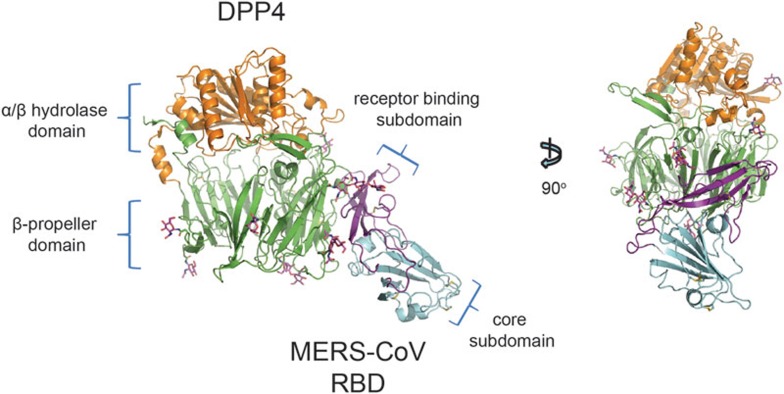
Figure 1
Figure 1
Overall structure of the complex. DPP4 extracellular domain consists of N-terminal eight-bladed β-propeller domain (green) and C-terminal α/β-hydrolase domain (orange). MERS-CoV RBD contains a core (cyan) and a receptor-binding subdomain (purple). The disulfide bonds are drawn as yellow sticks and the N-linked glycans are drawn as pink sticks.
Figure 2
Figure 2
Structural comparison between MERS-CoV RBD and SARS-CoV RBD. Domain structures of MERS-CoV S1 (A) and of SARS-CoV S1 (B). (C) Structure of MERS-CoV RBD. The receptor-binding subdomain is colored in purple and the core subdomain is colored in cyan. (D) Structure of SARS-CoV RBD (PDB code 2AJF). The receptor-binding subdomain is colored in purple and the core subdomain is colored in wheat. (E) Schematic illustration of MERS-CoV RBD topology. β strands are drawn as arrows and α helices are drawn as cylinders. The disulfide bonds are drawn as yellow sticks. (F) Schematic illustration of SARS-CoV RBD topology. β strands are drawn as arrows and α helices are drawn as cylinders. The disulfide bonds are drawn as yellow sticks.
Figure 3
Figure 3
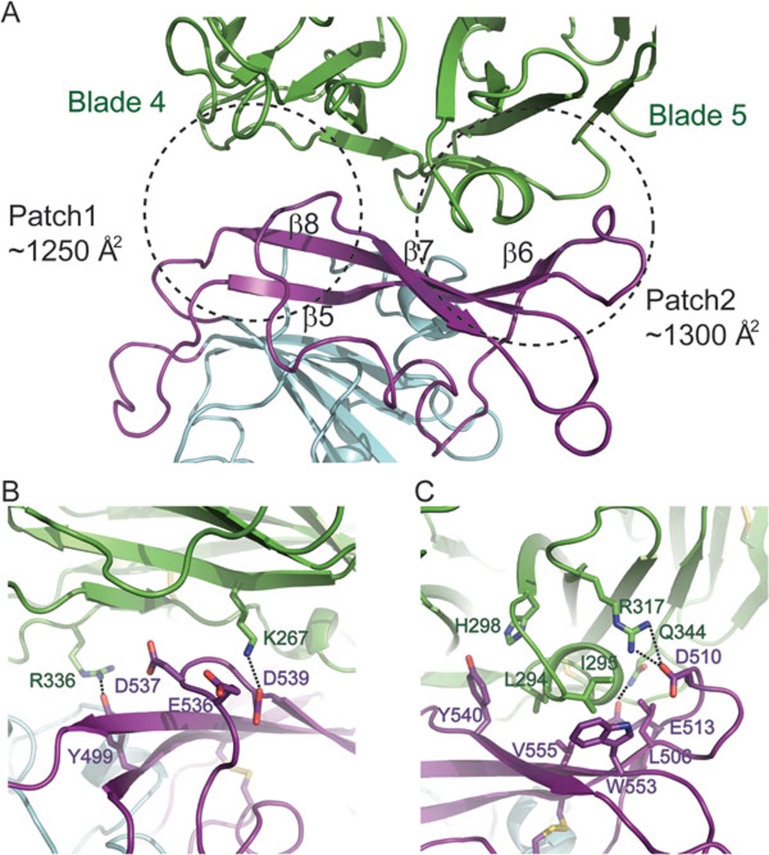
Binding interface. (A) DPP4 contacts the MERS-CoV RBD with its blades 4 and 5 in the N-terminal eight-bladed β-propeller domain. Patch 1 is centered around the C-terminal end of the long linker connecting β6 and β7 strands in MERS-CoV RBD. Patch 2 has a gently concaved outer surface in MERS-CoV RBD that contacts a linker containing a short α helix between blades 4 and 5 of DPP4. Amino acid interactions in patch 1 (B), and in patch 2 (C).
Figure 4
Figure 4
Effect of residue substitution on MERS-CoV RBD binding to DPP4 (A) and entry efficiency of pseudotyped viruses (B). (A) SDS-PAGE analysis of co-purified complexes of wild-type or mutant forms of His-tagged RBD and untagged DPP4. The actual residue changes in the RBD are indicated above each lane. The DPP4 untagged serves as a negative control to exclude nonspecific binding of untagged DPP4 with Ni-NTA resin. (B) Entry efficiency of pseudotyped viruses bearing the wild-type and mutant forms of viral spike glycoprotein. The percentage of entry efficiency was calculated on the basis of luciferase activity of mutant viruses versus that of the wild-type virus. Soluble RBD (∼150 μg/ml) and DPP4 (∼150 μg/ml) were also tested for their inhibitory activity against wild-type virus. One irrelevant soluble protein with the same concentration was used as a negative control. Error bars represent SD of two replicate experiments.

Comment in

  • Spiking the MERS-coronavirus receptor.
    Bosch BJ, Raj VS, Haagmans BL. Bosch BJ, et al. Cell Res. 2013 Sep;23(9):1069-70. doi: 10.1038/cr.2013.108. Epub 2013 Aug 13. Cell Res. 2013. PMID: 23938293 Free PMC article.

References

    1. Bermingham A, Chand MA, Brown CS, et al. Severe respiratory illness caused by a novel coronavirus, in a patient transferred to the United Kingdom from the Middle East, September 2012. Euro Surveill. 2012;17:20290. - PubMed
    1. Zaki AM, van Boheemen S, Bestebroer TM, Osterhaus AD, Fouchier RA. Isolation of a novel coronavirus from a man with pneumonia in Saudi Arabia. N Engl J Med. 2012;367:1814–1820. - PubMed
    1. de Groot RJ, Baker SC, Baric RS, et al. Middle East Respiratory Syndrome Coronavirus (MERS-CoV); Announcement of the Coronavirus Study Group. J Virol. 2013;87:7790–7792. - PMC - PubMed
    1. WHO. World Health Organization Global alert and response; Coronavirus infections. Available from: http://www.who.int/csr/disease/coronavirus_infections/en/
    1. Chan JF, Li KS, To KK, Cheng VC, Chen H, Yuen KY. Is the discovery of the novel human betacoronavirus 2c EMC/2012 (HCoV-EMC) the beginning of another SARS-like pandemic. J Infect. 2012;65:477–489. - PMC - PubMed

Publication types

Associated data