


doi: 10.1038/psp.2013.6.
Modeling and simulation as a tool to bridge efficacy and safety data in special populations
Affiliations
- PMID: 23835939
- PMCID: PMC3600759
- DOI: 10.1038/psp.2013.6
Item in Clipboard
Modeling and simulation as a tool to bridge efficacy and safety data in special populations
CPT Pharmacometrics Syst Pharmacol.
.
Abstract
The registration and approval of novel medicines have traditionally been based on evidence arising from large prospective trials. Such an approach is often not possible or unsuitable to evaluate the benefit-risk balance in special populations (e.g., children, ethnic groups, rare diseases). Inferences by modeling and simulation can play a major role in evidence synthesis. A framework is proposed that promotes its acceptability and the basis for decision making during development, registration, and therapeutic use of drugs.CPT: Pharmacometrics & Systems Pharmacology (2013) 2, e28; doi:10.1038/psp.2013.6; advance online publication 27 February 2013.
Figures
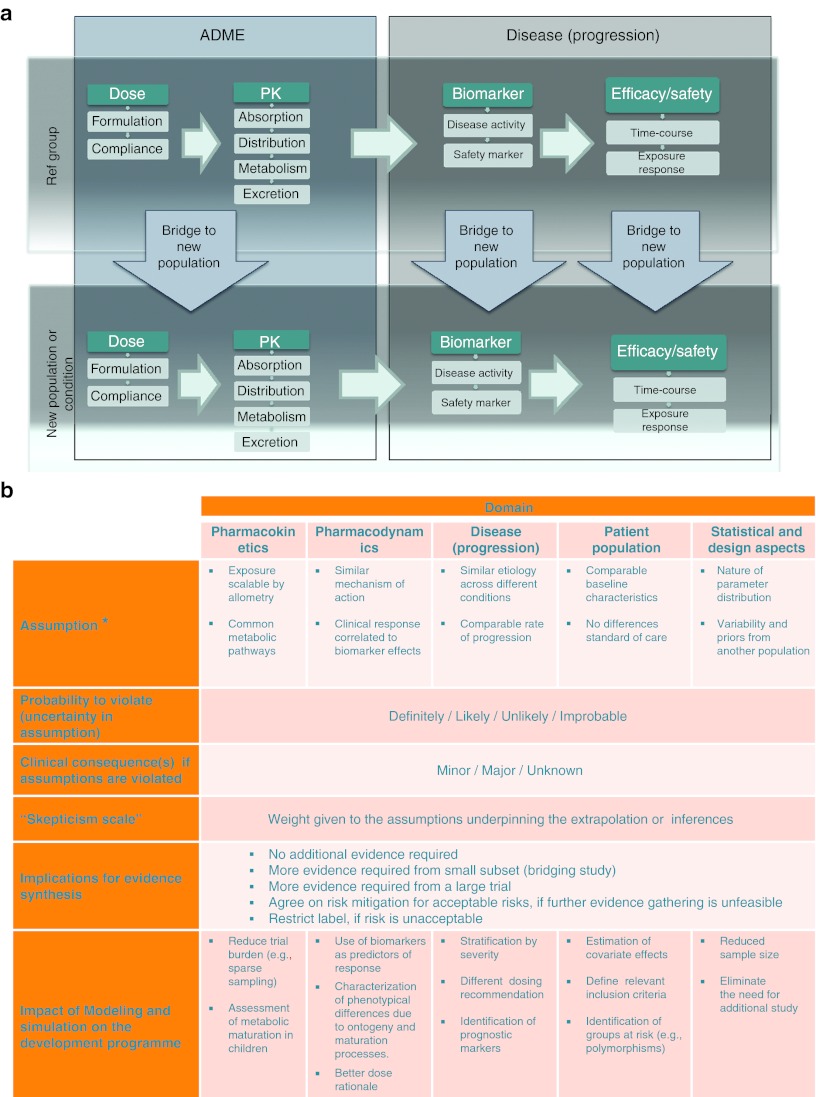
(a) Schematic diagram for translating, extrapolating and bridging findings within (horizontal axes) and across (vertical axes) populations. The diagram depicts the evidence required as well as the assumption building process for assessing the differences and similarities in clinical, biological, pharmacological, and pharmaceutical, substrates which should be considered and presented in a systematic manner. Each arrow represents a different step in the translation, extrapolation, or bridging of available evidence. The validity of such an inferential exercise as well as the decision on the need for additional evidence is substantiated by the criteria presented in the framework shown in b. (b) Framework for evidence synthesis by modeling and simulation. The less evidence is available or generated, the higher the implications of inferences by modeling and simulation. Implementation of a model-based approach requires a clear description of the risk and corresponding clinical consequences, including mitigation measures. Assumptions required for inferential purposes should be characterized into at least five categories: pharmacokinetics, pharmacodynamics, disease, population characteristics, and design factors. Of importance is the possibility to assess risk as the probability of an assumption being violated (i.e., from unlikely to definitely) and the clinical consequences associated with such violation (i.e., from minor to major). *Exemplified for comparison of new vs. reference population.
References
-
- Cella M., Gorter de Vries F., Burger D., Danhof M., &, Della Pasqua O. A model-based approach to dose selection in early pediatric development. Clin. Pharmacol. Ther. 2010;87:294–302. - PubMed
-
- Yuen E., Gueorguieva I., Wise S., Soon D., &, Aarons L. Ethnic differences in the population pharmacokinetics and pharmacodynamics of warfarin. J. Pharmacokinet. Pharmacodyn. 2010;37:3–24. - PubMed
LinkOut - more resources
Full Text Sources
Other Literature Sources
Miscellaneous
