Randomized Controlled Trial
. 2013 Nov;9(11):2409-17.
doi: 10.4161/hv.25610. Epub 2013 Jul 9.

Rotavirus specific plasma secretory immunoglobulin in children with acute gastroenteritis and children vaccinated with an attenuated human rotavirus vaccine

Affiliations
Randomized Controlled Trial

Rotavirus specific plasma secretory immunoglobulin in children with acute gastroenteritis and children vaccinated with an attenuated human rotavirus vaccine

Daniel Herrera et al. Hum Vaccin Immunother. 2013 Nov.

Abstract

Rotavirus (RV)-specific secretory immunoglobulin (RV-SIg) has been previously detected in serum of naturally RV infected children and shown to reflect the intestinal Ig immune response. Total plasma SIgA and plasma RV-SIg were evaluated by ELISA in children with gastroenteritis due or not due to RV infection and in 50 children vaccinated with the attenuated RIX4414 human RV vaccine and 62 placebo recipients. RV-SIg was only detected in children with evidence of previous RV infection or with acute RV gastroenteritis. Vaccinees had higher RV-SIg titers than placebo recipients and RV-SIg titers increased after the second vaccine dose. RV-SIg measured after the second dose correlated with protection when vaccinees and placebo recipients were analyzed jointly. RV-SIg may serve as a valuable correlate of protection for RV vaccines.

Keywords: correlate of protection; rotavirus; secretory immunoglobulin; vaccine.


Figures
None
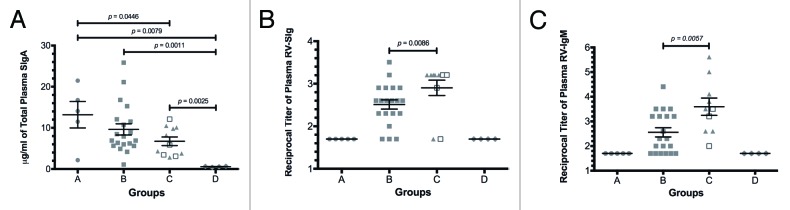
Figure 1. Total plasma SIgA, RV-SIg and RV-IgM in children with acute GE. (A)The concentration of SIgA for each sample was determined based on a standard curve of plasma with a known SIgA concentration (14.6 μg/ml). The limit of detection was 4.8 ng/ml. (B) and (C) The reported values correspond to the log10 of the inverse titer measured by ELISA. The plasma RV-IgM for groups A and D is below the limit of detection. Lines and error bars denote the mean and SEM, respectively. Differences between groups were evaluated with the nonparametric Mann–Whitney test and all p values reported are 1-tailed. Groups of children: Group A: RV-IgA-, RV-GE-; group B: RV-IgA+, RV-GE-; group C: RV-IgA- (triangles) and RV-IgA+ (open squares) RV-GE+ and group D: umbilical cord blood samples taken from healthy full-term newborn infants.
None
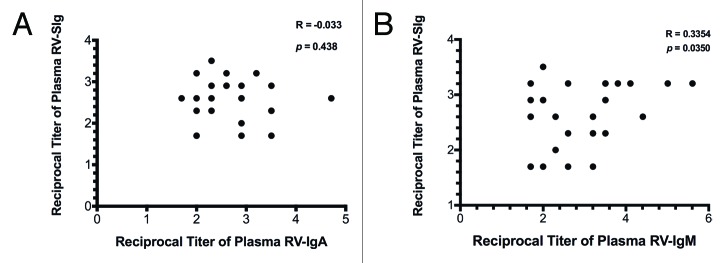
Figure 2. Correlations of RV-SIg with RV-IgA and RV-IgM. (A) Correlation (Spearman one-tailed test) between plasma RV-SIg and plasma RV-IgA titers of children from group B (RV-IgA+, RV-GE-) and children from group C with secondary infection (RV-IgA+, RV-GE+) analyzed jointly. (B) Correlation (Spearman one-tailed test) between plasma RV-SIg and plasma RV-IgM titers of children from groups B and C analyzed jointly.
None
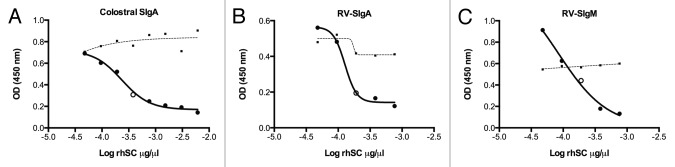
Figure 3. Effect of competing rhSC on measurement of purified colostral SIgA and RV-SIg. Reported values are optical density units (OD, 450 nm) (Y axis) and the log10 of the rhSC concentration in μg/μl (X Axis) used to compete the binding of: (A) purified colostral SIgA (0.076 μg/ml); (B) a plasma sample from a child in which RV-SIg was presumably only RV-SIgA (RV-IgA+, RV-IgM-); and (C) a plasma sample from a child in which RV-SIg was presumably only RV-SIgM (RV-IgA-, RV-IgM+). Open dots in graphics show the concentration of rhSC inducing approximately 50% of inhibition and the dashed lines correspond to the signal observed when samples were competed with albumin at the same concentrations as for rhSC.
None
Figure 4. Total plasma SIgA and RV-SIg in vaccinees and placebo recipients. Data for 50 vaccinees and 62 placebo recipients after dose 1 (D1) or dose 2 (D2) are shown. Lines and error bars denote the mean and SEM, respectively. Differences between vaccinees and placebo recipients, as well as between protected and non-protected children, were evaluated with the Mann–Whitney test and between vaccinees after D1 and D2 with the Wilcoxon test. All p values reported are 1-tailed. (A) The reported values correspond to μg/ml interpolated from a plasma pool with a known SIgA concentration (14.6 μg/ml). (B and C) The reported values correspond to the log10 of the inverse titer measured by ELISA.

References

    1. Tate JE, Burton AH, Boschi-Pinto C, Steele AD, Duque J, Parashar UD, WHO-coordinated Global Rotavirus Surveillance Network 2008 estimate of worldwide rotavirus-associated mortality in children younger than 5 years before the introduction of universal rotavirus vaccination programmes: a systematic review and meta-analysis. Lancet Infect Dis. 2012;12:136–41. doi: 10.1016/S1473-3099(11)70253-5. - DOI - PubMed
    1. WHO Meeting of the Strategic Advisory Group of Experts on immunization, October 2009--Conclusions and recommendations. Biologicals. 2010;38:170–7. doi: 10.1016/j.biologicals.2009.12.007. - DOI - PubMed
    1. Patel MM, Steele D, Gentsch JR, Wecker J, Glass RI, Parashar UD. Real-world impact of rotavirus vaccination. Pediatr Infect Dis J. 2011;30(Suppl):S1–5. doi: 10.1097/INF.0b013e3181fefa1f. - DOI - PubMed
    1. Patel M, Shane AL, Parashar UD, Jiang B, Gentsch JR, Glass RI. Oral rotavirus vaccines: how well will they work where they are needed most? J Infect Dis. 2009;200(Suppl 1):S39–48. doi: 10.1086/605035. - DOI - PMC - PubMed
    1. Angel J, Franco MA, Greenberg HB. Rotavirus immune responses and correlates of protection. Curr Opin Virol. 2012;2:419–25. doi: 10.1016/j.coviro.2012.05.003. - DOI - PMC - PubMed

Publication types