. 2014 Mar;22(3):705-12.
doi: 10.1002/oby.20559. Epub 2013 Dec 2.

Increased HO-1 levels ameliorate fatty liver development through a reduction of heme and recruitment of FGF21

Affiliations

Increased HO-1 levels ameliorate fatty liver development through a reduction of heme and recruitment of FGF21

Terry D Hinds Jr et al. Obesity (Silver Spring). 2014 Mar.

Retraction in

  • Retraction.
    [No authors listed] [No authors listed] Obesity (Silver Spring). 2023 Apr;31(4):1170. doi: 10.1002/oby.23735. Epub 2023 Feb 27. Obesity (Silver Spring). 2023. PMID: 36849874 Free PMC article.

Abstract

Objective: Obese leptin deficient (ob/ob) mice are a model of adiposity that displays increased levels of fat, glucose, and liver lipids. Our hypothesis is that HO-1 overexpression ameliorates fatty liver development.

Methods: Obese mice were administered cobalt protoporphyrin (CoPP) and stannic mesoporphyrin (SnMP) for 6 weeks. Heme, HO-1, HO activity, PGC1α, FGF21, glycogen content, and lipogenesis were assessed.

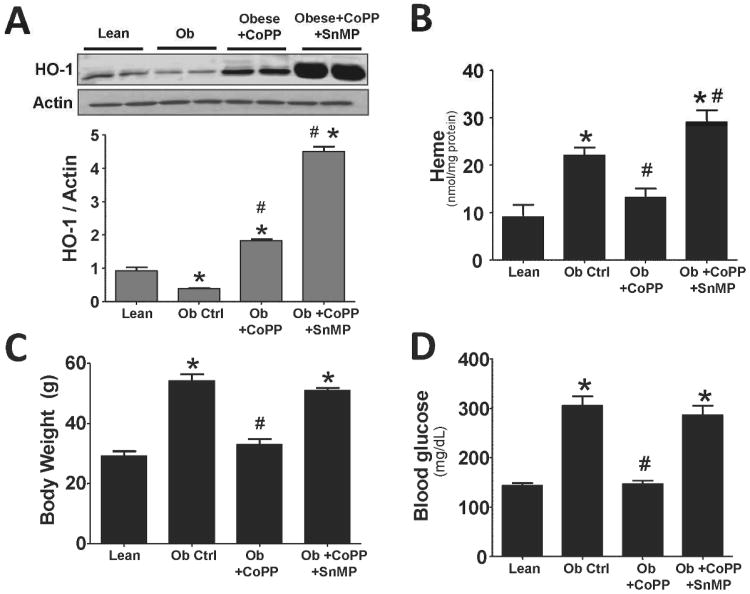
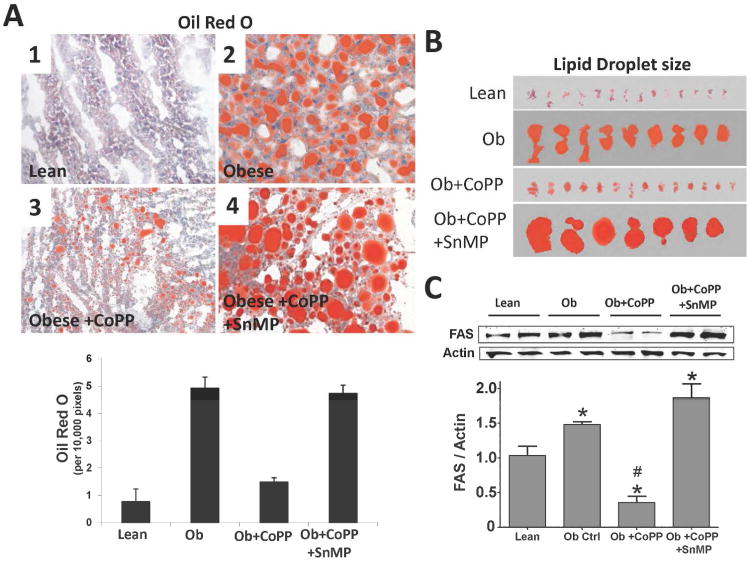
Results: CoPP administration increased hepatic HO-1 protein levels and HO activity, decreased hepatic heme, body weight gain, glucose levels, and resulted in decreased steatosis. Increased levels of HO-1 produced a decrease in lipid droplet size, Fatty acid synthase (FAS) levels involving recruitment of FGF21, PPARα, and Glut 1. These beneficial effects were reversed by inhibition of HO activity.

Conclusion: Increased levels of HO-1 and HO activity reduced the levels of obesity by reducing hepatic heme and lipid accumulation. These changes were manifested by decreases in cellular heme, increases in FGF21, glycogen content, and fatty liver. The beneficial effect of HO-1 induction results from an increase in PPARα and FGF21 levels and a decrease in PGC1α, levels they were reversed by SnMP. Low levels of HO-1 and HO activity are responsible for fatty liver.


Conflict of interest statement

Conflict Of Interest/Disclosure: The authors declared no conflict of interest.

Figures

Figure 1
Figure 1
A) Western blot and densitometry analyses of liver HO-1 and actin; B) measurement of Heme levels in liver; C) body weight; and D) blood glucose in lean, obese control, obese treated with CoPP, and obese treated with CoPP and SnMP. Values represent means ± SEM of five independent treatments. *, P < 0.05 vs. lean or #, P < 0.05 vs. obese control.
Figure 2
Figure 2
A) Oil Red O staining of lipids in liver and quantitative analysis of lean (1), obese control (2), obese treated with CoPP (3), and obese treated with CoPP and SnMP(4), magnifications: 40× (n=3). A representative section for each group is shown; B) lipid droplet size from Oil Red O stained livers; and C) Western blot and densitometry analyses of liver fatty acid synthase (FAS) and actin in lean, obese control, obese treated with CoPP, and obese treated with CoPP and SnMP. Values represent means ± SEM of five independent treatments. *, P < 0.05 vs. lean or #, P < 0.05 vs. obese control.
Figure 3
Figure 3
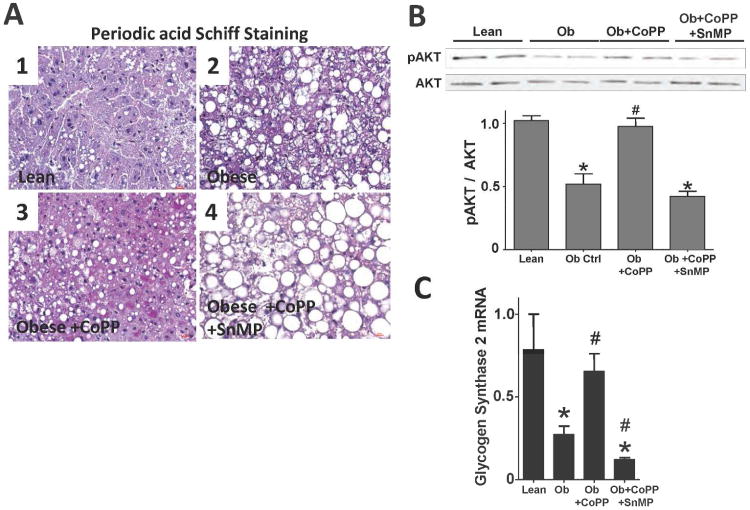
A) Periodic acid Schiff staining of glycogen in liver of lean (1), obese control (2), obese treated with CoPP (3), and obese treated with CoPP and SnMP(4), magnifications: 40× (n=3). A representative section for each group is shown; B) Western blot and densitometry analyses of AKT phosphorylation (pAKT) and total AKT (AKT) (n=4); and C) Real-time PCR of glycogen synthase 2 (GS2) expression in lean, obese control, obese treated with CoPP, and obese treated with CoPP and SnMP. Values represent means ± SEM of five independent treatments. *, P < 0.05 vs. lean or #, P < 0.05 vs. obese control.
Figure 4
Figure 4
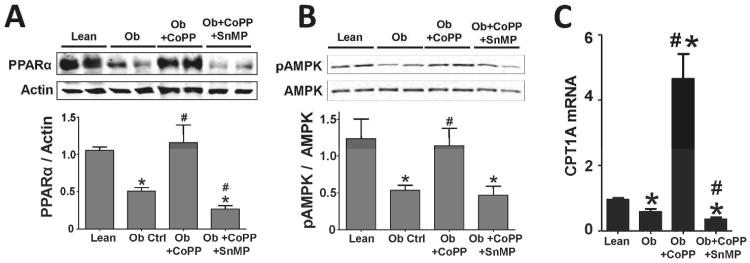
Western blot and densitometry analyses of A) PPARα and actin (n=4); and B) AMPK phosphorylation (pAMPK) and total AMPK (AMPK) (n=4) in lean, obese control, obese treated with CoPP, and obese treated with CoPP and SnMP. C) Real-time PCR of CPT1A expression (n=4-5) in lean, obese control, obese treated with CoPP, and obese treated with CoPP and SnMP. Values represent means ± SEM of five independent treatments. *, P < 0.05 vs. lean or #, P < 0.05 vs. obese control.
Figure 5
Figure 5
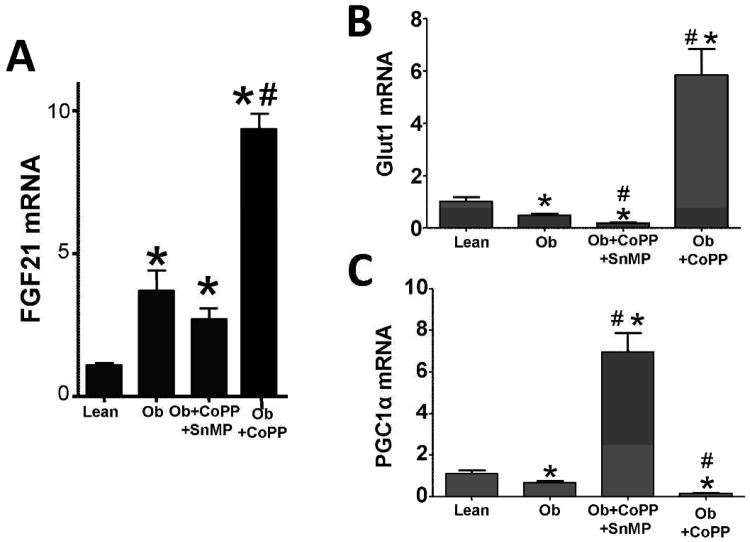
A) Real-time PCR of FGF21; B) Glut1; and C) PGC1α expression in lean, obese control, obese treated with CoPP, and obese treated with CoPP and SnMP. Values represent means ± SEM of five independent treatments. *, P < 0.05 vs. lean or #, P < 0.05 vs. obese control.
Figure 6
Figure 6
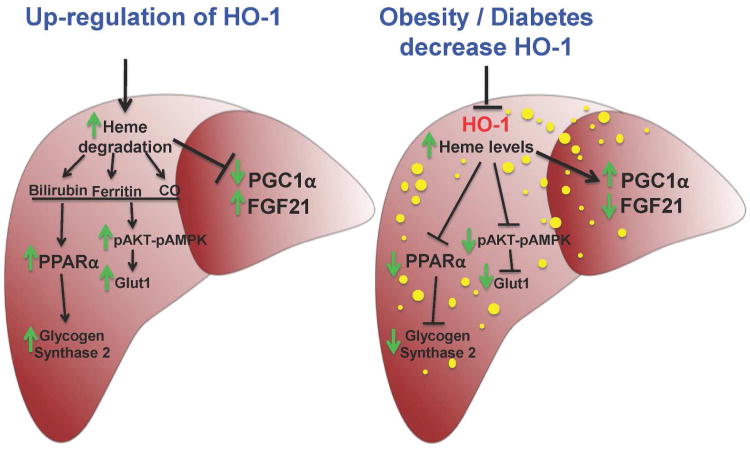
Schematic diagram of potential mechanisms underlying HO-1-mediated improvement of hepatic steatosis in NAFLD. Fatty liver is accompanied by decreases in HO-1 protein and HO activity, increased heme content and derangement of cell signaling including the increase in PGC1α expression and the decrease in FGF21 levels. Upregulation of HO-1 protein and HO activity by pharmacological agents leads to an increased in heme degradation and the generation of CO and bilirubin. CO and/or bilirubin enhance antioxidant mechanisms, thereby decreasing lipid droplets along an elevation of PPARα expression. Induction of PPARα leads to an increase in FGF21. Increase in HO activity enhances the phosphorylation of AKT and AMPK, resulting in increased Glut1 expression and the lowering of blood glucose levels. Thus, activation of the HO-1 protein and HO- activity along with an increase in PPARα-FGF21 module results in higher glycogen content in the liver and a decrease of liver steatosis.

References

    1. Krahenbuhl L, Lang C, Ludes S, Seiler C, Schafer M, Zimmermann A, et al. Reduced hepatic glycogen stores in patients with liver cirrhosis. Liver Int. 2003;23:101–109. - PubMed
    1. Estall JL, Ruas JL, Choi CS, Laznik D, Badman M, Maratos-Flier E, et al. PGC-1alpha negatively regulates hepatic FGF21 expression by modulating the heme/Rev-Erb(alpha) axis. Proc Natl Acad Sci U S A. 2009;106:22510–22515. - PMC - PubMed
    1. Adams LA, Waters OR, Knuiman MW, Elliott RR, Olynyk JK. NAFLD as a risk factor for the development of diabetes and the metabolic syndrome: an eleven-year follow-up study. Am J Gastroenterol. 2009;104:861–867. - PubMed
    1. Abraham NG, Kappas A. Pharmacological and clinical aspects of heme oxygenase. Pharmacol Rev. 2008;60:79–127. - PubMed
    1. Cao J, Peterson SJ, Sodhi K, Vanella L, Barbagallo I, Rodella LF, et al. Heme oxygenase gene targeting to adipocytes attenuates adiposity and vascular dysfunction in mice fed a high-fat diet. Hypertension. 2012;60:467–475. - PMC - PubMed

Publication types

MeSH terms