


Contagion of Cooperation in Static and Fluid Social Networks
- PMID: 23840422
- PMCID: PMC3686805
- DOI: 10.1371/journal.pone.0066199
Contagion of Cooperation in Static and Fluid Social Networks
Abstract
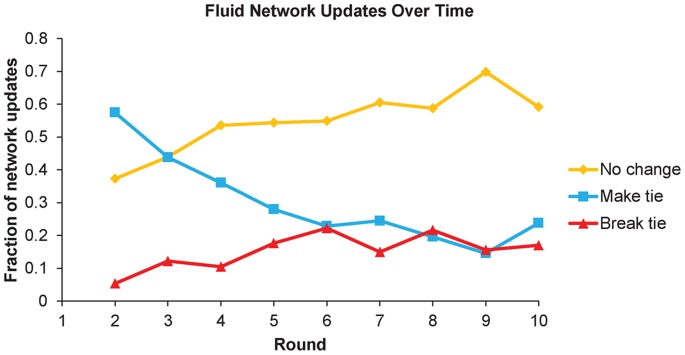
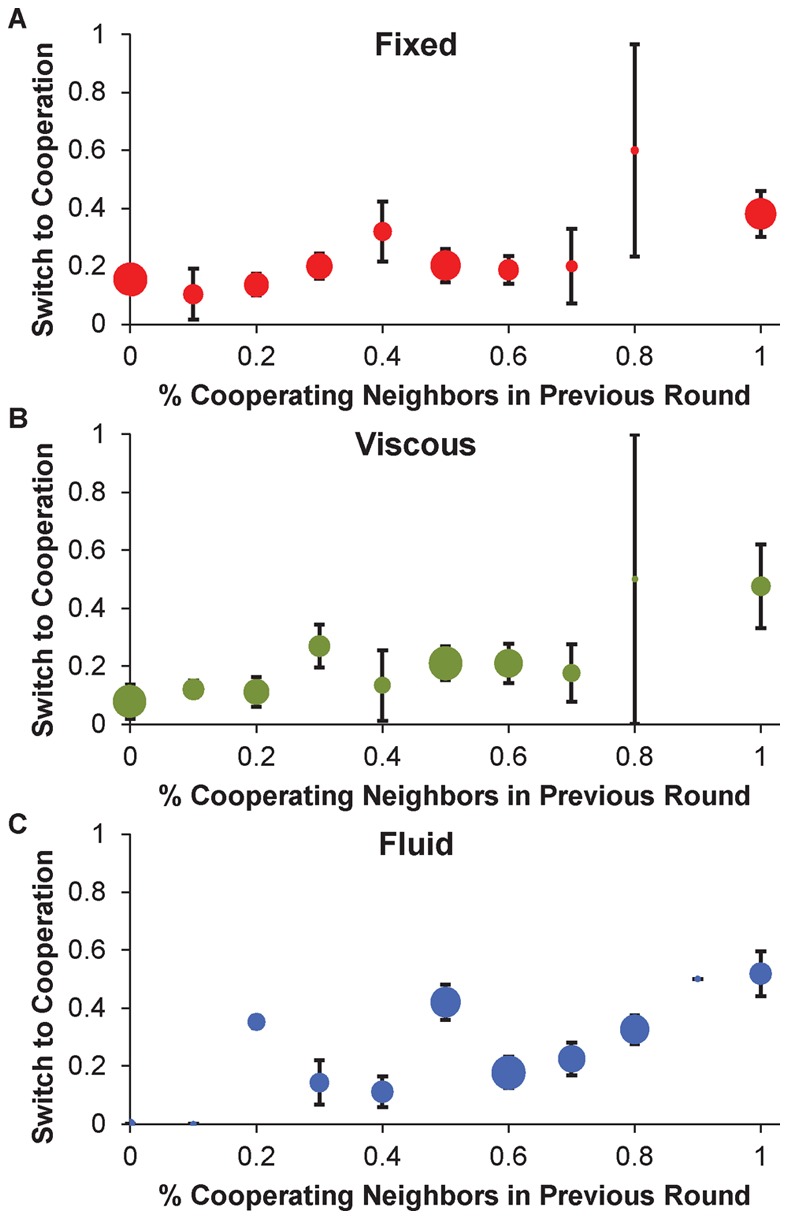
Cooperation is essential for successful human societies. Thus, understanding how cooperative and selfish behaviors spread from person to person is a topic of theoretical and practical importance. Previous laboratory experiments provide clear evidence of social contagion in the domain of cooperation, both in fixed networks and in randomly shuffled networks, but leave open the possibility of asymmetries in the spread of cooperative and selfish behaviors. Additionally, many real human interaction structures are dynamic: we often have control over whom we interact with. Dynamic networks may differ importantly in the goals and strategic considerations they promote, and thus the question of how cooperative and selfish behaviors spread in dynamic networks remains open. Here, we address these questions with data from a social dilemma laboratory experiment. We measure the contagion of both cooperative and selfish behavior over time across three different network structures that vary in the extent to which they afford individuals control over their network ties. We find that in relatively fixed networks, both cooperative and selfish behaviors are contagious. In contrast, in more dynamic networks, selfish behavior is contagious, but cooperative behavior is not: subjects are fairly likely to switch to cooperation regardless of the behavior of their neighbors. We hypothesize that this insensitivity to the behavior of neighbors in dynamic networks is the result of subjects' desire to attract new cooperative partners: even if many of one's current neighbors are defectors, it may still make sense to switch to cooperation. We further hypothesize that selfishness remains contagious in dynamic networks because of the well-documented willingness of cooperators to retaliate against selfishness, even when doing so is costly. These results shed light on the contagion of cooperative behavior in fixed and fluid networks, and have implications for influence-based interventions aiming at increasing cooperative behavior.
Conflict of interest statement
Figures

References
-
- Hardin G (1968) The Tragedy of the Commons. Science 162: 1243–1248. - PubMed
-
- Axelrod R (1984) The Evolution of Cooperation. New York: Basic Books.
-
- Fudenberg D, Maskin E (1986) The Folk Theorem in Repeated Games with Discounting or with Incomplete Information. Econometrica 54: 533–554.
-
- Ostrom E (1990) Governing the commons: The evolution of institutions for collective action: Cambridge Univ Pr.
-
- Nowak M, Sigmund K (1993) A strategy of win-stay, lose-shift that outperforms tit-for-tat in the Prisoner’s Dilemma game. Nature 364: 56–58. - PubMed
Publication types
MeSH terms
Grants and funding
LinkOut - more resources
Full Text Sources
Other Literature Sources
