


Prevalence of PTSD in Survivors of Stroke and Transient Ischemic Attack: A Meta-Analytic Review
- PMID: 23840467
- PMCID: PMC3686746
- DOI: 10.1371/journal.pone.0066435
Prevalence of PTSD in Survivors of Stroke and Transient Ischemic Attack: A Meta-Analytic Review
Abstract
Background and purpose: Posttraumatic stress disorder (PTSD) is common in survivors of acute life-threatening illness, but little is known about the burden of PTSD in survivors of stroke and transient ischemic attack (TIA). This study estimated the prevalence of stroke or TIA-induced posttraumatic stress disorder (PTSD) using systematic review and meta-analysis.
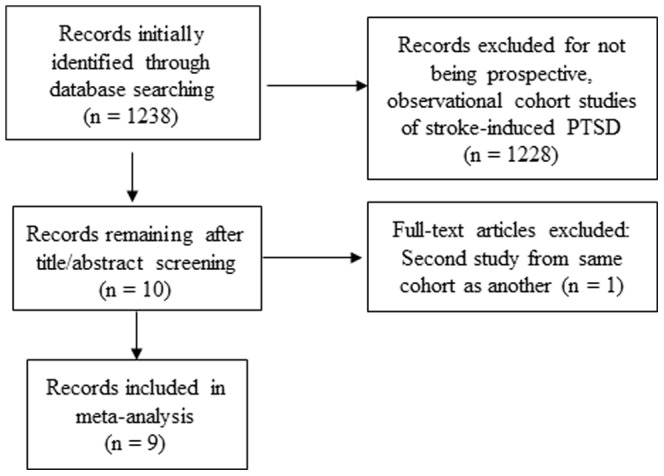
Methods: Potentially relevant peer-reviewed journal articles were identified by searching the Ovid MEDLINE, PsycINFO, PILOTS Database, The Cochrane Library and Scopus from inception to January 2013; all searches were conducted on January 31, 2013. Observational cohort studies that assessed PTSD with specific reference to a stroke or TIA that occurred at least 1 month prior to the PTSD assessment were included. PTSD rates and characteristics of the study and sample were abstracted from all included studies. The coding of all articles included demographics, sample size, study country, and method and timing of PTSD assessment.
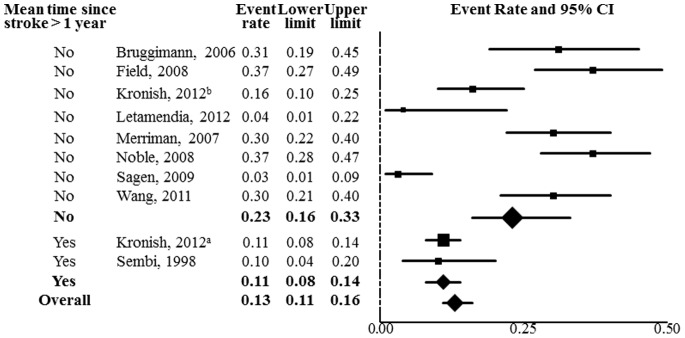
Results: Nine studies (N = 1,138) met our inclusion criteria. PTSD rates varied significantly across studies by timing of PTSD assessment (i.e., within 1 year of stroke/TIA versus greater than 1 year post-stroke/TIA; 55% of heterogeneity explained; Q 1 = 10.30; P = .001). Using a random effects model, the estimated rate of PTSD following stroke or TIA was 23% (95% CI, 16%-33%) within 1 year of the stroke or TIA and 11% (95% CI, 8%-14%) after 1 year.
Conclusions: Although PTSD is commonly thought to be triggered by external events such as combat or sexual assault, these results suggest that 1 in 4 stroke or TIA survivors develop significant PTSD symptoms due to the stroke or TIA. Screening for PTSD in a large population-based prospective cohort study with cardiovascular outcome assessments is needed to yield definitive prevalence, and determine whether stroke or TIA-induced PTSD is a risk factor for subsequent cardiovascular events or mortality.
Conflict of interest statement
Figures
References
-
- Kubzansky LD, Koenen KC, Spiro A 3rd, Vokonas PS, Sparrow D (2007) Prospective study of posttraumatic stress disorder symptoms and coronary heart disease in the Normative Aging Study. Arch Gen Psyc. Jan 64: 109–16. - PubMed
-
- Letamendia C, LeBlanc NJ, Pariente J, Simon NM, Thomas CL, et al.. (2012) Peritraumatic distress predicts acute posttraumatic stress disorder symptoms after a first stroke. Gen Hosp Psychiatr. 34; e11–3. - PubMed
Publication types
MeSH terms
Grants and funding
LinkOut - more resources
Full Text Sources
Other Literature Sources
Medical
Miscellaneous
