


Evidence for unintentional emotional contagion beyond dyads
- PMID: 23840683
- PMCID: PMC3696100
- DOI: 10.1371/journal.pone.0067371
Evidence for unintentional emotional contagion beyond dyads
Abstract
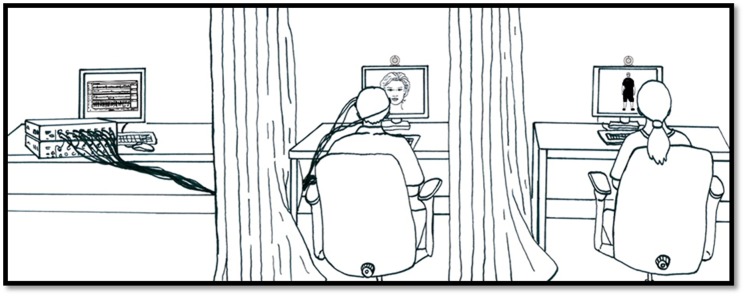
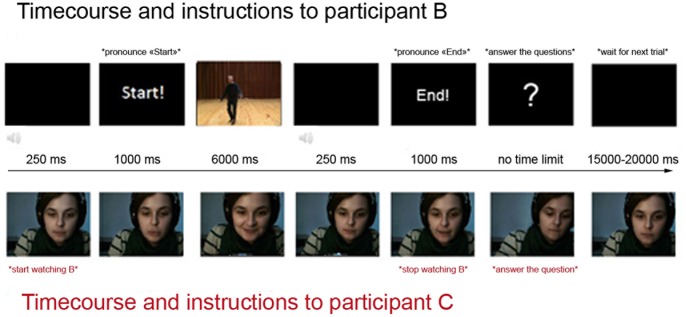
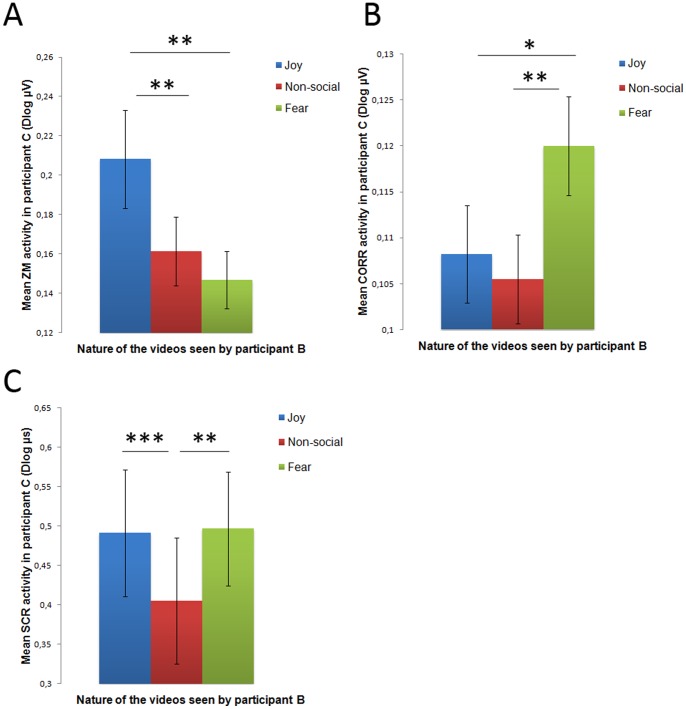
Little is known about the spread of emotions beyond dyads. Yet, it is of importance for explaining the emergence of crowd behaviors. Here, we experimentally addressed whether emotional homogeneity within a crowd might result from a cascade of local emotional transmissions where the perception of another's emotional expression produces, in the observer's face and body, sufficient information to allow for the transmission of the emotion to a third party. We reproduced a minimal element of a crowd situation and recorded the facial electromyographic activity and the skin conductance response of an individual C observing the face of an individual B watching an individual A displaying either joy or fear full body expressions. Critically, individual B did not know that she was being watched. We show that emotions of joy and fear displayed by A were spontaneously transmitted to C through B, even when the emotional information available in B's faces could not be explicitly recognized. These findings demonstrate that one is tuned to react to others' emotional signals and to unintentionally produce subtle but sufficient emotional cues to induce emotional states in others. This phenomenon could be the mark of a spontaneous cooperative behavior whose function is to communicate survival-value information to conspecifics.
Conflict of interest statement
Figures
References
-
- Raafat RM, Chater N, Frith C (2009) Herding in humans. Trends in Cognitive Sciences 13: 420–428. - PubMed
-
- Tarde G (1890) Les lois de l’imitation: étude sociologique. F. Alcan.
-
- Sighele S (1901) La foule criminelle: Essai de psychologie collective. F. Alcan.
-
- Le Bon G (1896) Psychologie des foules. Macmillan.
-
- Barsade SG (2002) The Ripple Effect: Emotional Contagion and Its Influence on Group Behavior. Administrative Science Quarterly 47: 644–675 doi:10.2307/3094912 - DOI
Publication types
MeSH terms
LinkOut - more resources
Full Text Sources
Other Literature Sources
