


Neural pathways conveying novisual information to the visual cortex
- PMID: 23840972
- PMCID: PMC3690246
- DOI: 10.1155/2013/864920
Neural pathways conveying novisual information to the visual cortex
Abstract
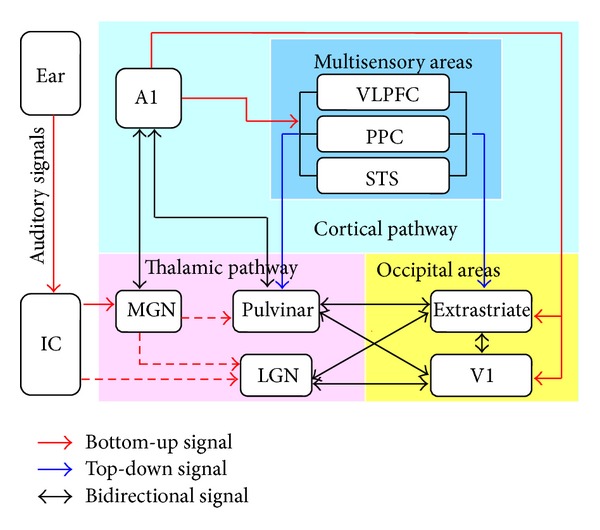
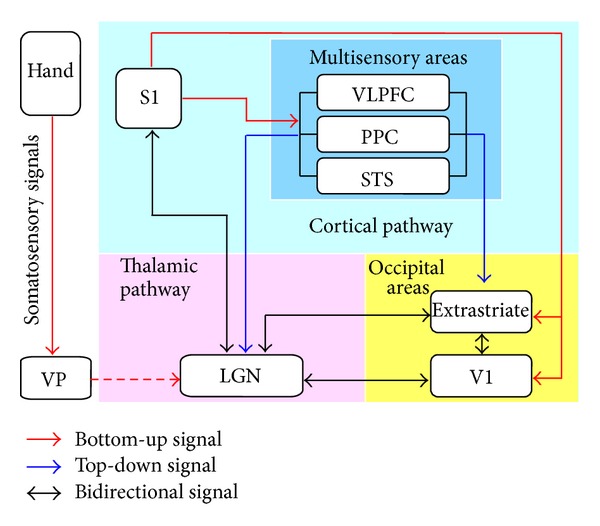
The visual cortex has been traditionally considered as a stimulus-driven, unimodal system with a hierarchical organization. However, recent animal and human studies have shown that the visual cortex responds to non-visual stimuli, especially in individuals with visual deprivation congenitally, indicating the supramodal nature of the functional representation in the visual cortex. To understand the neural substrates of the cross-modal processing of the non-visual signals in the visual cortex, we firstly showed the supramodal nature of the visual cortex. We then reviewed how the nonvisual signals reach the visual cortex. Moreover, we discussed if these non-visual pathways are reshaped by early visual deprivation. Finally, the open question about the nature (stimulus-driven or top-down) of non-visual signals is also discussed.
Figures
References
-
- Grill-Spector K, Malach R. The human visual cortex. Annual Review of Neuroscience. 2004;27:649–677. - PubMed
-
- Wandell BA, Dumoulin SO, Brewer AA. Visual field maps in human cortex. Neuron. 2007;56(2):366–383. - PubMed
-
- Felleman DJ, Van Essen DC. Distributed hierarchical processing in the primate cerebral cortex. Cerebral Cortex. 1991;1(1):1–47. - PubMed
-
- Seymour K, Clifford CWG, Logothetis NK, Bartels A. Coding and binding of color and form in visual cortex. Cerebral Cortex. 2010;20(8):1946–1954. - PubMed
Publication types
MeSH terms
LinkOut - more resources
Full Text Sources
Other Literature Sources
