


Characterization of bioactive compounds in Tunisian bitter orange (Citrus aurantium L.) peel and juice and determination of their antioxidant activities
- PMID: 23841062
- PMCID: PMC3697287
- DOI: 10.1155/2013/345415
Characterization of bioactive compounds in Tunisian bitter orange (Citrus aurantium L.) peel and juice and determination of their antioxidant activities
Abstract
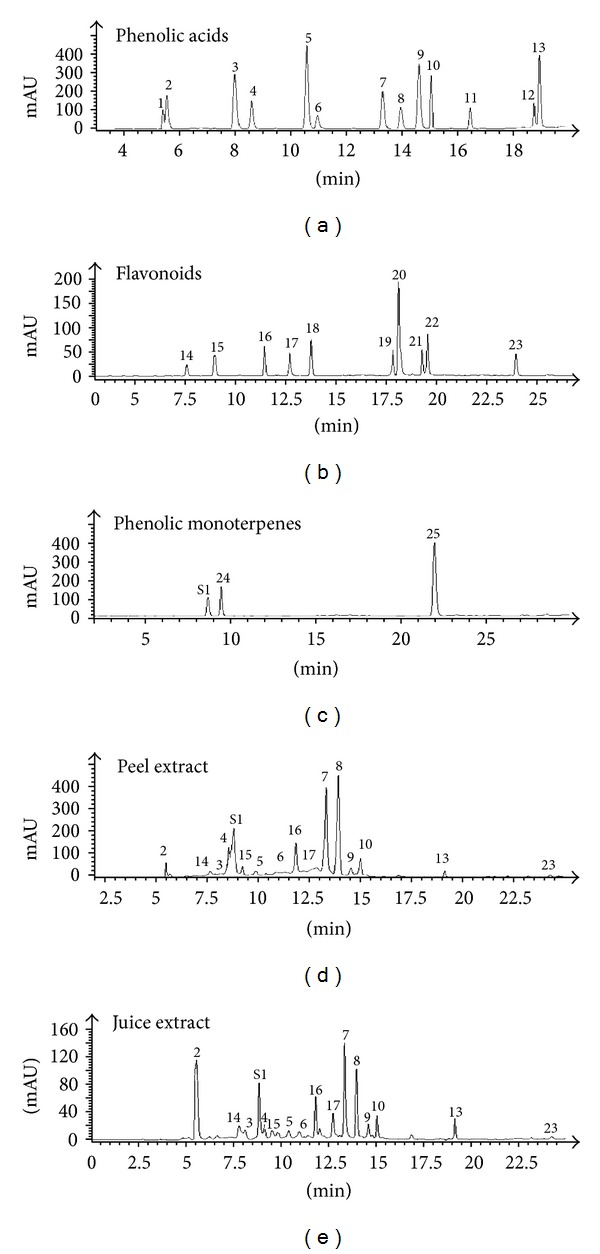
Citrus aurantium peel and juice aroma compounds were investigated by gas chromatography (GC) and gas chromatography-mass spectrometry (GC-MS), whereas phenolic compounds analysis was performed by reversed-phase high-performance liquid chromatography (RP-HPLC). Limonene was the major volatile compound of bitter orange peel (90.25%) and juice (91.61%). HPLC analysis of bitter orange peel and juice methanolic extracts indicated that phenolic acids constitute their main phenolic class representing 73.80% and 71.25%, respectively, followed by flavonoids (23.02% and 23.13%, resp.). p-Coumaric and ferulic acids were the most abundant phenolic compounds representing 24.68% and 23.79%, respectively, in the peel, while the juice contained 18.02% and 19.04%, respectively. The antioxidant activities of bitter orange peel and juice methanolic extracts have been evaluated using four in vitro assays, and the results were compared with the standard antioxidants (BHT, BHA, and ascorbic acid). Our findings demonstrated that Citrus aurantium peel and juice possess antioxidant activities which were less effective than those of antioxidant standards. Both extracts may be suggested as a new potential source of natural antioxidant.
Figures
References
-
- Kumaran A, Joel Karunakaran R. Antioxidant and free radical scavenging activity of an aqueous extract of Coleus aromaticus . Food Chemistry. 2006;97(1):109–114.
-
- Wichi HP. Enhanced tumour development by butylated hydroxyanisole (BHA) from the prospective of effect on forestomach and oesophageal squamous epithelium. Food and Chemical Toxicology. 1988;26:717–723. - PubMed
-
- Ramesh CK, Raghu KL, Jamuna KS. Govinden Soulange Joyce and Ranghoo-Sanmukhiya Vijayanti Mala and Vijay Avin BR. Comparative evaluation of antioxidant property in methanol extracts of some common vegetables of India. Annals of Biological Research. 2011;2(2):86–94.
-
- Bourgou S, Ksouri R, Bellila A, Skandrani I, Falleh H, Marzouk B. Phenolic composition and biological activities of Tunisian Nigella sativa L. shoots and roots. Comptes Rendus. 2008;331(1):48–55. - PubMed
-
- Jabri-Karoui I, Bettaieb I, Msaada K, Hammami M, Marzouk B. Research on the phenolic compounds and antioxidant activities of Tunisian Thymus capitatus. Journal of Functional Foods. 2012;4(3):661–669.
MeSH terms
Substances
LinkOut - more resources
Full Text Sources
Other Literature Sources
Medical
Miscellaneous
