


The genus Striga: a witch profile
- PMID: 23841683
- PMCID: PMC6638688
- DOI: 10.1111/mpp.12058
The genus Striga: a witch profile
Abstract
The genus Striga comprises about 30 obligate root-parasitic plants, commonly known as witchweeds. In particular, S. hermonthica, S. asiatica and S. gesnerioides cause immense losses to major stable crops in sub-Saharan Africa. Most Striga species parasitize grass species (Poaceae), but Striga gesnerioides has evolved to parasitize dicotyledonous plants. Aspects of phylogeny, economic impact, parasitic life style and molecular discoveries are briefly reviewed to profile one of the main biotic constraints to African agriculture.
Taxonomy: Striga Lour.; Kingdom Plant; Division Angiospermae; Clade Eudicots; Order Laminales; Family Orobanchaceae.
Important hosts: Sorghum Moench., maize (Zea mays L.), rice (Oryza L.), sugarcane (Saccharum L.), pearl millet [Pennisetum glaucum (L.) R. Br.], cowpea [Vigna unguiculata (L.) Walp.].
Disease symptoms: Stunted growth, drought-stressed-like appearance, in severe cases chlorosis and necrosis.
Economic importance: 1 billion $US per annum.
Disease control: Hand weeding, breeding, chemical control, intercropping with catch or trap crops.
Useful webpages: http://ppgp.huck.psu.edu; http://striga.psc.riken.jp.
© 2013 BSPP and JOHN WILEY & SONS LTD.
Figures
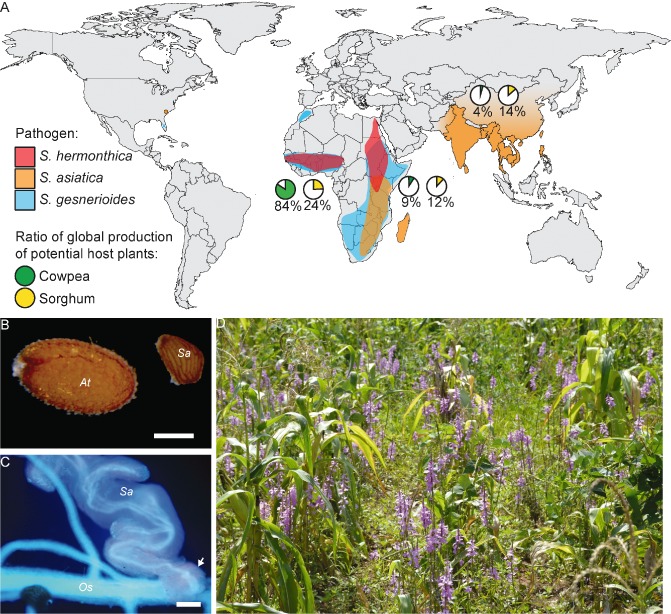
References
-
- Agabawi, K.A. and Younis, A.E. (1965) Effect of nitrogen application on growth and nitrogen content of Striga hermonthica, Benth. and Sorghum vulgare, Lur. grown for forage. Plant Soil, 23, 295–304.
-
- Atera, E. and Itoh, K. (2011) Evaluation of ecologies and severity of Striga weed on rice in sub‐Saharan Africa. Agric. Biol. J. N. Am. 2, 752–760.
-
- Ba, A.T. (1979) Notes on the histochemistry of the haustorium of Striga hermonthica. Proceedings, Second International Symposium on Parasitic Weeds, North Carolina, pp. 128–131.
-
- Bandaranayake, P.C.G. , Filappova, T. , Tomilov, A. , Tomilova, N.B. , Jamison‐McClung, D. , Ngo, Q. , Inoue, K. and Yoder J.I. (2010) A single‐electron reducing quinone oxidoreductase is necessary to induce haustorium development in the root parasitic plant Triphysaria . Plant Cell, 22, 1404–1419. - PMC - PubMed
-
- Bennett, J.R. and Mathews, S. (2006) Phylogeny of the parasitic plant family Orobanchaceae inferred from phytochrome A. Am. J. Bot. 93, 1039–1051. - PubMed
Publication types
MeSH terms
LinkOut - more resources
Full Text Sources
Other Literature Sources
