


Comment
doi: 10.1073/pnas.1310351110.
Epub 2013 Jul 10.
Adaptation of fibrous biopolymers to recurring increasing strains
Affiliations
- PMID: 23842087
- PMCID: PMC3725091
- DOI: 10.1073/pnas.1310351110
Item in Clipboard
Comment
Adaptation of fibrous biopolymers to recurring increasing strains
Proc Natl Acad Sci U S A.
.
No abstract available
Conflict of interest statement
The authors declare no conflict of interest.
Figures
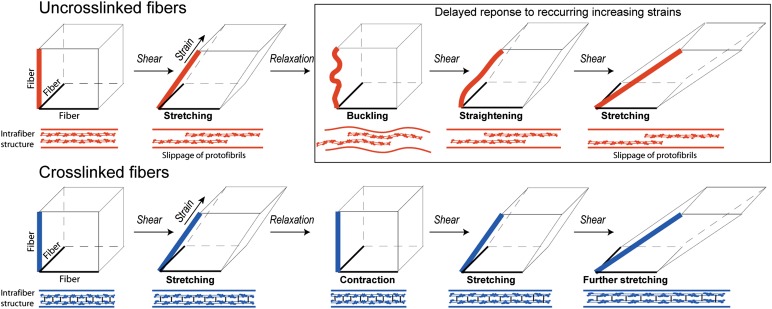
The mechanism for the delayed nonlinear response to recurring increasing shear strains of a viscoelastic protein polymer with a high degree of plasticity, exemplified by fibrin. Schematic representation of repeated shear deformation with increasing strain of 3D networks built of uncross-linked and cross-linked fibers. The lower left corner of the cube represents a branch point made up of three fibers, one of which is oriented in the direction of strain. The diagrams below each cube represent the internal structure of a fibrin fiber, showing two protofibrils. An uncross-linked fiber (red) lengthens irreversibly upon shear and buckles upon relaxation. The elongation is caused by the slippage of protofibrils past each other within the fiber. On repeated shear, the buckled fiber is straightened to the same point without stretching and additional delayed lengthening occurs only at higher strain. The cross-linked fiber (blue) lengthens reversibly upon shear and restores the initial length upon relaxation. The slippage of protofibrils within the fiber is precluded by covalent crosslinking and the fiber stretches because of molecular elongation and/or unfolding.
Comment on
-
Strain history dependence of the nonlinear stress response of fibrin and collagen networks.Proc Natl Acad Sci U S A. 2013 Jul 23;110(30):12197-202. doi: 10.1073/pnas.1222787110. Epub 2013 Jun 10. Proc Natl Acad Sci U S A. 2013. PMID: 23754380 Free PMC article.
References
-
- Collet JP, et al. Altered fibrin architecture is associated with hypofibrinolysis and premature coronary artery atherothrombosis. Arteroscler Thromb Vasc Biol. 2006;26(11):2567–2573. - PubMed
-
- Undas A, Ariëns RA. Fibrin clot structure and function: A role in the pathophysiology of arterial and venous thromboembolic diseases. Arterioscler Thromb Vasc Biol. 2011;31(12):e88–e99. - PubMed
-
- Hvas AM, et al. Tranexamic acid combined with recombinant factor VIII increases clot resistance to accelerated fibrinolysis in severe hemophilia A. J Thromb Haemost. 2007;5(12):2408–2414. - PubMed
Publication types
MeSH terms
Substances
LinkOut - more resources
Full Text Sources
Other Literature Sources
