. 2013 Sep;41(17):8021-33.
doi: 10.1093/nar/gkt602. Epub 2013 Jul 10.

Translational sensitivity of the Escherichia coli genome to fluctuating tRNA availability

Affiliations

Translational sensitivity of the Escherichia coli genome to fluctuating tRNA availability

Sibylle E Wohlgemuth et al. Nucleic Acids Res. 2013 Sep.

Abstract

The synthesis of protein from messenger RNA during translation is a highly dynamic process that plays a key role in controlling the efficiency and fidelity of genome-wide protein expression. The availability of aminoacylated transfer RNA (tRNA) is a major factor influencing the speed of ribosomal movement, which depending on codon choices, varies considerably along a transcript. Furthermore, it has been shown experimentally that tRNA availability can vary significantly under different growth and stress conditions, offering the cell a way to adapt translational dynamics across the genome. Existing models of translation have neglected fluctuations of tRNA pools, instead assuming fixed tRNA availabilities over time. This has lead to an incomplete understanding of this process. Here, we show for the entire Escherichia coli genome how and to what extent translational speed profiles, which capture local aspects of translational elongation, respond to measured shifts in tRNA availability. We find that translational profiles across the genome are affected to differing degrees, with genes that are essential or related to fundamental processes such as translation, being more robust than those linked to regulation. Furthermore, we reveal how fluctuating tRNA availability influences profiles of specific sequences known to play a significant role in translational control of gene expression.


Figures
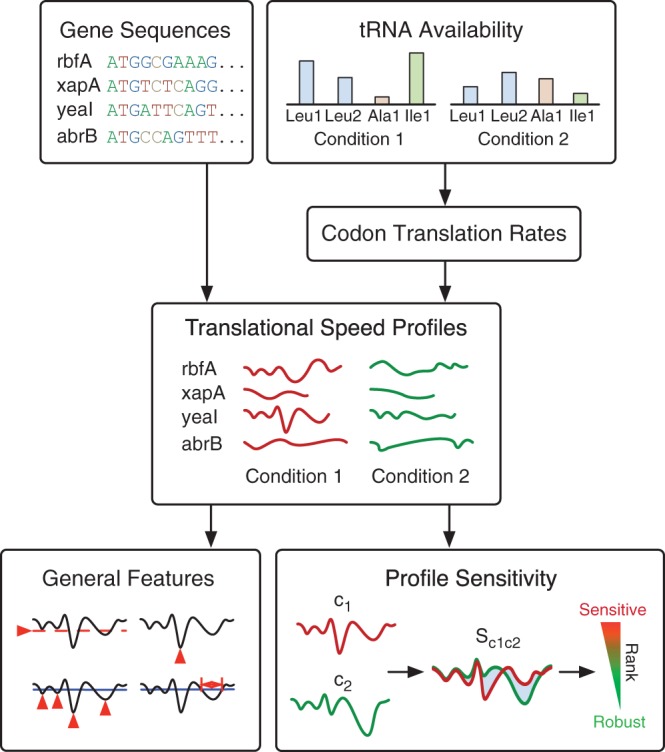
Figure 1.
Figure 1.
Overview of the workflow used to estimate translational profiles and analyze general features and sensitivities. The main inputs are tRNA availabilities (concentrations and charged fractions) and the gene sequences to be analyzed. In this study, several different sets of tRNA availabilities are used. From these, codon translation rates are calculated and translational profiles generated for each sequence. Profiles are then analyzed in isolation by looking at general features that can be further explored in terms of genome-wide distributions and by comparing changes to profile shapes owing to varying tRNA availability under different conditions (sensitivity analysis).
Figure 2.
Figure 2.
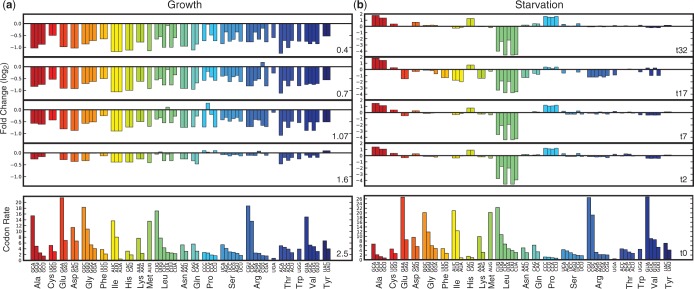
Estimated codon translation rates vary owing to differences in tRNA concentrations and charging. For both (a) growth rate data and (b) leucine starvation data, the absolute values of the codon translation rates at standard reference conditions are shown on the bottom subplots (growth rate of 2.5 doublings per hour and t = 0 for leucine starvation). Codons are colored according to the amino acid they code for. The top four subplots show the fold change in the rates, r, under each condition compared with the reference condition, formula image. During leucine starvation, both decreases and increases in codon rates are observed (e.g. codons for proline, histidine, alanine).
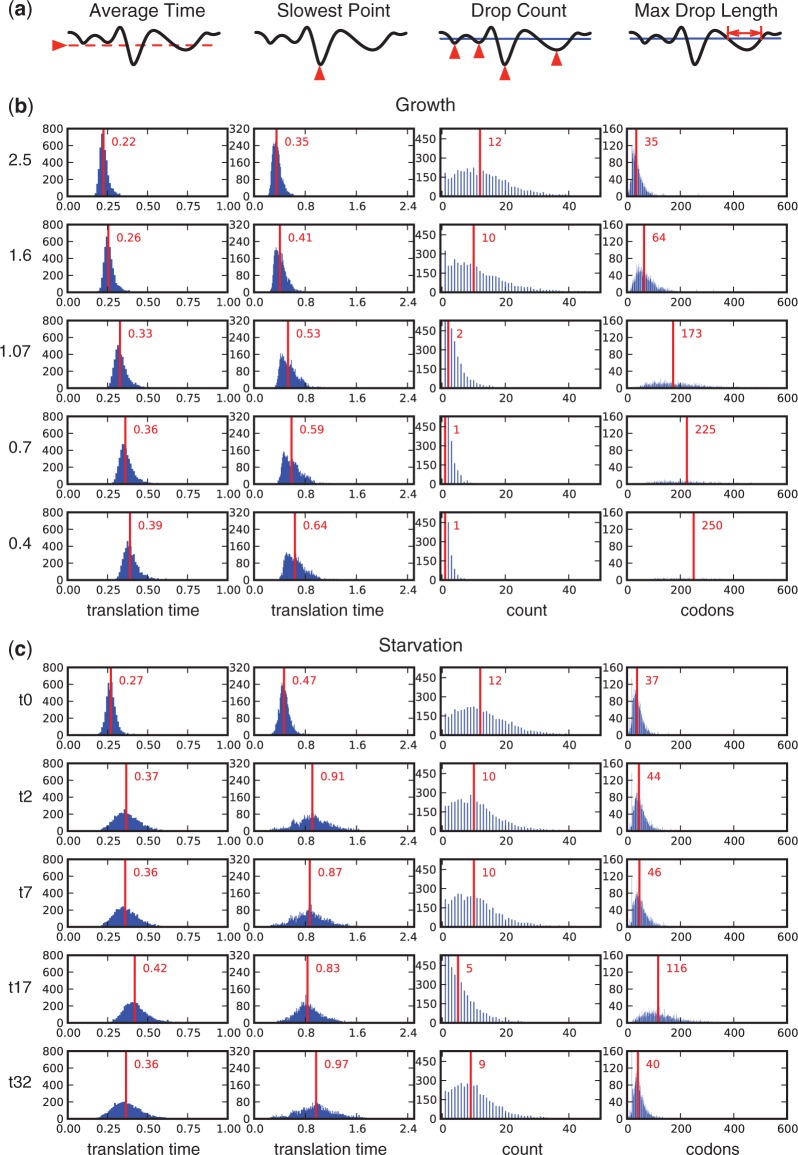
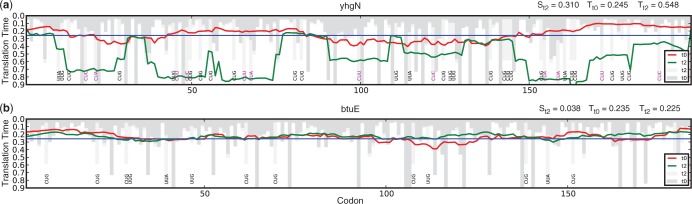
Figure 3.
Figure 3.
General features of translational profiles under differing conditions. (a) the four features that we analyzed for all profiles. Distributions of the features across the entire E. coli genome for (b) growth rate and (c) leucine starvation data sets. Red vertical lines and labels denote the median values of the distributions.
Figure 4.
Figure 4.
Changes to tRNA availability non-uniformly influence translational profiles across the genome. Comparison of two profiles taken from the (a) 10% most sensitive and (b) 10% least sensitive genes. These show the effect of changing rates for different leucine codons 2 min after leucine starvation. The high sensitivity of yhgN is mainly caused by the three low rate leucine codons CUU, CUC and CUA that vary greatly between these conditions. In comparison, these codons do not occur in the less sensitive sequence btuE, where only the fast CUG codon and the two less variable UUG and UUA codons are used. yhgN codes for an annotated non-essential inner membrane protein and btuE for a non-essential glutathione peroxidase. Red lines show the smoothed reference profiles before leucine starvation and green lines show the profiles 2 min after leucine starvation. The blue horizontal line indicates the threshold value used for the analysis of general profile features. Bars showing local codon speeds are colored in dark gray for reference condition and in light gray for starvation condition. To ensure the profile shape is clearly visible, some bars extend beyond the bottom of the plot. The annotation at the bottom shows all leucine codons, the three highly variable low rate leucine codons are shown in magenta and the faster and more robust codons are shown in black. formula image denotes the sensitivity value and formula image the average translation time under the respective condition c.
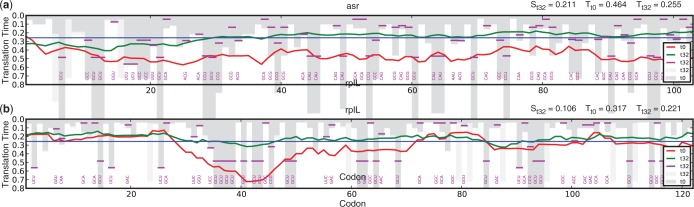
Figure 5.
Figure 5.
Selective charging of specific tRNAs under leucine starvation increases the translational speed of some genes. Shown are two sequences where the translation is accelerated during leucine starvation. (a) asr codes for an annotated non-essential acid shock-inducible protein and (b) rplL for an essential 50S ribosomal subunit protein. Red lines show the reference profiles at t = 0 min and green lines show the profiles t = 32 min after leucine starvation. The blue horizontal line indicates the threshold value used for the analysis of general profile features. Bars showing local codon speeds are colored in dark gray for reference condition and in light gray for rates that are decreased under starvation conditions. To ensure the profile shape is clearly visible, some bars extend beyond the bottom of the plot. Codons that show an increased rate under this condition are annotated in magenta, and the vertical lines denote the value of the accelerated speed. formula image denotes the sensitivity value and formula image the average translation time under the respective condition c.
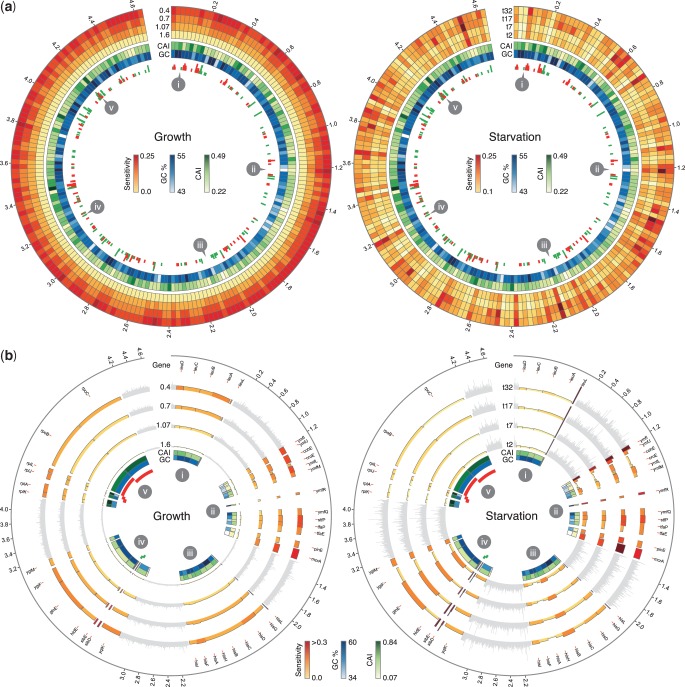
Figure 6.
Figure 6.
Genome-wide visualization of translational profile sensitivities. All plots display the entire E. coli genome and positions within the chromosome are indicated on the outer rim in Mbp. (a) Averaged sensitivities across the entire genome. The genome is split into 200 equal length portions, and averages are taken over genes that start within each region. Outer tracks show sensitivity heat maps (yellow = low, red = high) for differing conditions: (left) growth rates of 0.4, 0.7, 1.07, 1.6 and; (right) time points t = 32, 17, 7, 2 min after leucine starvation. The next two inner most heat maps show averaged general features of the genome. Specifically, the codon adaptation index (CAI) and GC%, with darker colors relating to higher values. Inner most tracks (displayed as bars) correspond to essential genes (red) and nucleotide sequences that are not translated (green). Each bar has a width the length of the gene it corresponds to, and bars are stacked in regions with high densities of essential genes or nucleotide sequences. (b) Gene-level sensitivities for the five highlighted regions marked on the upper plots. These relate to (i) the leucine biosynthesis operon leuLABCD; (ii) a region containing low GC% and CAI values; (iii) the histidine biosynthesis operon hisLGDCBHAFI; (iv) a region containing two untranslated nucleotide sequences; and (v) a region containing several essential genes related to the 50S ribosomal subunit and the RNA polymerase formula image subunit. The height and color of the histogram tracks relate to the gene sensitivity. Inner most tracks match the upper plots displaying CAI, GC%, essential genes and nucleotide sequences. Highlighted regions are zoomed by a factor of formula image to ensure individual genes are visible. Non-highlighted regions are shaded in light gray.

References

    1. Gingold H, Pilpel Y. Determinants of translation efficiency and accuracy. Mol. Syst. Biol. 2011;7:481. - PMC - PubMed
    1. Kudla G, Murray AW, Tollervey D, Plotkin JB. Coding-sequence determinants of gene expression in Escherichia coli. Science. 2009;324:255–258. - PMC - PubMed
    1. Plotkin JB, Kudla G. Synonymous but not the same: the causes and consequences of codon bias. Nat. Rev. Genet. 2011;12:32–42. - PMC - PubMed
    1. Zhang G, Hubalewska M, Ignatova Z. Transient ribosomal attenuation coordinates protein synthesis and co-translational folding. Nat. Struct. Mol. Biol. 2009;16:274–280. - PubMed
    1. Rosano GL, Ceccarelli EA. Rare codon content affects the solubility of recombinant proteins in a codon bias-adjusted Escherichia coli strain. Microb. Cell Fact. 2009;8:1. - PMC - PubMed

Publication types