. 2013 Sep 7;280(1766):20131381.
doi: 10.1098/rspb.2013.1381. Print 2013 Sep 7.

Behavioural fever is a synergic signal amplifying the innate immune response

Affiliations

Behavioural fever is a synergic signal amplifying the innate immune response

Sebastian Boltaña et al. Proc Biol Sci. .

Abstract

Behavioural fever, defined as an acute change in thermal preference driven by pathogen recognition, has been reported in a variety of invertebrates and ectothermic vertebrates. It has been suggested, but so far not confirmed, that such changes in thermal regime favour the immune response and thus promote survival. Here, we show that zebrafish display behavioural fever that acts to promote extensive and highly specific temperature-dependent changes in the brain transcriptome. The observed coupling of the immune response to fever acts at the gene-environment level to promote a robust, highly specific time-dependent anti-viral response that, under viral infection, increases survival. Fish that are not offered a choice of temperatures and that therefore cannot express behavioural fever show decreased survival under viral challenge. This phenomenon provides an underlying explanation for the varied functional responses observed during systemic fever. Given the effects of behavioural fever on survival and the fact that it exists across considerable phylogenetic space, such immunity-environment interactions are likely to be under strong positive selection.

Keywords: anti-viral response; behavioural fever; gene–environment interaction.


Figures
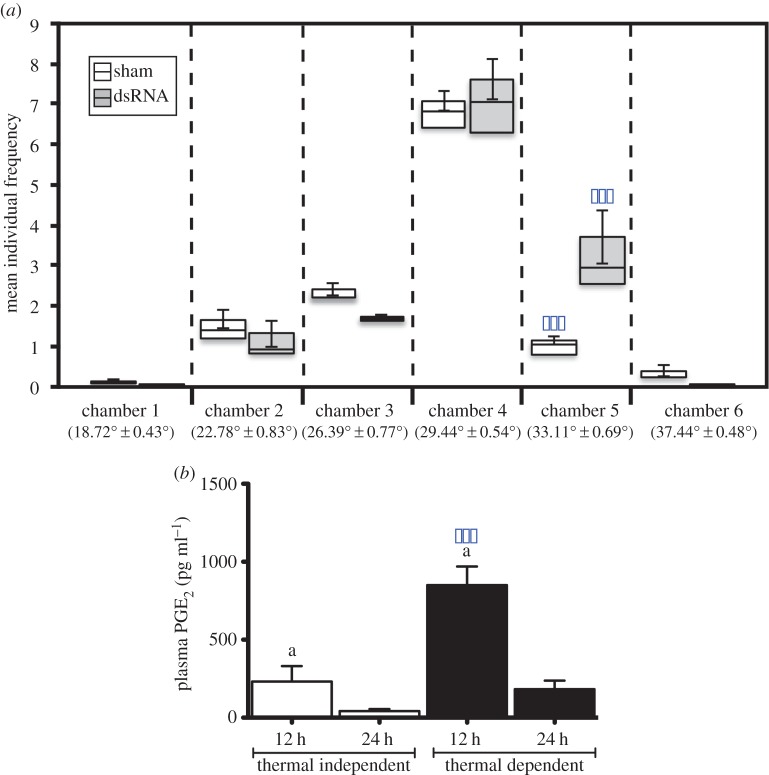
Figure 1.
Figure 1.
Behavioural fever in dsRNA-challenged adult zebrafish. (a) Frequency of chamber occupation in individual adult zebrafish (group = 10 individuals) challenged with dsRNA in a thermal gradient. Two-tailed repeated measures ANOVA; F5,1190 = 50.481, boxplots show Q1 and Q3 quartiles and mean values (n = 3 ± s.d., *p < 0.05; **p < 0.01; ***p < 0.001). (b) Plasma concentrations of PGE2 (pg ml−1) in dsRNA-challenged zebrafish (12 and 24 h) under constant conditions (Ti) or in a thermal gradient (Td) (29 ± 0.5°C) n = 6, one-tail ANOVA; F3,15 = 17.69, (n = 3, mean ± s.d, *p < 0.05; **p < 0.01; ***p < 0.001). (Online version in colour.)
Figure 2.
Figure 2.
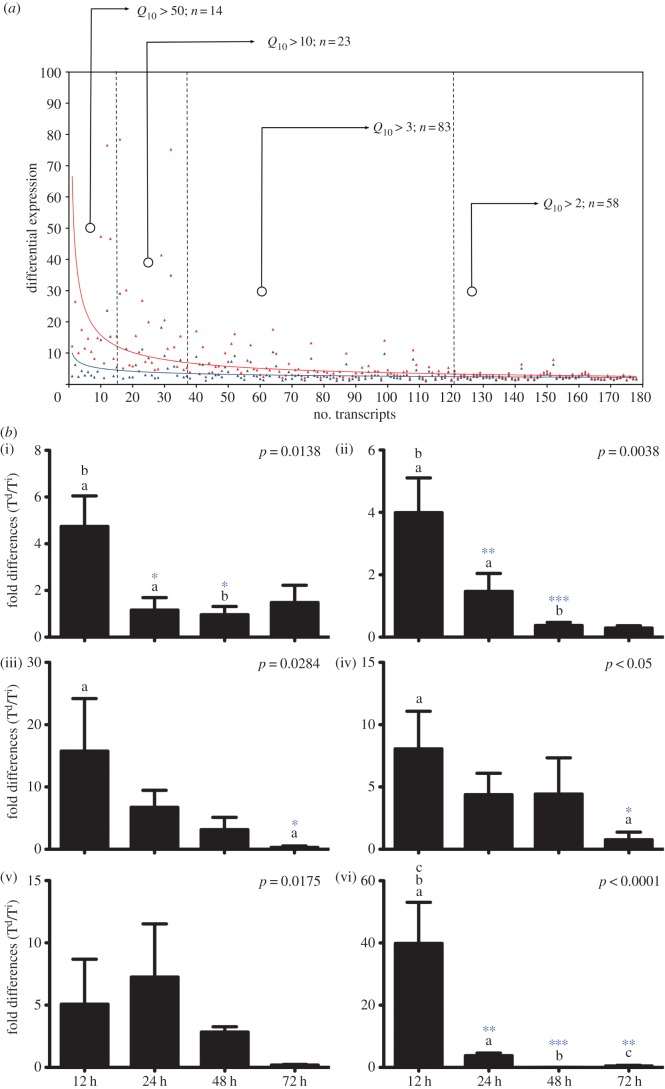
Gene–environment interaction during dsRNA-induced behavioural fever. (a) Differential expression levels of 156 (fold change greater than 2) dsRNA-induced transcripts common to both constant conditions (Ti) or in a thermal gradient (Td). Q10 values were calculated and shown in four groupings relative to intensity. Solid curves, red (Td) or blue (Ti) denote specific mRNA abundances relative to environmental condition. (b) qRT-PCR quantification of specific anti-viral mRNA accumulation over a 72 h time period post-dsRNA challenge. Values shown are maximal mRNA relative abundance ratio (Td/Ti) in dsRNA challenged fish (n = 6) mean ± s.d. Two-way ANOVA: (i) Stat-1a, (ii) Stat-1b, (iii) Irf7, (iv) Gig2, (v) Trim25 and (vi) Somatostatin (interaction values). Letters represent comparisons (a,b,c) and significance is Bonferroni post-hoc test (*p < 0.05; **p < 0.01; ***p < 0.001).
Figure 3.
Figure 3.
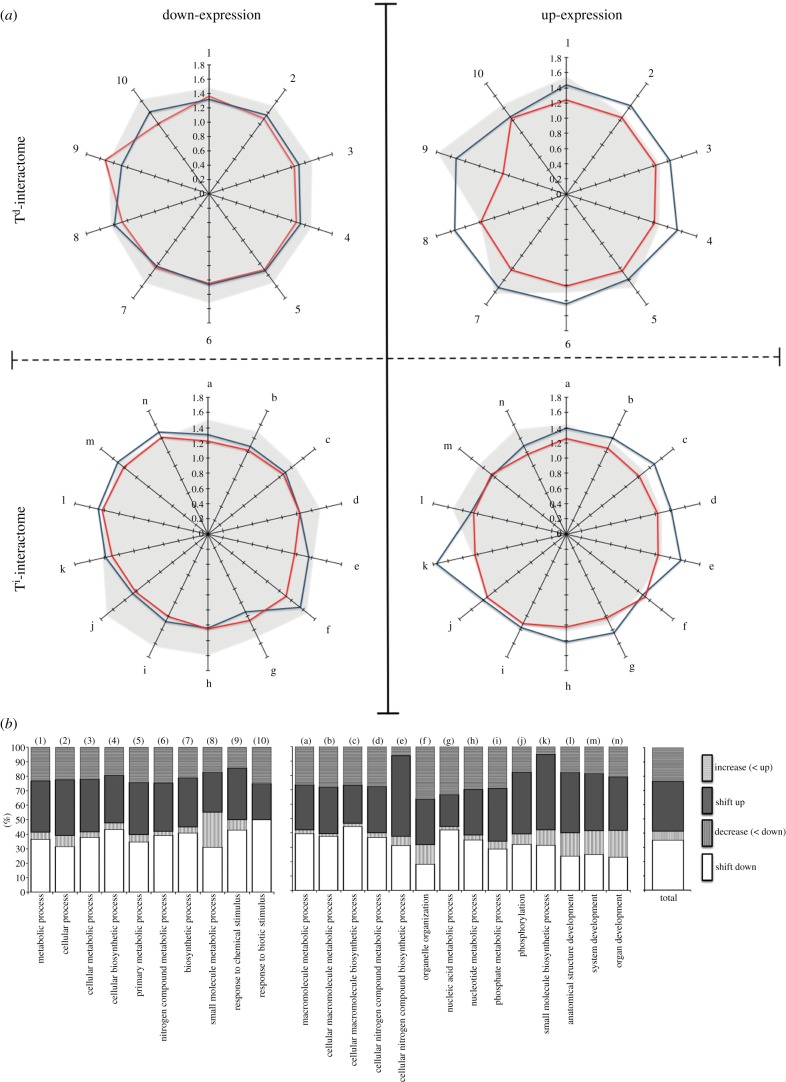
Temperature-dependent effects on transcriptome regulation. (a) Variation in total transcript abundance (insets; vertical axis = mean expression intensity over control interactome, one-tail ANOVA; F7,99 = 6.833, p < 0.0001) scores derived from Td and Ti interactome GO clusters (p < 0.05). Interactome numbering (1–10) and lettering (a–n) represents Td and Ti clusters, respectively, term description is in figure 2b. (b) Percentile representation of temperature dependent (Td versus Ti) directional shift (black and white bars represent up- and downregulated transcripts, respectively) and percentile increase of mean transcript abundance (horizontal or vertical etched bars represent % increase or decrease, respectively) in dsRNA-activated functional clusters.
Figure 4.
Figure 4.
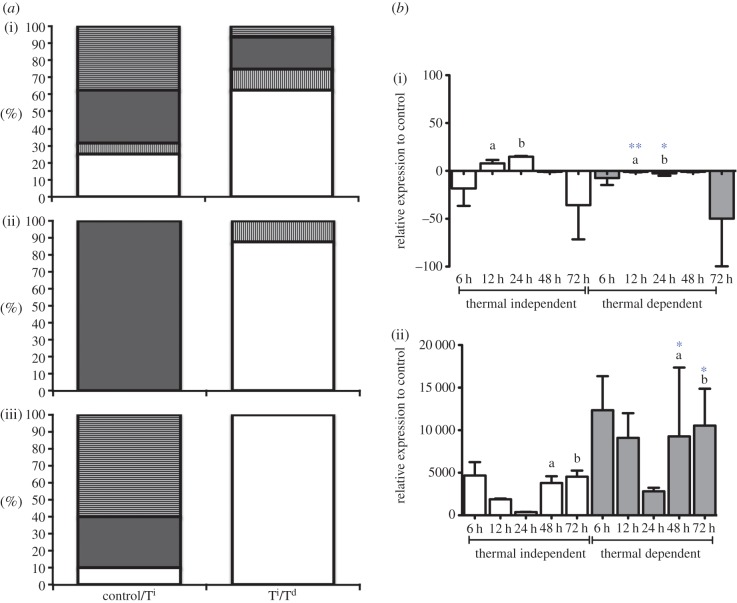
Regulation of the inflammatory reflex. (a) Percentile directional shift (Td versus Ti) (black and white bars represent up- and downregulated transcripts, respectively) and percentile increase of mean neuroreceptor mRNA transcript abundance (horizontal or vertical etched bars represent % increase or decrease, respectively) representative of regulatory pathways, b(i) α7-cholinergic receptor and b(ii) acetylcholinesterase mRNA abundance over a 72 h time period post-dsRNA challenge (Td versus Ti). Values shown are mRNA relative abundance ratio (n = 10 mean ± s.d., T-test, *p < 0.05; **p < 0.01; ***p < 0.001). a(i) nicotinic/cholinergic, a(ii) muscarinic and a(iii) adrenergic. (Online version in colour.)
Figure 5.
Figure 5.
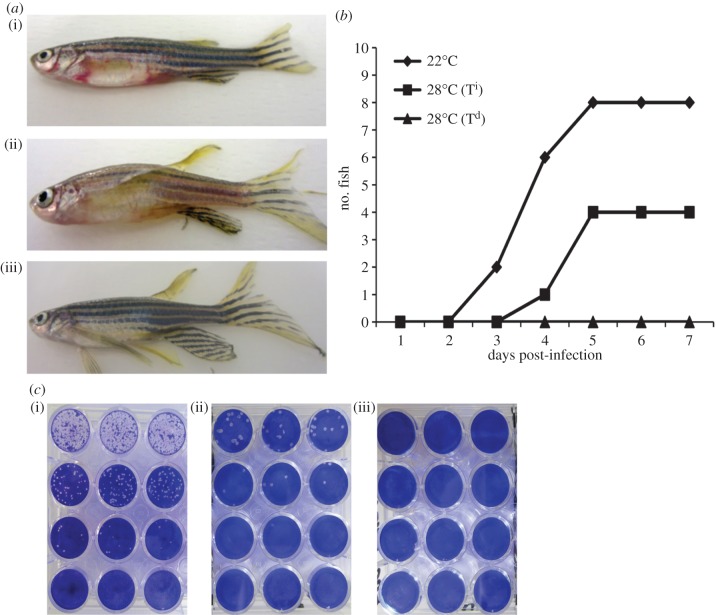
SVCV infection, clinical symptoms and virus recovery. (a) Representative photographs of individual zebrafish infected with SVCV 7dpi at (i) 22°C, (ii) 28°C (Ti) and (iii) 28oCd (Td), (b) appearance of clinical signs of skin haemorrhaging in SVCV-infected fish (n = 10) 1–7dpi in each experimental group and (c) plaque formation in EPC cell monolayers after infection with viral particles recovered from surviving SVCV-challenged fish 7dpi (n = 4) at (i) 22°C, (ii) 28°C (Ti) and (iii) 28°C (Td).

References

    1. Vaughn LK, Bernheim HA, Kluger MJ. 1974. Fever in the lizard Dipsosaurus dorsalis. Nature 252, 473–474 (doi:10.1038/252473a0) - DOI - PubMed
    1. Reynolds WW, Casterlin ME, Covert JB. 1976. Behavioural fever in teleost fishes. Nature 259, 41–42 (doi:10.1038/259041a0) - DOI - PubMed
    1. Casterlin ME, Reynolds WW. 1977. Behavioral fever in anuran amphibian larvae. Life Sci. 20, 593–596 (doi:10.1016/0024-3205(77)90461-1) - DOI - PubMed
    1. Casterlin ME, Reynolds WW. 1979. Fever induced in marine arthropods by prostaglandin E1. Life Sci. 25, 1601–1603 (doi:10.1016/0024-3205(79)90443-0) - DOI - PubMed
    1. Casterlin ME, Reynolds WW. 1980. Fever and antipyresis in the crayfish Cambarus bartoni. J. Physiol. (Lond.) 303, 417–421 - PMC - PubMed

Publication types