


Inhibition of protein synthesis alters protein degradation through activation of protein kinase B (AKT)
- PMID: 23843462
- PMCID: PMC3745334
- DOI: 10.1074/jbc.M112.445148
Inhibition of protein synthesis alters protein degradation through activation of protein kinase B (AKT)
Abstract
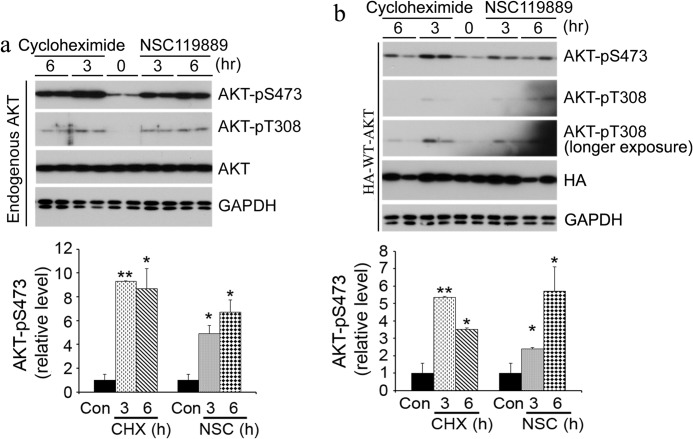
The homeostasis of protein metabolism is maintained and regulated by the rates of protein biosynthesis and degradation in living systems. Alterations of protein degradation may regulate protein biosynthesis through a feedback mechanism. Whether a change in protein biosynthesis modulates protein degradation has not been reported. In this study, we found that inhibition of protein biosynthesis induced phosphorylation/activation of AKT and led to phosphorylation of AKT target substrates, including FoxO1, GSK3α/β, p70S6K, AS160, and the E3 ubiquitin ligase MDM2. Phosphorylation of ribosomal protein S6 was also modulated by inhibition of protein biosynthesis. The AKT phosphorylation/activation was mediated mainly through the PI3K pathway because it was blocked by the PI3K inhibitor LY294002. The activated AKT phosphorylated MDM2 at Ser(166) and promoted degradation of the tumor suppressor p53. These findings suggest that inhibition of protein biosynthesis can alter degradation of some proteins through activation of AKT. This study reveals a novel regulation of protein degradation and calls for caution in blocking protein biosynthesis to study the half-life of proteins.
Keywords: AKT; Protein Degradation; Protein Synthesis; Protein Turnover; Signal Transduction.
Figures



References
-
- Baliga B. S., Pronczuk A. W., Munro H. N. (1969) Mechanism of cycloheximide inhibition of protein synthesis in a cell-free system prepared from rat liver. J. Biol. Chem. 244, 4480–4489 - PubMed
-
- Baskić D., Popović S., Ristić P., Arsenijević N. N. (2006) Analysis of cycloheximide-induced apoptosis in human leukocytes: fluorescence microscopy using annexin V/propidium iodide versus acridine orange/ethidium bromide. Cell Biol. Int. 30, 924–932 - PubMed
-
- Ishii H. H., Etheridge M. R., Gobé G. C. (1995) Cycloheximide-induced apoptosis in Burkitt lymphoma (BJA-B) cells with and without Epstein-Barr virus infection. Immunol. Cell Biol. 73, 463–468 - PubMed
-
- Tsuchida T., Kato T., Yamada A., Kawamoto K. (2002) Cycloheximide induces apoptosis of astrocytes. Pathol. Int. 52, 181–185 - PubMed
Publication types
MeSH terms
Substances
Grants and funding
LinkOut - more resources
Full Text Sources
Other Literature Sources
Molecular Biology Databases
Research Materials
Miscellaneous
