. 2013:2013:795906.
doi: 10.1155/2013/795906. Epub 2013 Jun 17.

Acupuncture-evoked response in somatosensory and prefrontal cortices predicts immediate pain reduction in carpal tunnel syndrome

Affiliations

Acupuncture-evoked response in somatosensory and prefrontal cortices predicts immediate pain reduction in carpal tunnel syndrome

Yumi Maeda et al. Evid Based Complement Alternat Med. 2013.

Abstract

The linkage between brain response to acupuncture and subsequent analgesia remains poorly understood. Our aim was to evaluate this linkage in chronic pain patients with carpal tunnel syndrome (CTS). Brain response to electroacupuncture (EA) was evaluated with functional MRI. Subjects were randomized to 3 groups: (1) EA applied at local acupoints on the affected wrist (PC-7 to TW-5), (2) EA at distal acupoints (contralateral ankle, SP-6 to LV-4), and (3) sham EA at nonacupoint locations on the affected wrist. Symptom ratings were evaluated prior to and following the scan. Subjects in the local and distal groups reported reduced pain. Verum EA produced greater reduction of paresthesia compared to sham. Compared to sham EA, local EA produced greater activation in insula and S2 and greater deactivation in ipsilateral S1, while distal EA produced greater activation in S2 and deactivation in posterior cingulate cortex. Brain response to distal EA in prefrontal cortex (PFC) and brain response to verum EA in S1, SMA, and PFC were correlated with pain reduction following stimulation. Thus, while greater activation to verum acupuncture in these regions may predict subsequent analgesia, PFC activation may specifically mediate reduced pain when stimulating distal acupoints.


Figures

Figure 1
Figure 1
Acupoints and schematic scan session. Verum EA was performed at both (a) local (PC7 to TW5) and (b) distal (SP6 to LV4) acupoints. Sham EA used noninsertive needles placed over sham points, SH1 and SH2. (c) Our fMRI event-related study design for acupuncture stimulation.
Figure 2
Figure 2
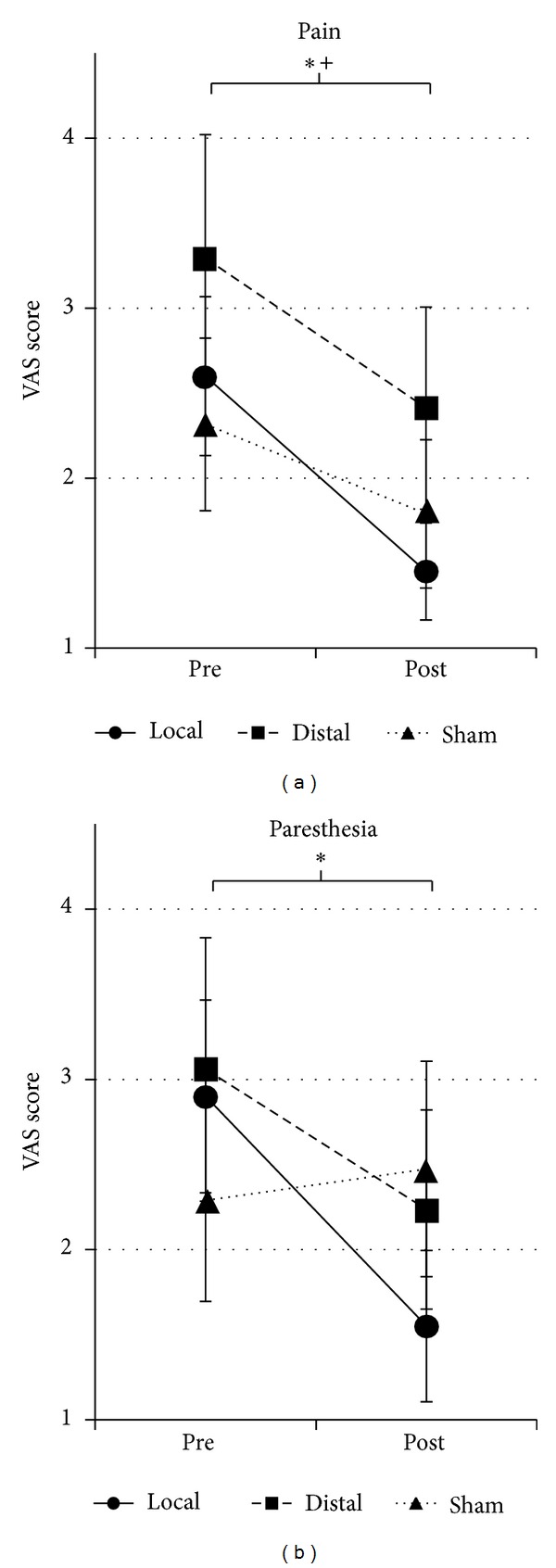
Symptom rating before and after acupuncture. A significant main effect of Time (pre versus post) was found for pain and paresthesia VAS score (F 1,56 = 19.3, P < 0.0001; F 1,56 = 5.2, P < 0.03, resp.), indicating reduced pain and paresthesia after acupuncture. Post hoc testing found that local EA reduced pain and paresthesia (*P < 0.01) while distal EA reduced pain (+ P < 0.05). Error bars indicate standard error of the mean.
Figure 3
Figure 3
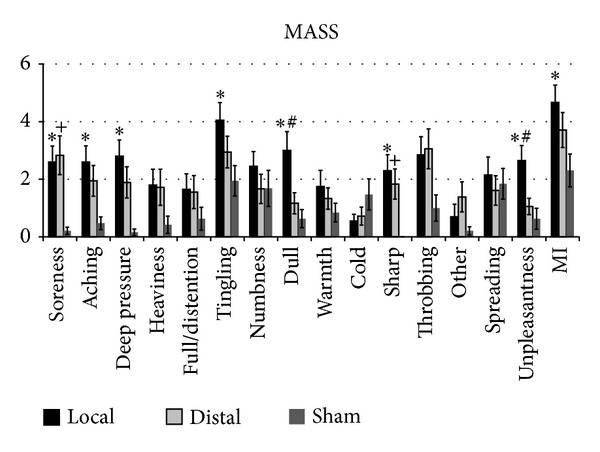
Acupuncture sensations. A significant difference between local and sham EA was found for soreness, aching, deep pressure, tingling, sharp pain, unpleasantness, and MI (*P < 0.05). A significant difference between distal and sham EA was found for soreness and sharp pain (+ P < 0.05). A significant difference between local and distal EA was found for dull pain and unpleasantness (# P < 0.05). Error bars indicate standard error of the mean.
Figure 4
Figure 4
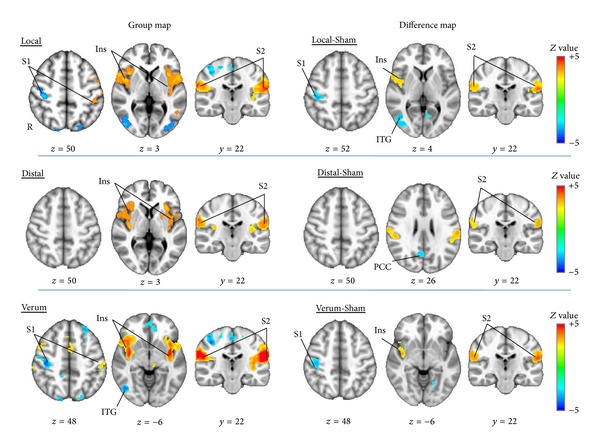
Group and difference maps of brain response during acupuncture. Local EA produced activation in contralateral primary somatosensory cortex (S1) and bilateral insulae and secondary somatosensory cortex (S2) and deactivation in ipsilateral S1. Distal EA produced activation in bilateral insula and S2. Verum EA (combined local and distal) produced activation in left S1 and bilateral insulae and secondary somatosensory cortex (S2) and deactivation in the medial prefrontal cortex (PFC) and right S1. Compared to sham EA, local EA produced greater activation in right insula and bilateral S2 and while greater deactivation in ipsilateral S1 and inferior temporal gyrus (ITG). Distal EA produced greater activation in bilateral S2 and greater deactivation in PCC. Verum EA produced greater activation in right insula and bilateral S2 and greater deactivation in right S1. Note: S1 was analyzed using a midsagittal plane flipped analysis (as S1 is known to be lateralized in activity relative to the stimulated side), while other regions were analyzed using a more conventional nonflipped analysis. All coordinates are in MNI space.
Figure 5
Figure 5
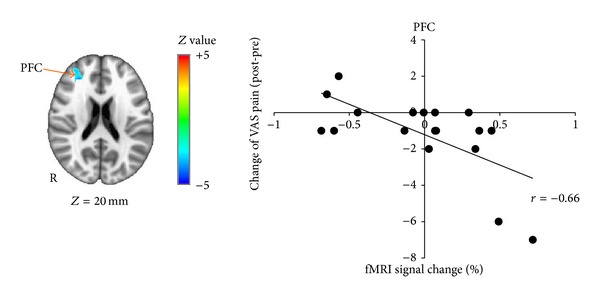
Brain response in right prefrontal cortex correlated with pain reduction in distal group. Brain response in right prefrontal cortex (PFC) was negatively correlated with change in VAS pain score (post-pre) in distal group. Percent signal change in rPFC was extracted from the peak voxel and plotted with change of VAS pain score (post-pre).
Figure 6
Figure 6
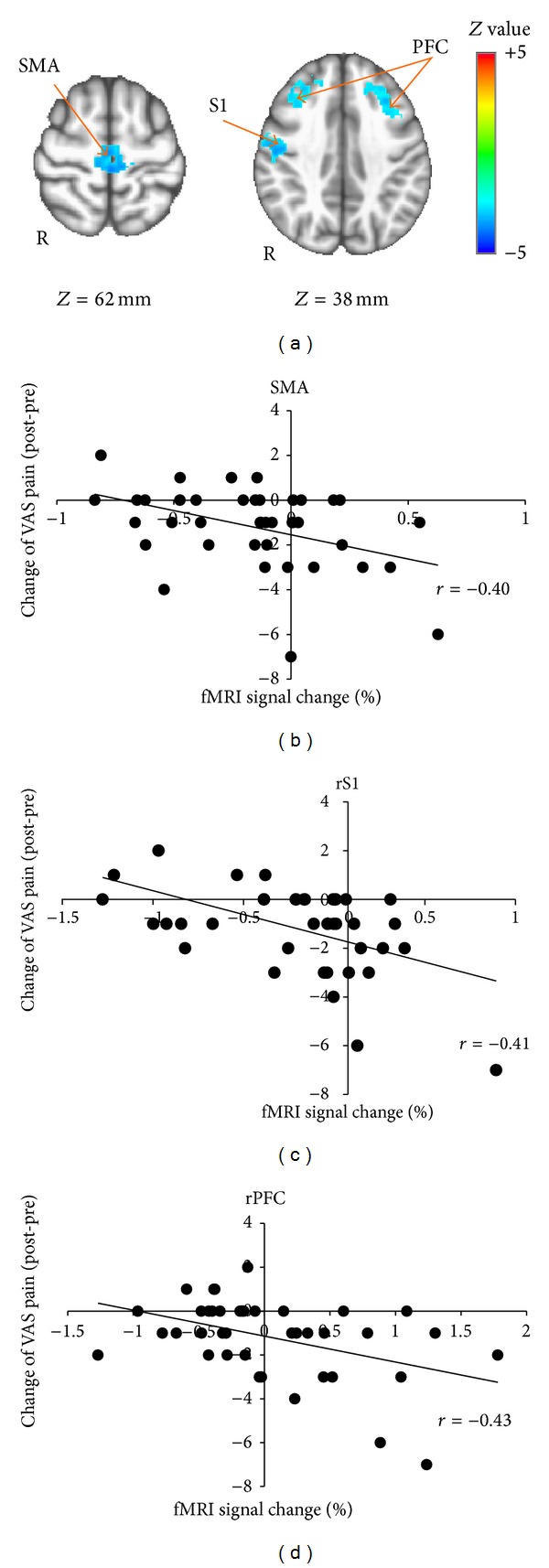
Brain response in bilateral SMA, PFC, and right S1 correlated with pain reduction in verum group. Brain response in bilateral SMA, PFC, and right S1 were negatively correlated with changes in VAS pain score (post-pre). fMRI percent signal change in SMA, PFC, and right S1 were extracted from the peak voxel and plotted with change of VAS pain score.

References

    1. Vickers AJ, Cronin AM, Maschino AC, et al. Acupuncture for chronic pain: individual patient data meta-analysis. Archives of Internal Medicine. 2012;172(19):1444–1453. - PMC - PubMed
    1. Kiernan MC, Mogyoros I, Burke D. Conduction block in carpal tunnel syndrome. Brain. 1999;122(5):933–941. - PubMed
    1. Yang C, Hsieh C, Wang N, et al. Acupuncture in patients with carpal tunnel syndrome a randomized controlled trial. Clinical Journal of Pain. 2009;25(4):327–333. - PubMed
    1. Kumnerddee W, Kaewtong A. Efficacy of acupuncture versus night splinting for carpal tunnel syndrome: a randomized clinical trial. Journal of the Medical Association of Thailand. 2010;93(12):1463–1469. - PubMed
    1. Yao E, Gerritz PK, Henricson E, et al. Randomized controlled trial comparing acupuncture with placebo acupuncture for the treatment of carpal tunnel syndrome. PM and R. 2012;4(5):367–373. - PubMed

LinkOut - more resources