


The continuum of maternal sepsis severity: incidence and risk factors in a population-based cohort study
- PMID: 23843991
- PMCID: PMC3699572
- DOI: 10.1371/journal.pone.0067175
The continuum of maternal sepsis severity: incidence and risk factors in a population-based cohort study
Abstract
Objective: To investigate the incidence and risk factors associated with uncomplicated maternal sepsis and progression to severe sepsis in a large population-based birth cohort.
Methods: This retrospective cohort study used linked hospital discharge and vital statistics records data for 1,622,474 live births in California during 2005-2007. Demographic and clinical factors were adjusted using multivariable logistic regression with robust standard errors.
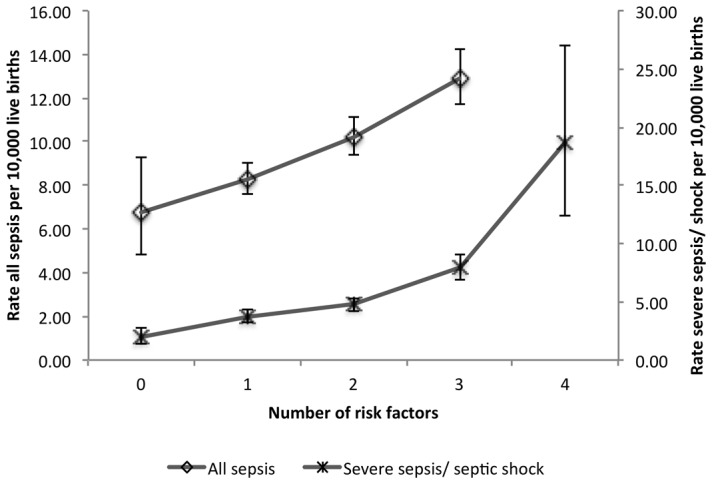
Results: 1598 mothers developed sepsis; incidence of all sepsis was 10 per 10,000 live births (95% CI = 9.4-10.3). Women had significantly increased adjusted odds (aOR) of developing sepsis if they were older (25-34 years: aOR = 1.29; ≥35 years: aOR = 1.41), had ≤high-school education (aOR = 1.63), public/no-insurance (aOR = 1.22) or a cesarean section (primary: aOR = 1.99; repeat: aOR = 1.25). 791 women progressed to severe sepsis; incidence of severe sepsis was 4.9 per 10,000 live births (95% CI = 4.5-5.2). Women had significantly increased adjusted odds of progressing to severe sepsis if they were Black (aOR = 2.09), Asian (aOR = 1.59), Hispanic (aOR = 1.42), had public/no-insurance (aOR = 1.52), delivered in hospitals with <1,000 births/year (aOR = 1.93), were primiparous (aOR = 2.03), had a multiple birth (aOR = 3.5), diabetes (aOR = 1.47), or chronic hypertension (aOR = 8.51). Preeclampsia and postpartum hemorrhage were also significantly associated with progression to severe sepsis (aOR = 3.72; aOR = 4.18). For every cumulative factor, risk of uncomplicated sepsis increased by 25% (95% CI = 17.4-32.3) and risk of progression to severe sepsis/septic shock increased by 57% (95% CI = 40.8-74.4).
Conclusions: The rate of severe sepsis was approximately twice the 1991-2003 national estimate. Risk factors identified are relevant to obstetric practice given their cumulative risk effect and the apparent increase in severe sepsis incidence.
Conflict of interest statement
Figures
References
-
- van Dillen J, Zwart J, Schutte J, van Roosmalen J (2010) Maternal sepsis: epidemiology, etiology and outcome. Curr Opin Infect Dis 23: 249–254 doi:10.1097/QCO.0b013e328339257c - DOI - PubMed
-
- Kramer HMC, Schutte JM, Zwart JJ, Schuitemaker NWE, Steegers EAP, et al. (2009) Maternal mortality and severe morbidity from sepsis in the Netherlands. Acta Obstet Gynecol Scand 88: 647–653 doi:10.1080/00016340902926734 - DOI - PubMed
-
- Cantwell R, Clutton-Brock T, Cooper G, Dawson A, Drife J, et al. (2011) Saving Mothers' Lives: Reviewing maternal deaths to make motherhood safer: 2006–2008. The Eighth Report of the Confidential Enquiries into Maternal Deaths in the United Kingdom. BJOG 118 Suppl 11–203 doi:10.1111/j.1471-0528.2010.02847.x - DOI - PubMed
-
- Martin GS, Mannino DM, Eaton S, Moss M (2003) The epidemiology of sepsis in the United States from 1979 through 2000. N Engl J Med 348: 1546–1554 doi:10.1056/NEJMoa022139 - DOI - PubMed
-
- Dombrovskiy VY, Martin AA, Sunderram J, Paz HL (2007) Rapid increase in hospitalization and mortality rates for severe sepsis in the United States: a trend analysis from 1993 to 2003. Crit Care Med 35: 1244–1250 doi:10.1097/01.CCM.0000261890.41311.E9 - DOI - PubMed
Publication types
MeSH terms
Grants and funding
LinkOut - more resources
Full Text Sources
Other Literature Sources
Medical
