


Association of atrial fibrosis quantified using LGE-MRI with atrial appendage thrombus and spontaneous contrast on transesophageal echocardiography in patients with atrial fibrillation
- PMID: 23844972
- PMCID: PMC3818287
- DOI: 10.1111/jce.12199
Association of atrial fibrosis quantified using LGE-MRI with atrial appendage thrombus and spontaneous contrast on transesophageal echocardiography in patients with atrial fibrillation
Abstract
Introduction: Transesophageal echocardiography (TEE) is used to evaluate for left atrial appendage (LAA) thrombi prior to restoration of sinus rhythm in atrial fibrillation (AF). We examined the relationship of atrial fibrosis quantified using late gadolinium enhancement MRI (LGE-MRI) with TEE findings.
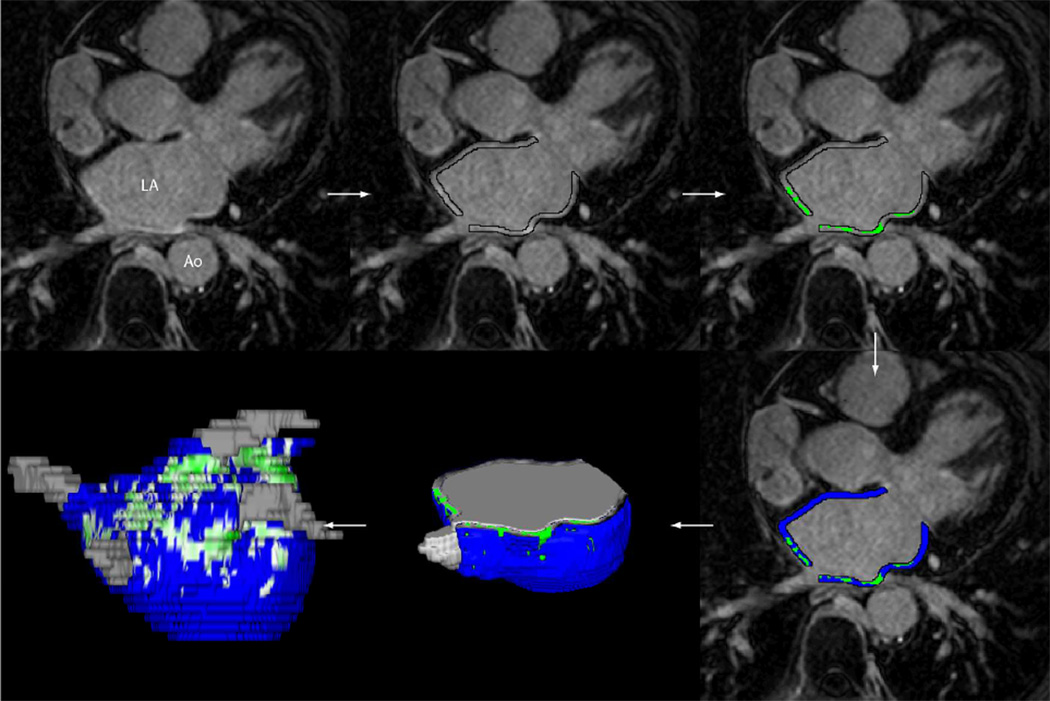
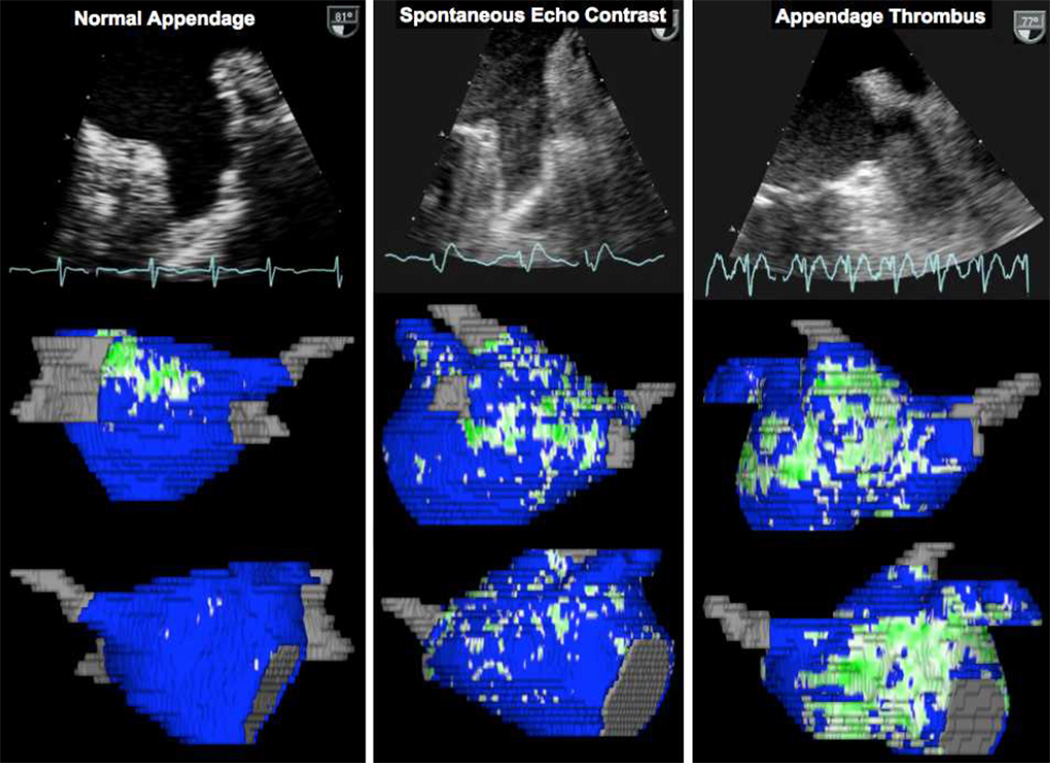
Methods and results: We included 178 patients with AF, undergoing TEE and LGE-MRI prior to ablation or cardioversion. LGE-MRI and subsequent image processing was used to quantify atrial fibrosis based on signal intensity analysis. The mean CHADS2 score was 1.24 ± 1.08 and CHA2 DS2 -VASc was 2.08 ± 1.33. The LAA was classified as normal, spontaneous echocardiographic contrast (SEC) present or thrombus present. LAA thrombus was found in 12 patients (6.7%) while SEC was identified in 19 patients (10.7%). Patients with thrombus had higher atrial fibrosis compared to patients without thrombus (26.9 ± 17.4% vs 16.7 ± 10.5%; P < 0.01). Atrial fibrosis was also higher in patients with SEC (23.3 ± 13.7%) compared to those without SEC (16.7 ± 10.8%; P = 0.01). Patients with high atrial fibrosis (>20%) were more likely to have a LAA thrombus (odds ratio 4.6; P = 0.02) and SEC (odds ratio 2.6; P = 0.06). Multivariate logistic regression showed high fibrosis (odds ratio 3.6; P < 0.01) and CHADS2 ≥2 (odds ratio 3.5; P < 0.01) were significant predictors of TEE abnormalities (LAA thrombus or SEC). The area under the curve for the model including high fibrosis, AF type and CHADS2 ≥2 or CHA2 DS2 -VASc ≥2 was 0.73 compared to 0.63 and 0.65 for CHADS2 and CHA2 DS2 -VASc alone.
Conclusions: Atrial fibrosis is independently associated with appendage thrombus and spontaneous contrast. It provides additional risk stratification not captured by clinical parameters.
Keywords: appendage thrombus; atrial fibrillation; catheter ablation; magnetic resonance imaging; stroke; transesophageal echocardiography.
© 2013 Wiley Periodicals, Inc.
Figures
References
-
- Wang TJ, Larson MG, Levy D, Vasan RS, Leip EP, Wolf PA, D'Agostino RB, Murabito JM, Kannel WB, Benjamin EJ. Temporal relations of atrial fibrillation and congestive heart failure and their joint influence on mortality: The framingham heart study. Circulation. 2003;107:2920–2925. - PubMed
-
- Roger VL, Go AS, Lloyd-Jones DM, Benjamin EJ, Berry JD, Borden WB, Bravata DM, Dai S, Ford ES, Fox CS, Fullerton HJ, Gillespie C, Hailpern SM, Heit JA, Howard VJ, Kissela BM, Kittner SJ, Lackland DT, Lichtman JH, Lisabeth LD, Makuc DM, Marcus GM, Marelli A, Matchar DB, Moy CS, Mozaffarian D, Mussolino ME, Nichol G, Paynter NP, Soliman EZ, Sorlie PD, Sotoodehnia N, Turan TN, Virani SS, Wong ND, Woo D, Turner MB. Heart disease and stroke statistics--2012 update: A report from the american heart association. Circulation. 2012;125:e2–e220. - PMC - PubMed
-
- Dulli DA, Stanko H, Levine RL. Atrial fibrillation is associated with severe acute ischemic stroke. Neuroepidemiology. 2003;22:118–123. - PubMed
-
- Allessie M, Ausma J, Schotten U. Electrical, contractile and structural remodeling during atrial fibrillation. Cardiovascular Research. 2002;54:230–246. - PubMed
-
- Ausma J, Wijffels M, Thone F, Wouters L, Allessie M, Borgers M. Structural changes of atrial myocardium due to sustained atrial fibrillation in the goat. Circulation. 1997;96:3157–3163. - PubMed
Publication types
MeSH terms
Substances
Grants and funding
LinkOut - more resources
Full Text Sources
Other Literature Sources
Medical
