Review
. 2013 Aug;29(8):385-93.
doi: 10.1016/j.pt.2013.06.003. Epub 2013 Jul 8.

Wolbachia: Can we save lives with a great pandemic?

Affiliations
Review

Wolbachia: Can we save lives with a great pandemic?

Daniel LePage et al. Trends Parasitol. 2013 Aug.

Abstract

Wolbachia pipientis is the most common bacterial infection in the animal world and wields a vast influence on invertebrate reproduction, sex determination, speciation, and behavior worldwide. These avenues of research have made seminal gains, including the latest use of Wolbachia to alter mosquito populations and a strengthened focus on using anti-Wolbachia therapies against filarial nematode infections. This work is further bolstered by a more refined knowledge of Wolbachia biology spanning mechanisms to relevance. Here we tally the most up-to-date knowledge in the field and review the immense implications that this global infection has for the basic and applied life sciences.

Keywords: Wolbachia pipientis; filarial disease; vector control.


Figures

Figure 1
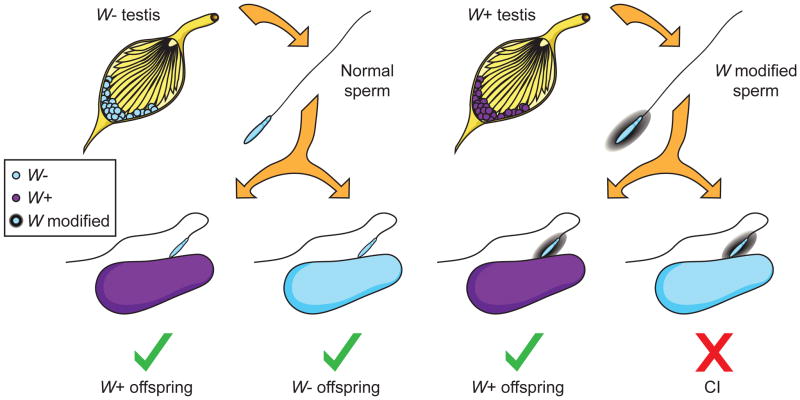
Figure 1. Wolbachia-induced cytoplasmic incompatibility
Wolbachia (W, purple) infection causes a modification in the sperm that can be rescued by eggs of infected females but leads to embryonic death in uninfected embryos. Abbreviations: W−, Wolbachia-uninfected; W+, Wolbachia-infected; W modified, Wolbachia-modified sperm. Illustration by Robert M. Brucker.
Figure 2
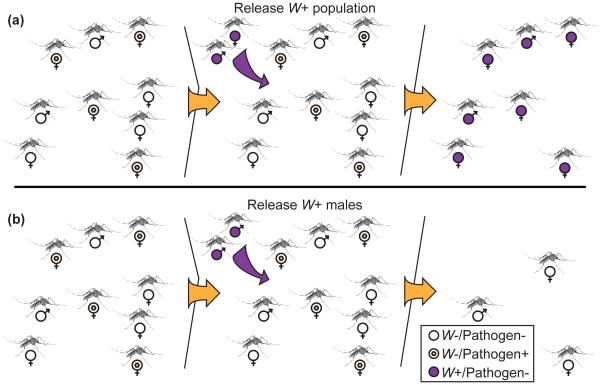
Figure 2. Vector control strategies
(A) Population Replacement Strategy switches a wild population of mosquitoes (pathogen carrying, Wolbachia uninfected) with a pathogen-free one through Wolbachia-induced CI. (B) In the Incompatible Insect Technique, a release of just Wolbachia infected males leads to high levels of CI and a reduction in the total vector population. Abbreviations: W−, Wolbachia-uninfected; W+, Wolbachia-infected; Pathogen+, pathogen-infected; Pathogen-, pathogen-uninfected. Illustration by Robert M. Brucker.
Figure 3
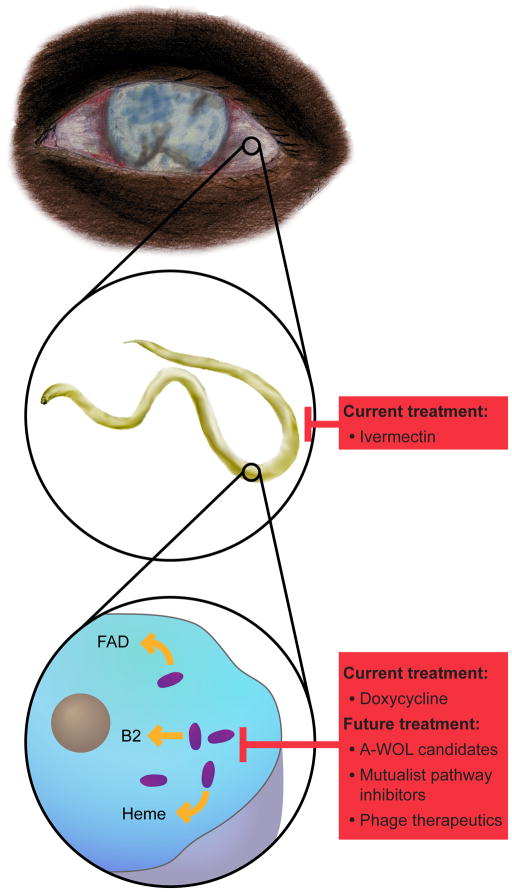
Figure 3. Elimination of filarial nematodes
Diseases such as river blindness and lymphatic filariasis, traditionally treated with anti-filarial medications, could benefit from anti-Wolbachia approaches that target the host-bacterial symbiosis. Illustration by Robert M. Brucker.

References

    1. Zug R, Hammerstein P. Still a host of hosts for Wolbachia: Analysis of recent data suggests that 40% of terrestrial arthropod species are infected. PLoS One. 2012;7:e38544. - PMC - PubMed
    1. Ferri E, et al. New insights into the evolution of Wolbachia infections in filarial nematodes inferred from a large range of screened species. PLoS One. 2011;6:e20843. - PMC - PubMed
    1. Le Clec’h W, et al. Cannibalism and predation as paths for horizontal passage of Wolbachia between terrestrial isopods. PLoS One. 2013;8:e60232. - PMC - PubMed
    1. Frydman HM, et al. Somatic stem cell niche tropism in Wolbachia. Nature. 2006;441:509–12. - PubMed
    1. Iturbe-Ormaetxe I, et al. Wolbachia and the biological control of mosquito-borne disease. EMBO reports. 2011;12:508–18. - PMC - PubMed

Publication types