Single FGF-23 measurement and time-averaged plasma phosphate levels in hemodialysis patients
- PMID: 23846463
- PMCID: PMC3789357
- DOI: 10.2215/CJN.13021212
Single FGF-23 measurement and time-averaged plasma phosphate levels in hemodialysis patients
Abstract
Background and objectives: Plasma phosphate levels display considerable intraindividual variability. The phosphatonin fibroblast growth factor 23 is a central regulator of plasma phosphate levels, and it has been postulated to be a more stable marker than conventional CKD-mineral and bone disorder parameters. Thus, fibroblast growth factor 23 has been hypothesized to reflect time-averaged plasma phosphate levels in CKD patients.
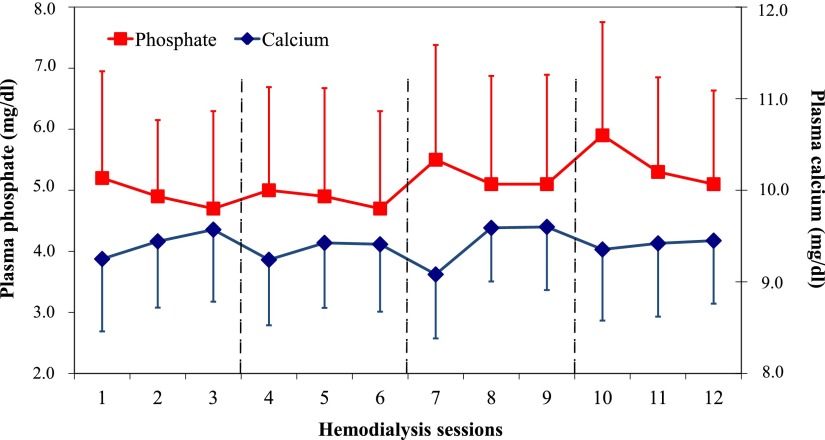
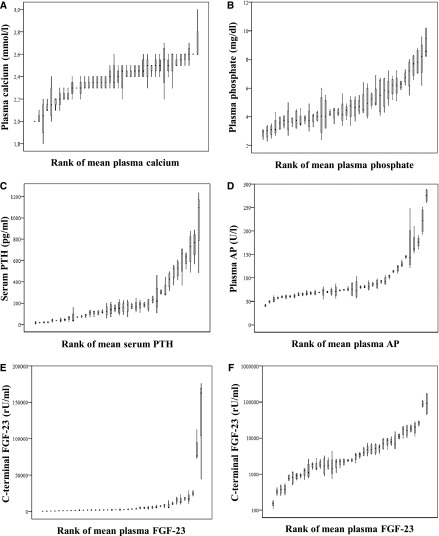
Design, setting, participants, & measurements: Among 40 patients from the outpatient dialysis center, serial measurements of plasma calcium and phosphate (before every dialysis session) as well as C-terminal fibroblast growth factor 23, parathyroid hormone, and alkaline phosphatase (one time weekly) were performed over a study period of 4 weeks in November and December of 2011. Intraindividual variability of repeated plasma fibroblast growth factor 23 measurements compared with other CKD-mineral and bone disorder markers was tested, and the association of a single plasma fibroblast growth factor 23 measurement with time-averaged plasma phosphate levels was analyzed.
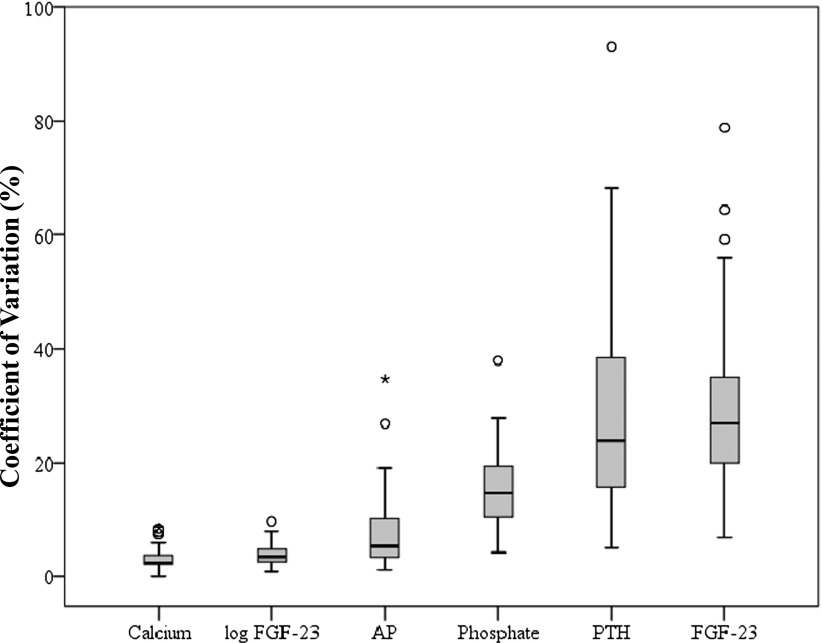
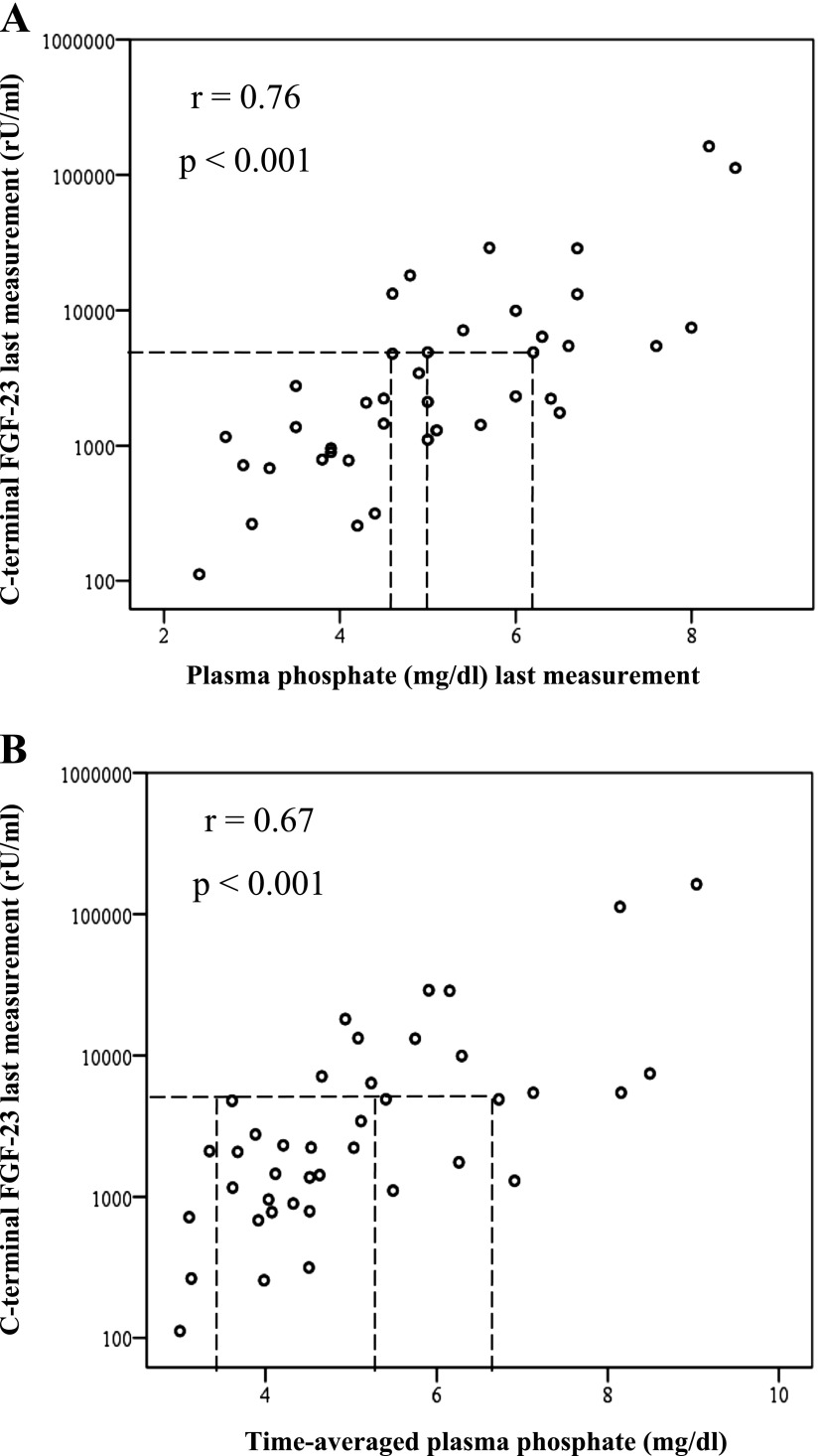
Results: Against expectations, intraindividual variability of fibroblast growth factor 23 (median coefficient of variation=27%; interquartile range=20-35) was not lower than variability of plasma phosphate (median coefficient of variation=15%; interquartile range=10-20), parathyroid hormone (median coefficient of variation=24%; interquartile range=15-39), plasma calcium (median coefficient of variation=3%; interquartile range=2-4), or alkaline phosphatase (median coefficient of variation=5%; interquartile range=3-10). Moreover, the correlation between the last fibroblast growth factor 23 measurement after 4 weeks and time-averaged plasma phosphate did not surpass the correlation between the last fibroblast growth factor 23 measurement and a single plasma phosphate value (r=0.67, P<0.001; r=0.76, P<0.001, respectively).
Conclusions: Surprisingly, fibroblast growth factor 23 was not more closely associated to time-averaged plasma phosphate levels than a single plasma phosphate value, and it did not show a lower intraindividual variability than other tested markers of CKD-mineral and bone disorder. Thus, fibroblast growth factor 23 should not be used in clinical practice as a reflector of time-averaged plasma phosphate levels.
Figures
References
-
- Ketteler M, Wolf M, Hahn K, Ritz E: Phosphate: A novel cardiovascular risk factor. Eur Heart J 34: 1099–1101, 2013 - PubMed
-
- Block GA, Hulbert-Shearon TE, Levin NW, Port FK: Association of serum phosphorus and calcium x phosphate product with mortality risk in chronic hemodialysis patients: A national study. Am J Kidney Dis 31: 607–617, 1998 - PubMed
-
- Block GA, Klassen PS, Lazarus JM, Ofsthun N, Lowrie EG, Chertow GM: Mineral metabolism, mortality, and morbidity in maintenance hemodialysis. J Am Soc Nephrol 15: 2208–2218, 2004 - PubMed
-
- Tentori F, Blayney MJ, Albert JM, Gillespie BW, Kerr PG, Bommer J, Young EW, Akizawa T, Akiba T, Pisoni RL, Robinson BM, Port FK: Mortality risk for dialysis patients with different levels of serum calcium, phosphorus, and PTH: The Dialysis Outcomes and Practice Patterns Study (DOPPS). Am J Kidney Dis 52: 519–530, 2008 - PubMed
-
- Wald R, Sarnak MJ, Tighiouart H, Cheung AK, Levey AS, Eknoyan G, Miskulin DC: Disordered mineral metabolism in hemodialysis patients: An analysis of cumulative effects in the Hemodialysis (HEMO) Study. Am J Kidney Dis 52: 531–540, 2008 - PubMed
MeSH terms
Substances
LinkOut - more resources
Full Text Sources
Other Literature Sources
Medical