


Enhanced bactericidal potency of nanoliposomes by modification of the fusion activity between liposomes and bacterium
- PMID: 23847417
- PMCID: PMC3700910
- DOI: 10.2147/IJN.S42617
Enhanced bactericidal potency of nanoliposomes by modification of the fusion activity between liposomes and bacterium
Abstract
Background: Pseudomonas aeruginosa represents a good model of antibiotic resistance. These organisms have an outer membrane with a low level of permeability to drugs that is often combined with multidrug efflux pumps, enzymatic inactivation of the drug, or alteration of its molecular target. The acute and growing problem of antibiotic resistance of Pseudomonas to conventional antibiotics made it imperative to develop new liposome formulations to overcome these mechanisms, and investigate the fusion between liposome and bacterium.
Methods: The rigidity, stability and charge properties of phospholipid vesicles were modified by varying the cholesterol, 1,2-dioleoyl-sn-glycero-3-phosphatidylethanolamine (DOPE), and negatively charged lipids 1,2-dimyristoyl-sn-glycero-3-phosphoglycerol sodium salt (DMPG), 1,2-dimyristoyl-sn-glycero-3-phopho-L-serine sodium salt (DMPS), 1,2-dimyristoyl-sn-glycero-3-phosphate monosodium salt (DMPA), nature phosphatidylserine sodium salt from brain and nature phosphatidylinositol sodium salt from soybean concentrations in liposomes. Liposomal fusion with intact bacteria was monitored using a lipid-mixing assay.
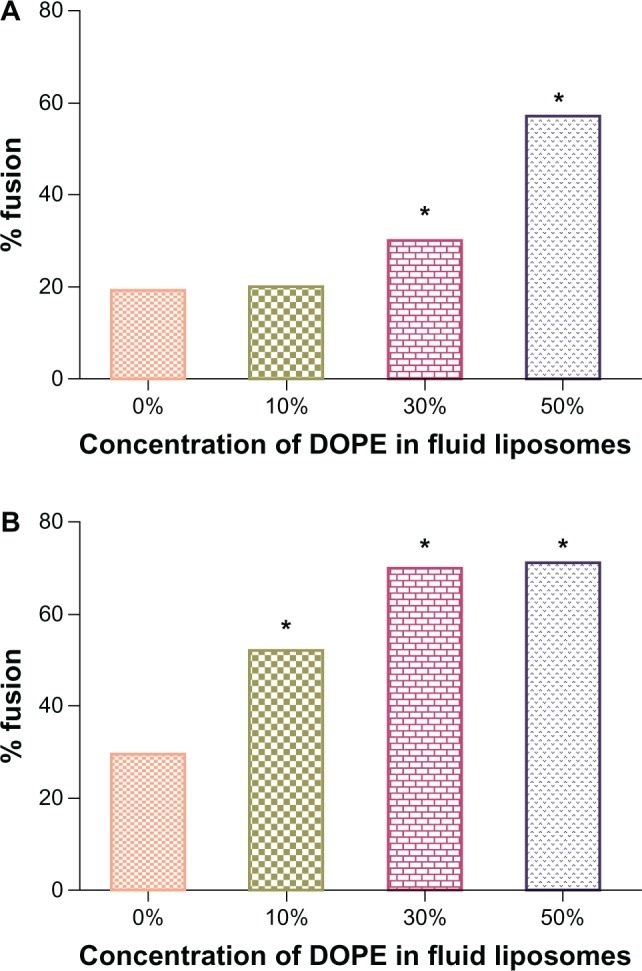
Results: It was discovered that the fluid liposomes-bacterium fusion is not dependent on liposomal size and lamellarity. A similar degree of fusion was observed for liposomes with a particle size from 100 to 800 nm. The fluidity of liposomes is an essential pre-request for liposomes fusion with bacteria. Fusion was almost completely inhibited by incorporation of cholesterol into fluid liposomes. The increase in the amount of negative charges in fluid liposomes reduces fluid liposomes-bacteria fusion when tested without calcium cations due to electric repulsion, but addition of calcium cations brings the fusion level of fluid liposomes to similar or higher levels. Among the negative phospholipids examined, DMPA gave the highest degree of fusion, DMPS and DMPG had intermediate fusion levels, and PI resulted in the lowest degree of fusion. Furthermore, the fluid liposomal encapsulated tobramycin was prepared, and the bactericidal effect occurred more quickly when bacteria were cultured with liposomal encapsulated tobramycin.
Conclusion: The bactericidal potency of fluid liposomes is dramatically enhanced with respect to fusion ability when the fusogenic lipid, DOPE, is included. Regardless of changes in liposome composition, fluid liposomes-bacterium fusion is universally enhanced by calcium ions. The information obtained in this study will increase our understanding of fluid liposomal action mechanisms, and help in optimizing the new generation of fluid liposomal formulations for the treatment of pulmonary bacterial infections.
Keywords: Pseudomonas aeruginosa; bacteria; fusion; lipid composition; liposomes.
Figures




References
-
- Beaulac C, Clement-Major S, Hawari J, Lagace J. In vitro kinetics of drug release and pulmonary retention of microencapsulated antibiotic in liposomal formulations in relation to the lipid composition. J Microencapsul. 1997;14(3):335–348. - PubMed
-
- Omri A, Suntres ZE, Shek PN. Enhanced activity of liposomal polymyxin B against Pseudomonas aeruginosa in a rat model of lung infection. Biochem Pharmacol. 2002;64(9):1407–1413. - PubMed
-
- Beaulac C, Sachetelli S, Lagace J. In-vitro bactericidal efficacy of sub-MIC concentrations of liposome-encapsulated antibiotic against gram-negative and gram-positive bacteria. J Antimicrob Chemother. 1998;41(1):35–41. - PubMed
-
- Nicolosi D, Scalia M, Nicolosi VM, Pignatello R. Encapsulation in fusogenic liposomes broadens the spectrum of action of vancomycin against Gram-negative bacteria. Int J Antimicrob Agents. 2010;35(6):553–558. - PubMed
-
- Drulis-Kawa Z, Dorotkiewicz-Jach A. Liposomes as delivery systems for antibiotics. Int J Pharm. 2010;387(1–2):187–198. - PubMed
Publication types
MeSH terms
Substances
LinkOut - more resources
Full Text Sources
Other Literature Sources
Medical
Molecular Biology Databases
Research Materials
Miscellaneous
