


On the antiquity of language: the reinterpretation of Neandertal linguistic capacities and its consequences
- PMID: 23847571
- PMCID: PMC3701805
- DOI: 10.3389/fpsyg.2013.00397
On the antiquity of language: the reinterpretation of Neandertal linguistic capacities and its consequences
Abstract
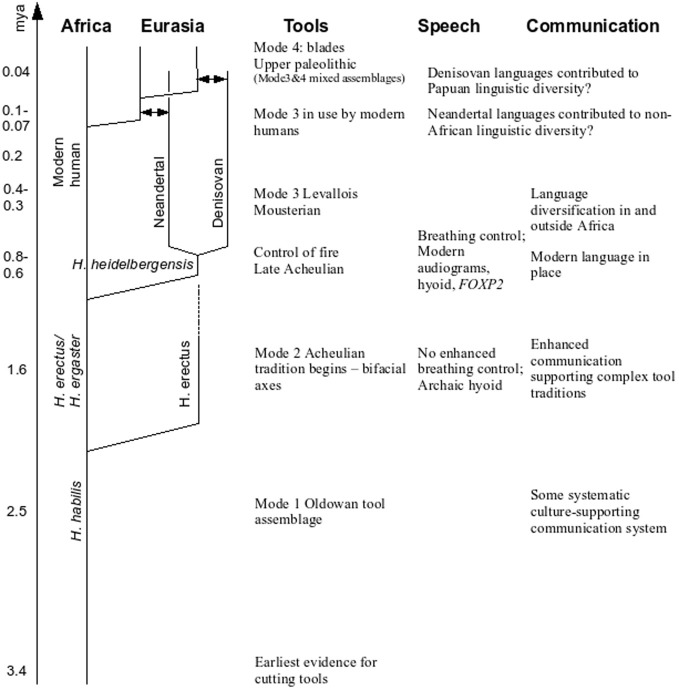
It is usually assumed that modern language is a recent phenomenon, coinciding with the emergence of modern humans themselves. Many assume as well that this is the result of a single, sudden mutation giving rise to the full "modern package." However, we argue here that recognizably modern language is likely an ancient feature of our genus pre-dating at least the common ancestor of modern humans and Neandertals about half a million years ago. To this end, we adduce a broad range of evidence from linguistics, genetics, paleontology, and archaeology clearly suggesting that Neandertals shared with us something like modern speech and language. This reassessment of the antiquity of modern language, from the usually quoted 50,000-100,000 years to half a million years, has profound consequences for our understanding of our own evolution in general and especially for the sciences of speech and language. As such, it argues against a saltationist scenario for the evolution of language, and toward a gradual process of culture-gene co-evolution extending to the present day. Another consequence is that the present-day linguistic diversity might better reflect the properties of the design space for language and not just the vagaries of history, and could also contain traces of the languages spoken by other human forms such as the Neandertals.
Keywords: genetic admixture; human evolution; language contact; language evolution.
Figures
References
LinkOut - more resources
Full Text Sources
Other Literature Sources
Research Materials
