


Evidence for impaired amyloid β clearance in Alzheimer's disease
- PMID: 23849219
- PMCID: PMC3978761
- DOI: 10.1186/alzrt187
Evidence for impaired amyloid β clearance in Alzheimer's disease
Abstract
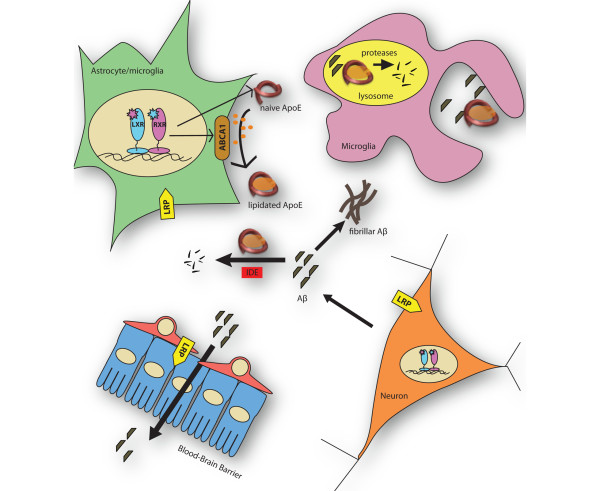
Alzheimer's disease (AD) is a common neurodegenerative disease characterized by the accumulation of extracellular plaques and intracellular tangles. Recent studies support the hypothesis that the accumulation of amyloid beta (Aβ) peptide within the brain arises from an imbalance of the production and clearance of Aβ. In rare genetic forms of AD, this imbalance is often caused by increased production of Aβ. However, recent evidence indicates that, in the majority of cases of AD, Aβ clearance is impaired. Apolipoprotein E (ApoE), the dominant cholesterol and lipid carrier in the brain, is critical for Aβ catabolism. The isoform of ApoE and its degree of lipidation critically regulate the efficiency of Aβ clearance. Studies in preclinical models of AD have demonstrated that coordinately increasing levels of ApoE and its lipid transporter, ABCA1, increases the clearance of Aβ, suggesting that this pathway may be a potential therapeutic target for AD.
Figures
References
-
- Cirrito JR, May PC, O'Dell MA, Taylor JW, Parsadanian M, Cramer JW, Audia JE, Nissen JS, Bales KR, Paul SM, DeMattos RB, Holtzman DM. In vivo assessment of brain interstitial fluid with microdialysis reveals plaque-associated changes in amyloid-beta metabolism and half-life. J Neurosci. 2003;5:8844–8853. - PMC - PubMed
-
- Castellano JM, Deane R, Gottesdiener AJ, Verghese PB, Stewart FR, West T, Paoletti AC, Kasper TR, DeMattos RB, Zlokovic BV, Holtzman DM. Low-density lipoprotein receptor overexpression enhances the rate of brain-to-blood Abeta clearance in a mouse model of beta-amyloidosis. Proc Natl Acad Sci USA. 2012;5:15502–15507. doi: 10.1073/pnas.1206446109. - DOI - PMC - PubMed
Publication types
Grants and funding
LinkOut - more resources
Full Text Sources
Other Literature Sources
Miscellaneous
