


Safety of ranibizumab in routine clinical practice: 1-year retrospective pooled analysis of four European neovascular AMD registries within the LUMINOUS programme
- PMID: 23850682
- PMCID: PMC3756427
- DOI: 10.1136/bjophthalmol-2013-303232
Safety of ranibizumab in routine clinical practice: 1-year retrospective pooled analysis of four European neovascular AMD registries within the LUMINOUS programme
Abstract
Purpose: Evaluation of 1-year safety profile of intravitreal ranibizumab 0.5 mg in neovascular age-related macular degeneration (NV-AMD) within routine clinical practice.
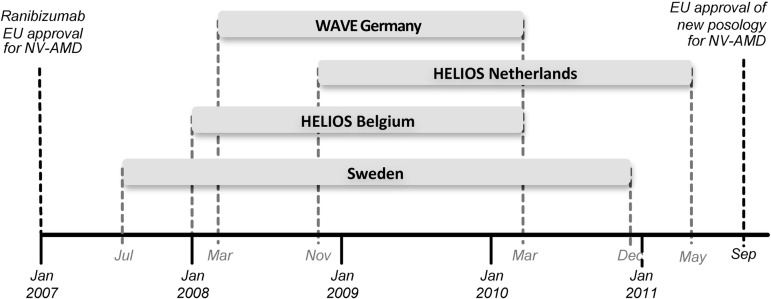
Methods: The LUMINOUS programme comprises a prospective observational study assessing ranibizumab 'real-world' safety and clinical effectiveness across licensed indications worldwide and an annual retrospective pooled safety analysis from completed NV-AMD ranibizumab registries. 1-year data from four European registries are available. This retrospective pooled safety analysis assessed 1-year incidence rates for safety events of particular interest (key ocular or systemic events possibly related to the injection procedure or vascular endothelial growth factor inhibition) together with treatment exposure. Patients were treated according to local protocols within the ranibizumab licence.
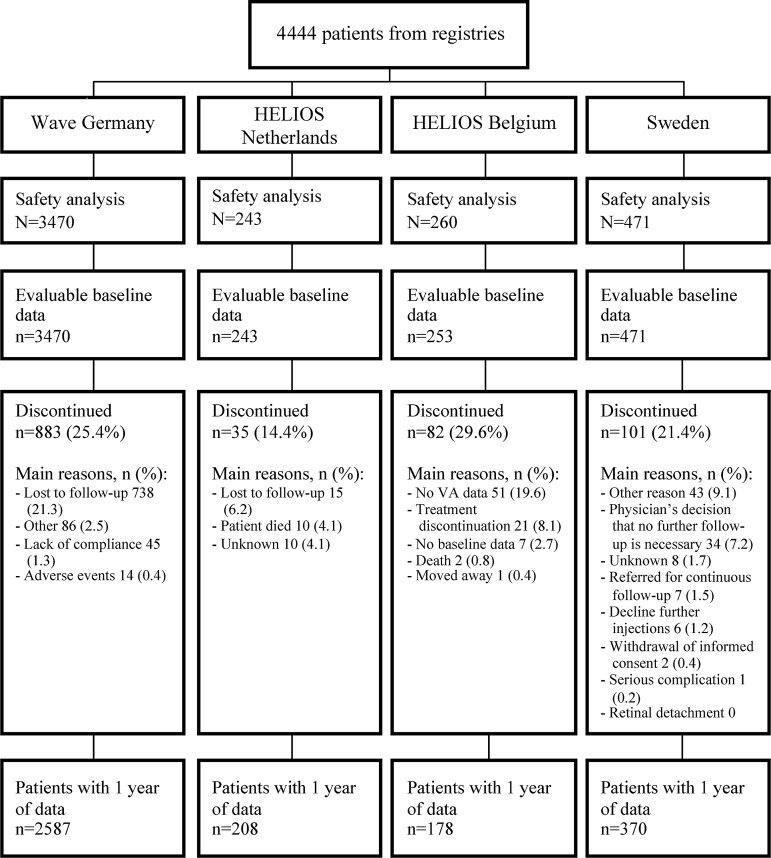
Results: Data of 4444 patients from registries in Germany (n=3470), the Netherlands (n=243), Belgium (n=260) and Sweden (n=471) were retrospectively pooled. Between 70.4% and 84.4% of enrolled patients completed 1 year of follow-up. Most frequent overall ocular events of particular interest were retinal pigment epithelial tears (27 patients; <1%) and intraocular pressure-related events (12 patients; <0.3%). Most frequent non-ocular event of particular interest was stroke (19 patients; 0.4%); annual incidence of stroke was low across all registries (0.0-0.5%).
Conclusions: Ranibizumab demonstrated favourable 1-year safety profile for NV-AMD in this routine clinical practice sample, consistent with previous reported trial data. Additional data from a larger patient population are needed to better describe the long-term safety profile of ranibizumab in routine clinical practice and further evaluate risk for infrequent but serious events in 'real-life' settings. The 5-year LUMINOUS prospective observational study will address this need.
Keywords: Degeneration; Macula; Treatment Medical.
Figures
References
-
- Brown DM, Kaiser PK, Michels M, et al. Ranibizumab versus verteporfin for neovascular age-related macular degeneration. N Engl J Med 2006;355:1432–44 - PubMed
-
- Brown DM, Michels M, Kaiser PK, et al. Ranibizumab versus verteporfin photodynamic therapy for neovascular age-related macular degeneration: two-year results of the ANCHOR study. Ophthalmology 2009;116:57–65 - PubMed
-
- Rosenfeld PJ, Brown DM, Heier JS, et al. Ranibizumab for neovascular age-related macular degeneration. N Engl J Med 2006;355:1419–31 - PubMed
-
- Brown DM, Campochiaro PA, Bhisitkul RB, et al. Sustained benefits from ranibizumab for macular edema following branch retinal vein occlusion: 12-month outcomes of a phase III study. Ophthalmology 2011;118:1594–602 - PubMed
-
- Campochiaro PA, Brown DM, Awh CC, et al. Sustained benefits from ranibizumab for macular edema following central retinal vein occlusion: twelve-month outcomes of a phase III study. Ophthalmology 2011;118:2041–9 - PubMed
Publication types
MeSH terms
Substances
LinkOut - more resources
Full Text Sources
Other Literature Sources
Medical
