


Nisin resistance of Listeria monocytogenes is increased by exposure to salt stress and is mediated via LiaR
- PMID: 23851083
- PMCID: PMC3754191
- DOI: 10.1128/AEM.01797-13
Nisin resistance of Listeria monocytogenes is increased by exposure to salt stress and is mediated via LiaR
Abstract
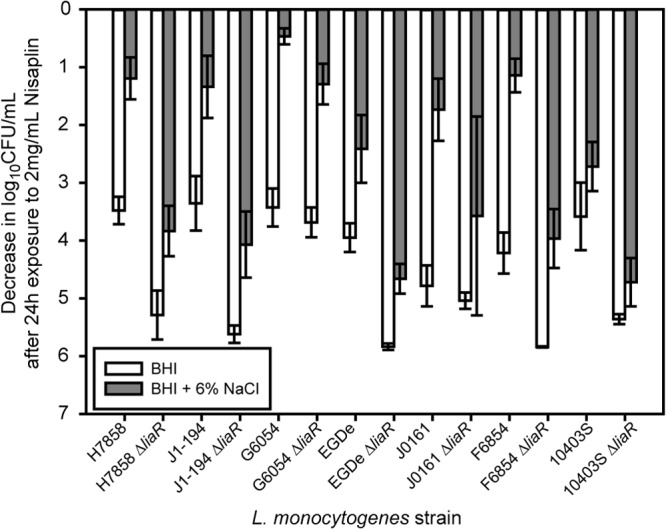
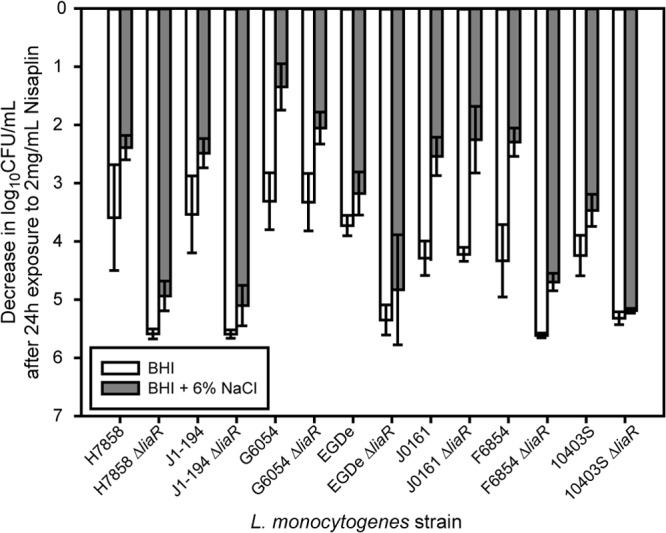
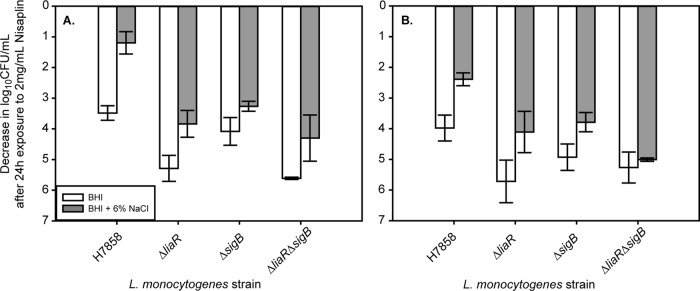
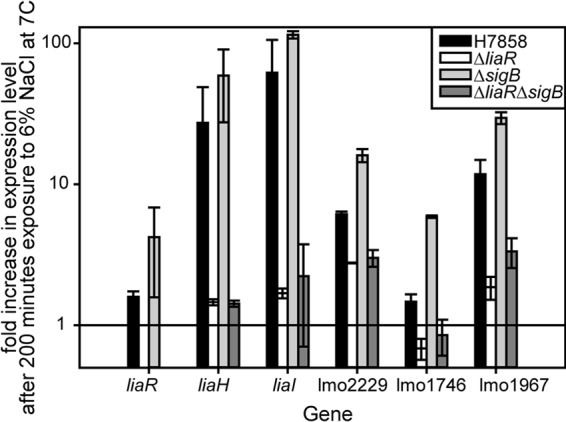
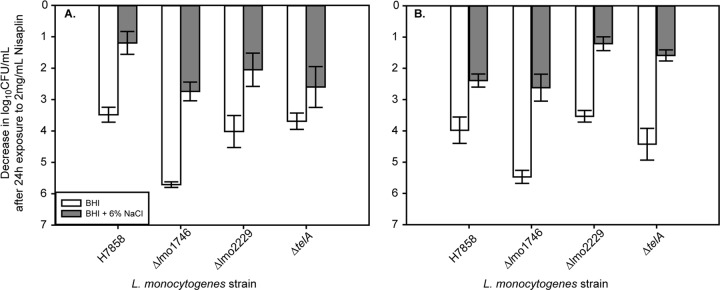
Growth of Listeria monocytogenes on refrigerated, ready-to-eat food is a significant food safety concern. Natural antimicrobials, such as nisin, can be used to control this pathogen on food, but little is known about how other food-related stresses may impact how the pathogen responds to these compounds. Prior work demonstrated that exposure of L. monocytogenes to salt stress at 7°C led to increased expression of genes involved in nisin resistance, including the response regulator liaR. We hypothesized that exposure to salt stress would increase subsequent resistance to nisin and that LiaR would contribute to increased nisin resistance. Isogenic deletion mutations in liaR were constructed in 7 strains of L. monocytogenes, and strains were exposed to 6% NaCl in brain heart infusion broth and then tested for resistance to nisin (2 mg/ml Nisaplin) at 7°C. For the wild-type strains, exposure to salt significantly increased subsequent nisin resistance (P < 0.0001) over innate levels of resistance. Compared to the salt-induced nisin resistance of wild-type strains, ΔliaR strains were significantly more sensitive to nisin (P < 0.001), indicating that induction of LiaFSR led to cross-protection of L. monocytogenes against subsequent inactivation by nisin. Transcript levels of LiaR-regulated genes were induced by salt stress, and lmo1746 and telA were found to contribute to LiaR-mediated salt-induced nisin resistance. These data suggest that environmental stresses similar to those on foods can influence the resistance of L. monocytogenes to antimicrobials such as nisin, and potential cross-protective effects should be considered when selecting and applying control measures for this pathogen on ready-to-eat foods.
Figures
References
-
- Swaminathan B, Cabanes D, Zhang W, Cossart P. 2007. Listeria monocytogenes. In Doyle MP, Beuchat LR. (ed), Food microbiology: fundamentals and frontiers, 3rd ed. ASM Press, Washington, DC
-
- FDA 2003. Quantitative assessment of relative risk to public health from foodborne Listeria monocytogenes among selected categories of ready-to-eat foods. FDA, Silver Spring, MD
-
- Pradhan AK, Ivanek R, Grohn YT, Geornaras I, Sofos JN, Wiedmann M. 2009. Quantitative risk assessment for Listeria monocytogenes in selected categories of deli meats: impact of lactate and diacetate on listeriosis cases and deaths. J. Food Prot. 72:978–989 - PubMed
-
- Ferreira MA, Lund BM. 1996. The effect of nisin on Listeria monocytogenes in culture medium and long-life cottage cheese. Lett. Appl. Microbiol. 22:433–438 - PubMed
-
- Franklin NB, Cooksey KD, Getty KJ. 2004. Inhibition of Listeria monocytogenes on the surface of individually packaged hot dogs with a packaging film coating containing nisin. J. Food Prot. 67:480–485 - PubMed
Publication types
MeSH terms
Substances
Grants and funding
LinkOut - more resources
Full Text Sources
Other Literature Sources
Medical
