Review
. 2013 Sep;26(3):159-79.
doi: 10.1007/s00497-013-0222-y. Epub 2013 Jul 14.

Apomixis in plant reproduction: a novel perspective on an old dilemma

Affiliations
Review

Apomixis in plant reproduction: a novel perspective on an old dilemma

Gianni Barcaccia et al. Plant Reprod. 2013 Sep.

Abstract

Seed is one of the key factors of crop productivity. Therefore, a comprehension of the mechanisms underlying seed formation in cultivated plants is crucial for the quantitative and qualitative progress of agricultural production. In angiosperms, two pathways of reproduction through seed exist: sexual or amphimictic, and asexual or apomictic; the former is largely exploited by seed companies for breeding new varieties, whereas the latter is receiving continuously increasing attention from both scientific and industrial sectors in basic research projects. If apomixis is engineered into sexual crops in a controlled manner, its impact on agriculture will be broad and profound. In fact, apomixis will allow clonal seed production and thus enable efficient and consistent yields of high-quality seeds, fruits, and vegetables at lower costs. The development of apomixis technology is expected to have a revolutionary impact on agricultural and food production by reducing cost and breeding time, and avoiding the complications that are typical of sexual reproduction (e.g., incompatibility barriers) and vegetative propagation (e.g., viral transfer). However, the development of apomixis technology in agriculture requires a deeper knowledge of the mechanisms that regulate reproductive development in plants. This knowledge is a necessary prerequisite to understanding the genetic control of the apomictic process and its deviations from the sexual process. Our molecular understanding of apomixis will be greatly advanced when genes that are specifically or differentially expressed during embryo and embryo sac formation are discovered. In our review, we report the main findings on this subject by examining two approaches: i) analysis of the apomictic process in natural apomictic species to search for genes controlling apomixis and ii) analysis of gene mutations resembling apomixis or its components in species that normally reproduce sexually. In fact, our opinion is that a novel perspective on this old dilemma pertaining to the molecular control of apomixis can emerge from a cross-check among candidate genes in natural apomicts and a high-throughput analysis of sexual mutants.


Figures
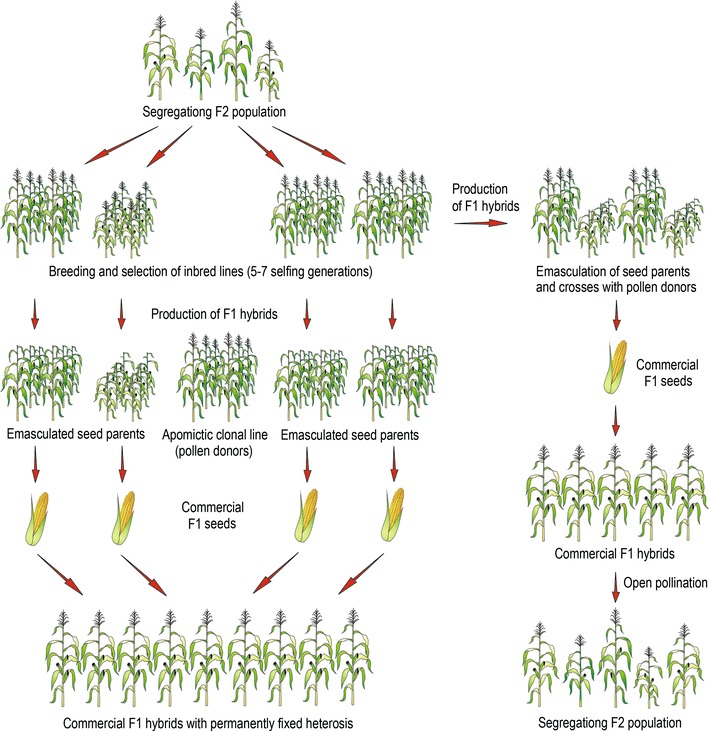
Fig. 1
Fig. 1
Comparison between conventional and apomixis-mediated methods for breeding F1 hybrid varieties. In traditional breeding, within a segregating population (e.g., F2 population) some genotypes are selected and after some generation of selfing followed by phenotypic selection, tested for their specific combining ability in order to be used as parental lines for the constitution of heterotic F1 hybrid seeds. The best performing inbred lines are selected, multiplied in isolated fields, and crossed in pairwise combinations to obtain uniform, vigorous, and high-yield F1 hybrids. This scheme, however, requires a series of actions: the two inbred lines must be kept pure and multiplied in separate fields. Then, to obtain the hybrid seed, it is necessary to establish a dedicated field where about one quarter of the plants is used as pollinator (i.e., pollen donor inbred) and on the remaining plants (i.e., seed parent inbred) the hybrid F1 seeds will be harvested. Farmers cannot re-use seeds collected from F1 hybrids as these seeds will give rise to highly variable populations because of genetic segregation and recombination. Using apomictic lines, however, the situation would be much simpler. Once superior inbred lines to be used as seed parent are selected, they can be crossed with clonal lines as pollen donors carrying the gene for apomixis, in order to obtain F1 hybrid seeds sharing a highly heterozygous genotype. From this moment on, each F1 hybrid variety can be maintained for several generations with permanently fixed heterosis
Fig. 2
Fig. 2
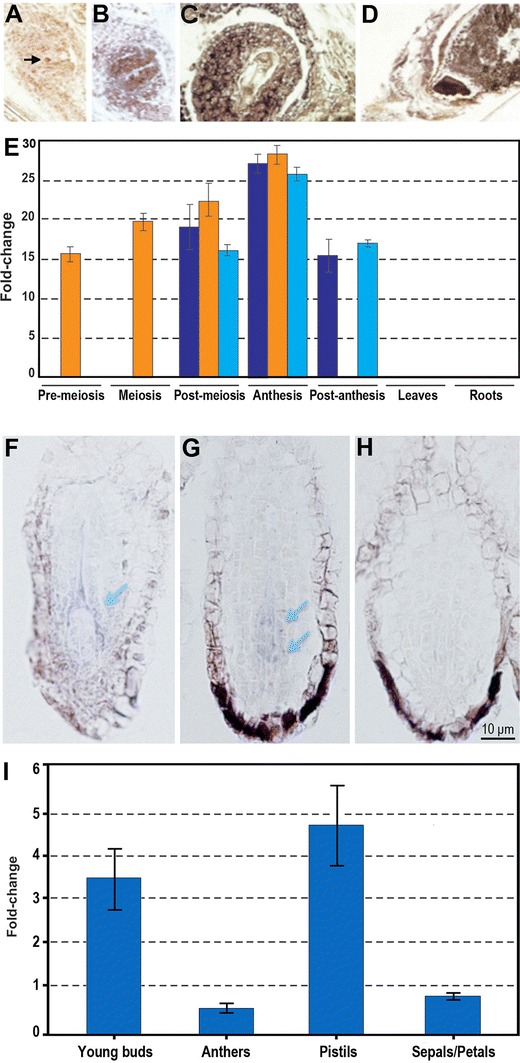
Expression data related to candidate genes for apomixis. Gene expression patterns and levels of APOSTART6 in P. pratensis and ARIADNE7 in H. perforatum as assessed by in situ hybridization and real-time RT-PCR analysis. ad APOSTART6 expression patterns in longitudinal sections of P. pratensis ovaries: signal is present in one or more nucellar cells (arrow) within the ovule of apomictic genotypes (a) and in the megaspore mother cell in sexual genotypes (data not shown, for details see Albertini et al. 2005). Signal is then present during embryo sac development (b, c) and embryo development (d). e Expression patterns and level of transcripts encoded by APOSTART6 in apomictic (dark blue), sexual (red), and parthenogenic recombinant (light blue) genotypes of P. pratensis (for details see Marconi et al. 2013). Delay of expression in apomictic and parthenogenetic genotypes suggests an involvement of APOSTART6 in parthenogenesis. f, g Longitudinal sections of H. perforatum ovules at the stage of female meiosis showing hybridization signals of ARIADNE7 transcripts (arrows) in correspondence with nucellar tissues next to megaspores; h negative control (courtesy of Giulio Galla, University of Padova). i Expression levels of the ARIADNE7 transcripts in young buds, anthers, pistils, and sepals and petals: this gene was found preferentially expressed in pistils and young buds of apomictic genotypes. Specificity of expression domain in apomictic and aposporic genotypes suggests an involvement of ARIADNE7 in apospory

References

    1. Akiyama Y, Conner JA, Goel S, Morishige DT, Mullet JE, Hanna WW, Ozias-Akins P. High-resolution physical mapping in Pennisetum squamulatum reveals extensive chromosomal heteromorphism of the genomic region associated with apomixis. Plant Physiol. 2004;134:1733–1741. doi: 10.1104/pp.103.033969. - DOI - PMC - PubMed
    1. Albertini E, Barcaccia G (2007) Apomeiosis in Poa pratensis L. and Medicago sativa L. In: Horandl E, Grossniklaus U, Sharbel T, van Dijk P (eds) Apomixis: evolution, mechanisms and perspectives. Gantner, Ruggel [Regnum Veg. 147], pp 93–116
    1. Albertini E, Porceddu A, Ferranti F, Reale L, Barcaccia G, Falcinelli M. Apospory and parthenogenesis may be uncoupled in Poa pratensis L: cytological and genetic evidences. Sex Plant Reprod. 2001;14:213–217. doi: 10.1007/s00497-001-0116-2. - DOI - PubMed
    1. Albertini E, Marconi G, Barcaccia G, Raggi L, Falcinelli M. Isolation of candidate genes for apomixis in Poa pratensis L. Plant Mol Biol. 2004;56:879–894. doi: 10.1007/s11103-004-5211-y. - DOI - PubMed
    1. Albertini E, Marconi G, Reale L, Barcaccia G, Porceddu A, Ferranti F, Falcinelli M. SERK and APOSTART: candidate genes for apomixis in Poa pratensis L. Plant Physiol. 2005;138:2185–2199. doi: 10.1104/pp.105.062059. - DOI - PMC - PubMed

Publication types