


Correlation between mutation rate and genome size in riboviruses: mutation rate of bacteriophage Qβ
- PMID: 23852383
- PMCID: PMC3761305
- DOI: 10.1534/genetics.113.154963
Correlation between mutation rate and genome size in riboviruses: mutation rate of bacteriophage Qβ
Abstract
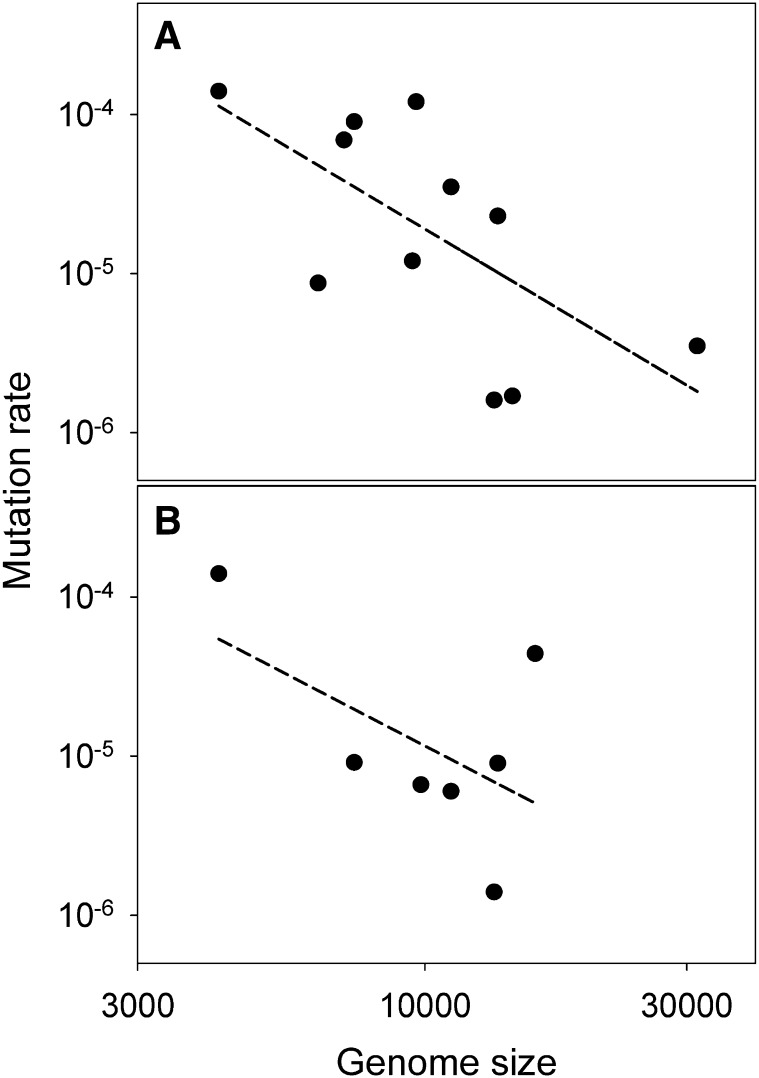
Genome sizes and mutation rates covary across all domains of life. In unicellular organisms and DNA viruses, they show an inverse relationship known as Drake's rule. However, it is still unclear whether a similar relationship exists between genome sizes and mutation rates in RNA genomes. Coronaviruses, the RNA viruses with the largest genomes (∼30 kb), encode a proofreading 3' exonuclease that allows them to increase replication fidelity. However, it is unknown whether, conversely, the RNA viruses with the smallest genomes tend to show particularly high mutation rates. To test this, we measured the mutation rate of bacteriophage Qβ, a 4.2-kb levivirus. Amber reversion-based Luria-Delbrück fluctuation tests combined with mutant sequencing gave an estimate of 1.4 × 10(-4) substitutions per nucleotide per round of copying, the highest mutation rate reported for any virus using this method. This estimate was confirmed using a direct plaque sequencing approach and after reanalysis of previously published estimates for this phage. Comparison with other riboviruses (all RNA viruses except retroviruses) provided statistical support for a negative correlation between mutation rates and genome sizes. We suggest that the mutation rates of RNA viruses might be optimized for maximal adaptability and that the value of this optimum may in turn depend inversely on genome size.
Figures
References
-
- Anderson J. P., Daifuku R., Loeb L. A., 2004. Viral error catastrophe by mutagenic nucleosides. Annu. Rev. Microbiol. 58: 183–205. - PubMed
-
- Barton N., 1995. A general model for the evolution of recombination. Genet. Res. 65: 123–145. - PubMed
-
- Batschelet E., Domingo E., Weissmann C., 1976. The proportion of revertant and mutant phage in a growing population, as a function of mutation and growth rate. Gene 1: 27–32. - PubMed
-
- Bull J. J., Badgett M. R., Springman R., Molineux I. J., 2004. Genome properties and the limits of adaptation in bacteriophages. Evolution 58: 692–701. - PubMed
Publication types
MeSH terms
Grants and funding
LinkOut - more resources
Full Text Sources
Other Literature Sources
