Adaptive deep brain stimulation in advanced Parkinson disease
- PMID: 23852650
- PMCID: PMC3886292
- DOI: 10.1002/ana.23951
Adaptive deep brain stimulation in advanced Parkinson disease
Abstract
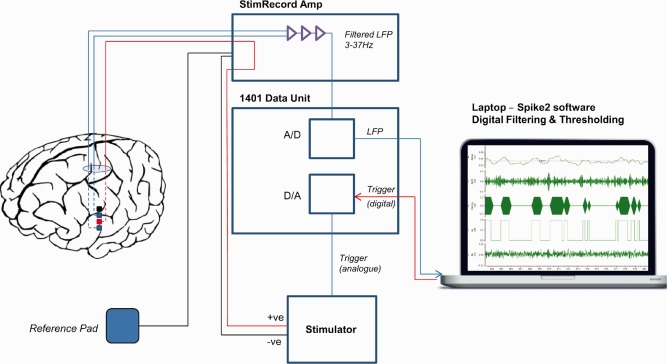
Objective: Brain-computer interfaces (BCIs) could potentially be used to interact with pathological brain signals to intervene and ameliorate their effects in disease states. Here, we provide proof-of-principle of this approach by using a BCI to interpret pathological brain activity in patients with advanced Parkinson disease (PD) and to use this feedback to control when therapeutic deep brain stimulation (DBS) is delivered. Our goal was to demonstrate that by personalizing and optimizing stimulation in real time, we could improve on both the efficacy and efficiency of conventional continuous DBS.
Methods: We tested BCI-controlled adaptive DBS (aDBS) of the subthalamic nucleus in 8 PD patients. Feedback was provided by processing of the local field potentials recorded directly from the stimulation electrodes. The results were compared to no stimulation, conventional continuous stimulation (cDBS), and random intermittent stimulation. Both unblinded and blinded clinical assessments of motor effect were performed using the Unified Parkinson's Disease Rating Scale.
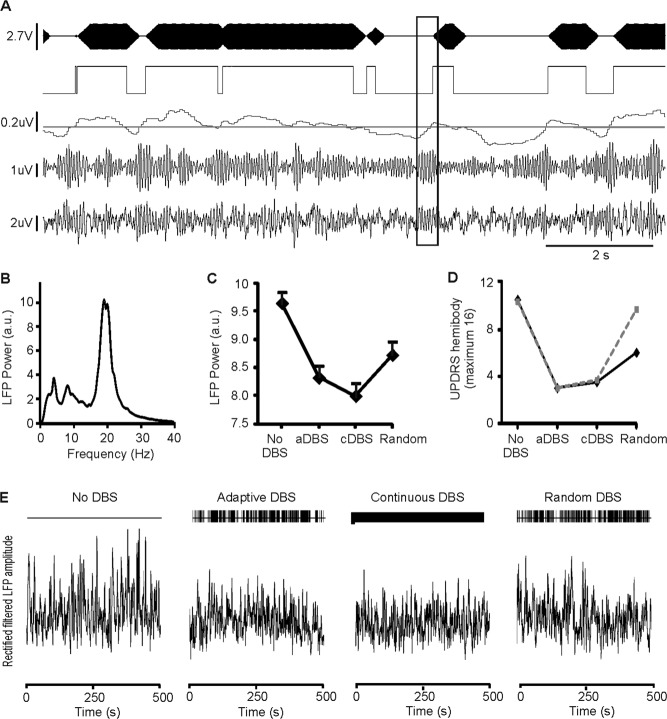
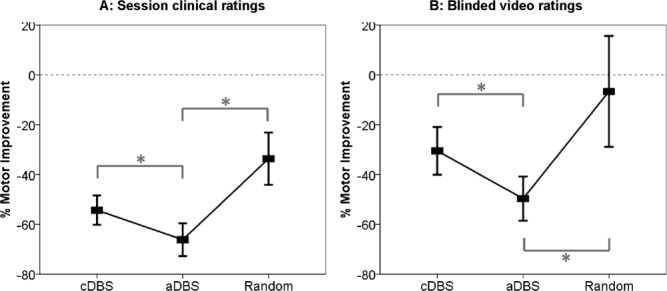
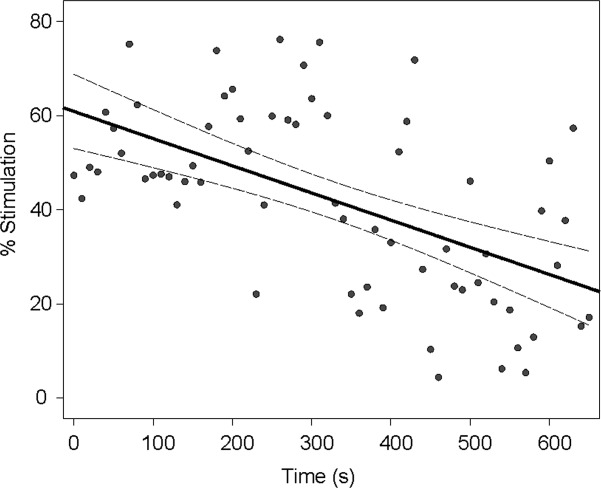
Results: Motor scores improved by 66% (unblinded) and 50% (blinded) during aDBS, which were 29% (p = 0.03) and 27% (p = 0.005) better than cDBS, respectively. These improvements were achieved with a 56% reduction in stimulation time compared to cDBS, and a corresponding reduction in energy requirements (p < 0.001). aDBS was also more effective than no stimulation and random intermittent stimulation.
Interpretation: BCI-controlled DBS is tractable and can be more efficient and efficacious than conventional continuous neuromodulation for PD.
Copyright © 2013 American Neurological Association.
Figures
Comment in
-
Commentary on "Adaptive deep brain stimulation in advanced Parkinson disease".Ann Neurol. 2013 Sep;74(3):447-8. doi: 10.1002/ana.23966. Epub 2013 Sep 10. Ann Neurol. 2013. PMID: 23818322 No abstract available.
References
MeSH terms
Substances
Grants and funding
LinkOut - more resources
Full Text Sources
Other Literature Sources
Medical