. 2013 Feb;9(1):13-22.
doi: 10.2174/1573395511309010003.

Possible Mechanisms of Lymphoma Development in Sjögren's Syndrome

Affiliations
Free PMC article

Possible Mechanisms of Lymphoma Development in Sjögren's Syndrome

Lingli Dong et al. Curr Immunol Rev. 2013 Feb.
Free PMC article

Abstract

Primary Sjögren's syndrome (pSS) is a systemic as well as an organ-specific autoimmune disease characterized by lymphocytic infiltration of the glandular epithelial tissue. SS patients have been reported to be at highest risk of developing lymphoproliferative neoplasms, when compared with patients with other rheumatoid diseases. Factors such as cytokine stimulation, environmental factors, viral infection and genetic events as well as vitamin deficiency may contribute to the development of lymphoma. Over the past few decades, numerous efforts have been made to assess the relationship between lymphoma and SS. These include epidemiological surveys, molecular biologic assessments of clonality and well-linked register cohort studies evaluating the predictive value of clinical, laboratory and histological findings. Nevertheless, the mechanisms and factors predictive of lymphoma development in pSS patients remain to be defined. This review summarizes updated knowledge on the incidence of and risk factors for lymphoma development in pSS patients, as well as discussing the most recent findings on the development and treatment of lymphoma in pSS patients and the possible mechanism of lymphoma development.

Keywords: Incidence of lymphoma development; Sjögren’s syndrome; lymphoma; lymphoproliferative disease; therapeutic progression..


Figures
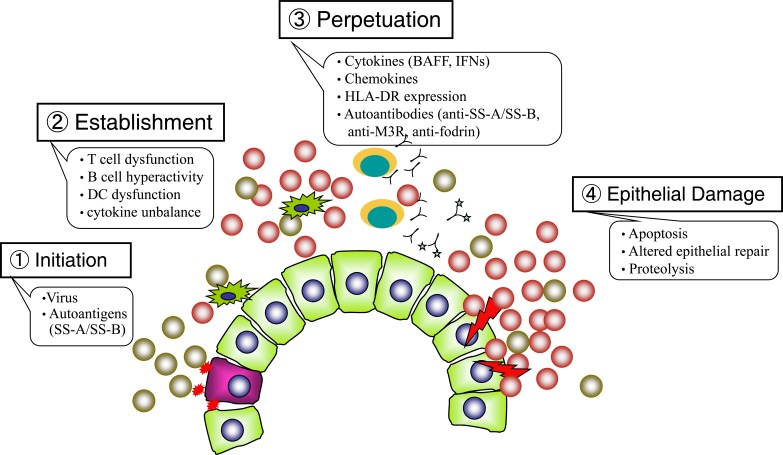
Fig. (1)
Fig. (1)
Pathogenesis of primary SS. The pathogenesis of SS is multifactorial and includes several different steps. Initiation: An initial event (either viral or non-viral) induces cellular necrosis or apoptosis, subsequently expression of the SS-A and/or SS-B antigens on the glandular-cell surface. Establishment: T cell dysfunction, B cell hyperactivity and abnormal function of dendritic cell contribute to establishment of the histopathological lesions. Perpetuation: Production of cytokines (BAFF, IFNs, etc.) and chemokines by the injured gland promote the migration of lymphocytes and dendritic cells in the gland. IFNs up-regulate cell surface expression of HLA class I or II, and of costimulatory molecules such as CD40L and B-7. Antibodies to SS-A/SS-B antigens are produced by HLA-DR-positive B lymphocytes under the influence of a T-helper lymphocytes. Epithelial damage: Production of IFNs by the dendritic cells perpetuates the process of lymphocyte homing, activation and apoptosis of glandular cells. Thus, this vicious cycle that links the innate and acquired immune systems may occur in SS patients.
Fig. (2)
Fig. (2)
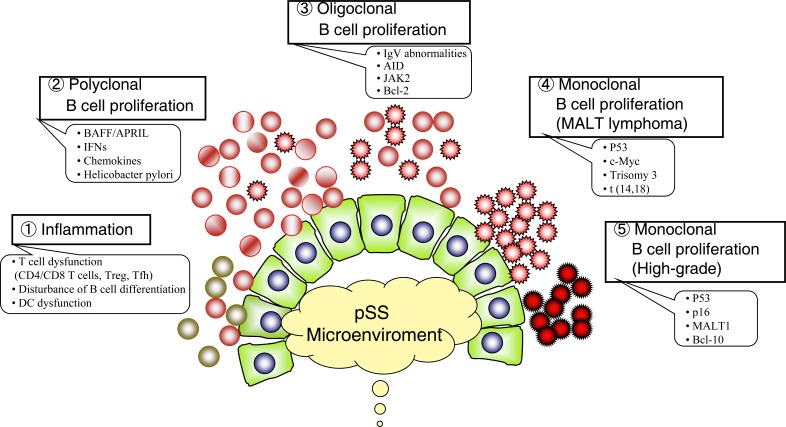
Hypothetical model of lymphoma development in SS patients. The transition from autoimmune state to lymphoma is a multi-step process and that chronic stimulation by exoantigen or autoantigen plays an important role in the development of lymphoma by driving the proliferation of specific B cells and increasing the frequency of their transformation. Inflammation: Infiltration of CD4+ T cells, memory B cells and dendritic cells in the minor salivary glands perpetuate chronic inflammation. (Polyclonal B cell proliferation: Increased production of BAFF and IFNs in SS patients cause polyclonal B cell proliferation and thereby contribute to the characteristic pattern of myoepithelial sialadenitis (MESA) or benign lymphoepithelial lesion. Oligoclonal B cell proliferation: BAFF specifically regulates B lymphocyte proliferation and survival, altered B cell differentiation. Chronic stimulation by exoantigen or autoantigen may drive the proliferation of specific B cells through restricted usage of immunoglobulin heavy chain complementarity determining region 3 (IgVH-CDR3) and increasing the frequency of their transformation. Monoclonal B cell proliferation: During B cell development, immunoglobulins undergo recombination, somatic mutation and isotype switching. These events may increase the risk of translocation of oncogenes such as Bcl-2 and c-Myc to immunoglobulin loci (chromosome 14q32). Transformation to high grade malignancy: Defect of P53 tumor-suppressor activity, high frequency of t(14,18) translocation, amplification of bcl-2 and/or c-Myc, and trisomy 3 may facilitate the progression of low-grade MALT lymphoma to more malignant high-grade lymphoma.

References

    1. Tzioufas AG, Vlachoyiannopoulos PG. Sjogren's syndrome: an update on clinical, basic and diagnostic therapeutic aspects. J Autoimmun. 2012;39(1-2):1–3. - PubMed
    1. Dafni UG, Tzioufas AG, Staikos P, Skopouli FN, Moutsopoulos HM. Prevalence of Sjogren's syndrome in a closed rural community. Ann Rheum Dis. 1997;56(9):521–5. - PMC - PubMed
    1. Miceli-Richard C, Comets E, Loiseau P, Puechal X, Hachulla E, Mariette X. Association of an IRF5 gene functional polymorphism with Sjogren's syndrome. Arthritis Rheum. 2007;56(12):3989–94. - PMC - PubMed
    1. Nordmark G, Kristjansdottir G, Theander E, et al. Additive effects of the major risk alleles of IRF5 and STAT4 in primary Sjogren's syndrome. Genes Immun. 2009;10(1):68–76. - PubMed
    1. Korman BD, Alba MI, Le JM, et al. Variant form of STAT4 is associated with primary Sjogren's syndrome. Genes Immun. 2008;9(3):267–70. - PubMed

LinkOut - more resources