. 2013 Jul;1(3):331-348.
doi: 10.1177/2167702613478594.

The Emerging Field of Human Social Genomics

Affiliations

The Emerging Field of Human Social Genomics

George M Slavich et al. Clin Psychol Sci. 2013 Jul.

Abstract

Although we generally experience our bodies as being biologically stable across time and situations, an emerging field of research is demonstrating that external social conditions, especially our subjective perceptions of those conditions, can influence our most basic internal biological processes-namely, the expression of our genes. This research on human social genomics has begun to identify the types of genes that are subject to social-environmental regulation, the neural and molecular mechanisms that mediate the effects of social processes on gene expression, and the genetic polymorphisms that moderate individual differences in genomic sensitivity to social context. The molecular models resulting from this research provide new opportunities for understanding how social and genetic factors interact to shape complex behavioral phenotypes and susceptibility to disease. This research also sheds new light on the evolution of the human genome and challenges the fundamental belief that our molecular makeup is relatively stable and impermeable to social-environmental influence.

Keywords: 5-HTTLPR; DNA; RNA; disease; gene regulation; health; in_ammation; interleukin-6; metagenomics; social epidemiology; social isolation; social rejection; stress; transcription factors; transcriptome.


Conflict of interest statement

Declaration of Conflicting Interests

The authors declare that they have no conflicts of interest with respect to their authorship or the publication of this article.

Figures
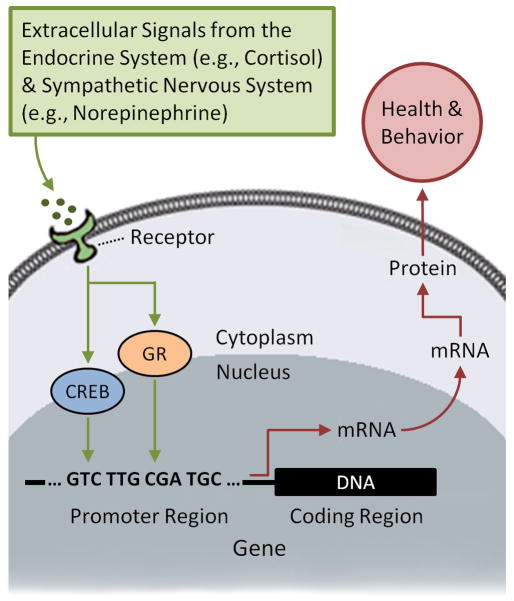
Fig. 1
Fig. 1
Exogenous control of human gene expression by stress. Central to human social genomics is the fact that social-environmental conditions, especially our subjective perceptions of those conditions, can reach deep inside the body to regulate the expression of broad sets of genes, or gene profiles. Receptors on the surface of cells “hear” extracellular signals from the endocrine and sympathetic nervous system, which respond to social experiences such as social isolation and rejection. Intracellular transcription factors, including the cyclic AMP response element-binding protein (CREB) and the glucocorticoid receptor (GR), then relay the signal to the nucleus of the cell, where the transcription factors bind to gene promoters and upregulate the transcription of DNA into mRNA. mRNA is then translated to produce amino acid sequences that form the basis for a wide range of proteins that influence human health and behavior. Individual differences in sensitivity to social context is influenced by the fact that several factors, such as a person’s genotype, can affect the binding of transcription factors to promoters, thereby influencing the likelihood that a particular signal results in gene transcription. Because only genes that are transcribed into RNA actually shape health outcomes and behavioral phenotypes, any process that influences transcription factor binding affinity (e.g., polymorphisms, methylation, histone modification) can substantially affect a person’s propensity to develop certain diseases or traits.
Fig. 2
Fig. 2
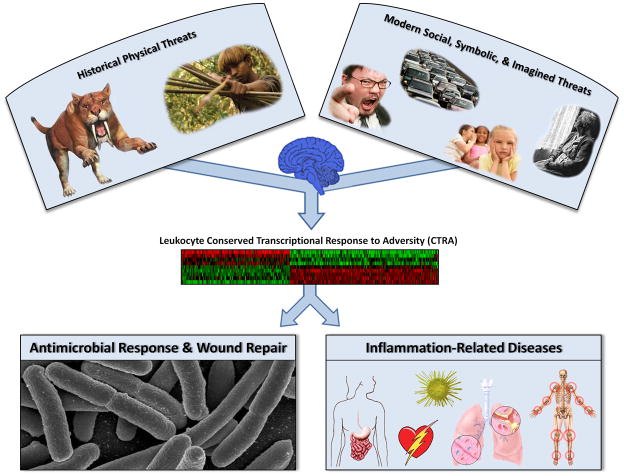
Conserved transcriptional response to adversity (CTRA). The CTRA emerges from neurobiological activation of leukocyte inflammatory genes and inhibition of innate antiviral genes in response to subjectively experienced physical or social threat. This proinflammatory skewing of the leukocyte basal transcriptome would be adaptive in response to physical threat, given that such threats were historically associated with increased risk for wounding and bacterial infection. However, social, symbolic, or imagined threats occurring in the contemporary social environment can also activate the CTRA, which maladaptively deflects host defenses away from the now more prevalent threat of socially mediated viral infections and toward the now diminished threats of injury and bacterial infection. Because the CTRA can be activated by imagined social threat (i.e., in the absence of actual physical threat), chronic activation of the CTRA can occur, which promotes the development of several inflammation-related conditions, including cardiovascular disease, depression, metabolic syndrome, neurodegenerative disorders, and certain neoplastic diseases. These psychiatric and physical conditions cause substantial morbidity and dominate modern mortality.
Fig. 3
Fig. 3
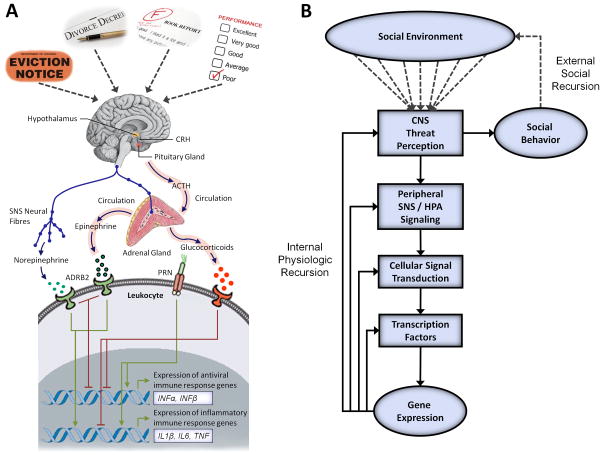
Human social signal transduction. Social signal transduction is the process by which subjectively perceived social conditions and historically and developmentally derived anticipatory worries alter genomewide transcriptional dynamics. (a) Social-environmental threats are neurocognitively appraised and converted into changing patterns of activity in the sympathetic nervous system (SNS) and hypothalamic-pituitary-adrenal (HPA) axis. Neuroeffector molecules from these systems engage specific gene transcriptional programs in differing target cells. In leukocytes, for example, SNS and HPA signaling suppress innate antiviral genes (e.g., IFNA, IFNB), whereas SNS signaling activates, and HPA signaling inhibits, proinflammatory cytokine genes (e.g., IL1B, IL6, IL8, TNF). (b) These processes can also be depicted conceptually, highlighting the fact that social experiences can become biologically embedded in at least two ways. First, internal physiologic recursion can occur, given that the genes targeted by social signal transduction pathways encode the molecules that mediate social signal transduction (e.g., receptors, intracellular signaling molecules, transcription factors, and growth factors). This recursive process propagates experienced-induced transcriptional alterations forward in time by sensitizing signal transduction pathways to the external social environment. Second, external social recursion can occur, given that social signal transduction can modulate genes involved in the regulation of social behavior (e.g., defensive responses to perceived threat). This recursive process takes place when conspecifics in the surrounding environment change their behavior in response to an individual’s altered actions, locking the individuals in a reciprocal feedback system. These two pathways give social-environmental experiences the ability to influence the basal cellular transcriptome for weeks and years after the initial environmental impetus has passed. ACTH = adrenocorticotropin hormone; ADRB2 = β2-adrenergic receptor; CRH = corticotrophin releasing hormone; PRR = pattern recognition receptor.
Fig. 4
Fig. 4
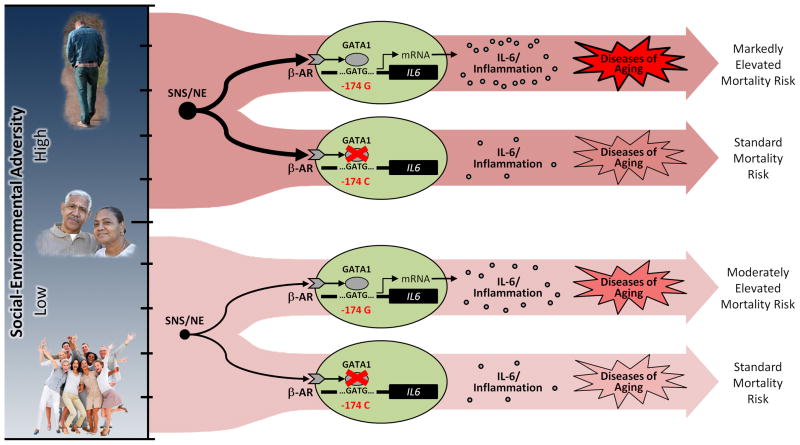
Concretizing gene-environment interactions in health. Graphically illustrated are the results of a recent study that showed that a single nucleotide polymorphism in the human IL6 promoter alters the ability for threat-activated GATA1 transcription factors to bind to DNA. Whereas high DNA binding affinity transduces the social threat–related signal downstream where it upregulates IL6 gene expression, low binding affinity effectively disconnects this key proinflammatory cytokine from socioenvironmental regulation via sympathetic nervous system (SNS)/β-adrenergic receptor (βAR) signaling. Consistent with the prediction that these mechanisms are relevant for health, individuals who were homozygous for the GATA1-sensitive G allele died 2.8 years sooner than their counterparts bearing the GATA1-insensitive C allele. These results thus provide a genetic basis for differences in risk and resilience to social-environmental adversity, as well as a general framework for understanding why negative social experiences are more strongly related to increased IL6 expressivity, systemic inflammation, and inflammation-related disease risk for some individuals compared to others. IL-6 = interleukin-6; NE = norepinephrine.

References

    1. Amit I, Garber M, Chevrier N, Leite AP, Donner Y, Eisenhaure T, Regev A. Unbiased reconstruction of a mammalian transcriptional network mediating pathogen responses. Science. 2009;326:257–263. - PMC - PubMed
    1. Antoni MH, Lutgendorf SK, Blomberg B, Carver CS, Lechner S, Diaz A, Cole SW. Cognitive- behavioral stress management reverses anxiety-related leukocyte transcriptional dynamics. Biological Psychiatry. 2012;71:366–372. - PMC - PubMed
    1. Aschbacher K, Epel E, Wolkowitz OM, Prather AA, Puterman E, Dhabhar FS. Maintenance of a positive outlook during acute stress protects against pro-inflammatory reactivity and future depressive symptoms. Brain, Behavior, and Immunity. 2012;26:346–352. - PMC - PubMed
    1. Asson-Batres MA, Spurgeon SL, Diaz J, DeLoughery TG, Bagby GC., Jr Evolutionary conservation of the AU-rich 3′ untranslated region of messenger RNA. Proceedings of the National Academy of Sciences of the United States of America. 1994;91:1318–1322. - PMC - PubMed
    1. Avitsur R, Stark JL, Dhabhar FS, Kramer KA, Sheridan JF. Social experience alters the response to social stress in mice. Brain, Behavior, and Immunity. 2003;17:426–437. - PubMed

LinkOut - more resources